Advertisements
Advertisements
प्रश्न
Briefly explain the following statement from the text.
“The lack of determinism in quantum theory!”
Advertisements
उत्तर
The statement occurs in the text Adventure by Jayant Vishnu Narlikar. This statement is made by Prof. Gaitonde in response to the explanation of Catastrophic theory as explained by Rajendra. Rajendra was trying to rationalise the experiences of Prof. Gaitonde in which he witnessed an altogether new version of Indian History. According to the revelations made to Gaitonde, the Marathas emerged as victorious in the Battle of Panipat and extended influence over the entire country making India self-reliant in all respect. The Maratha Peshwas were gradually replaced by democratically elected bodies. Rajendra tried to explain this varied version by applying the catastrophic theory. The catastrophic theory postulates that there can be many alternative realities existing simultaneously. This theory has been developed on the basis of experiments on small systems like atom and their constituent particles. The physicists have observed that the behaviour of these systems cannot be predicted definitively even if all the physical laws governing those systems are known. That means there is a lack of determinism. This theory has been developed in Quantum physics and wonderfully explains phenomena like that experienced by Prof. Gaitonde was convinced by the explanation offered by Rajendra which could resolve the perplexities as presented before him in the face of two different versions of Indian history.
APPEARS IN
संबंधित प्रश्न
India, my India, where the first human eyes awoke to heavenly light! All Asia’s holy place of pilgrimage, great Motherland of might! World – mother, first giver to humankind of philosophy and sacred lore, knowledge thou gav’st to an, God – love, works, art, religion’s opened door.
O even with all that grandeur dwarfed or turned and can vaunt thy mighty name?
Before us still there floats the idea of those splendid days of gold; a new world in our vision wakes, Love’s India we shall rise to mould. India, my India, who dare call thee a thing for pity’s grace today? Mother of wisdom, worship, works nurse of the spirit inward ray!
(1) The poem is a ……………………
(a) Praise
(b) Prayer
(c) Story in the form of poem
(d) Song of condolence [Choose the correct alternative]
(2) What has India given to the world?
(3) How does the poet visualize New India?
(4) Give the rhyme scheme of the first four lines.
(5) Name and explain the figure of speech that dominates the poem.
Answer any four of the following questions in 30-40 words each:
(a) What did Franz wonder about when he entered the class that day?
(b) What shocking experience did Douglas have at YMCA pool?
(c) Why does Kamala Das compare her mother to 'a pale winter's moon'?
(d) What rich bountry has the heaven given us? (A Thing of Beauty)
(e) Why did the Maharaja have to pay a bill of three lakh rupees to the British jewellers?
(f) What problem did Roger Skunk face when he went to play with his friends. How did he solve it?
Answer any four of the following in 30–40 words each :
(a) Describe the irony in Saheb's name.
(b) Why was Gandhiji opposed to C.F. Andrews helping him in Champaran?
(c) Aunt Jennifer's efforts to get rid of her fear proved to be futile. Comment.
(d) What does Stephen Spender want to be done for the children of the school in a slum?
(e) When he was only ten days old, a prediction was made about the future of the Tiger King. What was ironic about it?
(f) What was his father's chief concern about Dr. Sadao?
(i) The interest of Maharashtra and that of India should be one for the progress of Maharashtra state, because ................
How do chimps drink water from the waterholes?
Read the following extract carefully and complete the activities given below :
A1 Complete the following :
(i) Books were found on the _____________ and ____________.
(ii) The tales are described as ______________ and __________.
|
Have you forgotten? Don't you know?
We'll say it very loud and slow:
THEY ... USED ... TO ... READ! They'd READ and READ,
AND READ and READ, and then proceed
To READ some more. Great Scott! Gadzooks!
One-half of their lives was reading books!
The nursery shelves held books galore!
Books cluttered up the nursery floor!
And in the bedroom, by the bed,
More books were waiting to be read!
Such wondrous, fine, fantastic tales
Of dragons, gypsies, queens, and whales
And treasure isles, and distant shores
Where smugglers rowed with muffled oars,
And pirates wearing purple pants,
And sailing ships and elephants,
And cannibals crouching 'round the pot,
Stirring away at something hot.
(It smells so good, what can it be?
Good gracious, it's Penelope.)
|
Is drama a good medium for conveying a social message? Discuss.
“I have done something; oh, God! I've done something real at last.” Why does Andrew say this? What does it mean?
We 'draw up a deed'. Complete the following phrase with an appropriate word.
________ends meet
Examine the communication channels in the story between Paul and his mother.
In English, the peacock is associated with pride. ‘As proud as a peacock’ is a commonly used simile. With what qualities is the peacock associated with the literature of your language?
What would you say are 'the finer growths' that the story supports in a novel?
Read the following statement and mark those that apply to you.
I wish to be friends with someone but my friendship is rejected.
Read the extract and state whether the following statement is true or false. Correct the false statement.
The aroma of the ‘desi’ rice would spread around the village.
Read the poem and fill in the table.
| Time of the day | Location | Poet’s Activity | Hawker’s Activities | Gardener’s Activities | Watchman’s Activities |
| Morning | __________ | __________ | __________ | __________ | __________ |
| Afternoon | __________ | __________ | __________ | __________ | __________ |
| Night | __________ | __________ | __________ | __________ | __________ |
Which pictures reflect gender equality? Write their numbers.
Pick out a word from the poem to complete the sentence meaningfully.
Stephen Hawking was a ______ (famous) Astrophysicist.
What do restive horses do?
Find a suitable object for each comparison.
Choose the odd one out :
Bottom, Moth, Mustardseed, Cobweb.
Mayor Peter Stockmann is a contrast to Dr. Thomas Stockmann. Justify.
How do the following avoid giving anything to the traveller?
Motiram
(Answer in one or two lines.)
Who erected the first known veterinary hospitals in the world?
Read the passage and answer the following:
Who has written the book?
Link the items in the three columns properly.
| A | B | C |
| The past | A sea beneath a cloudless sun | A pleasant time which has ended |
| The present hour | A soft and mild autumn evening | An exciting, thrilling time which has no end. |
| The future | A green and flowery spray Where a young bird sits | A time, full of life in which you gather strength |
Prepare similar word chains using the following ideas.
size - small _______________.
Write the meaning of doth.
Complete the following diagram.
Answer in your own words.
Why does a mother tell Neel about his Grandpa?
Write your own impressions about the news items given in (a), (b), (c), and (d) in the table below.
| News item | Good news Bad news | Reliable Unreliable | Interesting Uninteresting Boring | Others |
| (a) | ||||
| (b) | ||||
| (c) | ||||
| (d) |
Pick out from the poem, two lines each that reflect an optimistic (positive) attitude and pessimistic (negative) attitude.
Optimism :
- ______
- ______
Pessimism :
- ______
- ______
Does Marouckla get any of the things she brings?
Read the following line from the poem and answer the question that follow.
In the dim past, nor holding back in fear From what the future veils; but with a whole And happy heart, that pays its toll To Youth and Age, and travels on with cheer.
Identify the rhyming words of the given lines.
What do you understand by the mother’s act of throwing the shoe?
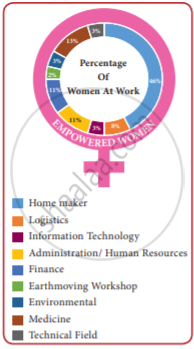
Read the data below and answer the following question.
Choose the correct answer.
Identify the three jobs where the same percentage of women work.
What should we learn from our teachers?
| soft | vain | fear | joy | love | heard | toiled | mild | good | sand | life | harsh |
The ______, the______, which it may bring.
When are we in a state of trance?
Read these lines and answer the question given below.
The laughter and beauty of women long dead;
Explain the meaning of the above line.
The author did not want to plant saplings in the forest because______.
What did mother ask Raj to buy?
Complete the sentence given below with word/phrase.
The whole earth smelled ______ and ______.
Where is the poet going in the dream?
The second daughter ________ the milet to a flock of birds.
When did the battle of Nauranang start? How long did it continue?
Read scene I of the play carefully and answer the question below.
Whom does Mother Wolf talk about? How does she describe him?
Vicky’s father decided to change his son’s character.
Choose the odd one out.
What did the hen-pigeon whisper?
Parents help us to overcome our______.
If we didn’t have boundaries, we don’t need _______.
What happened to Jayan?
______will often say to be honest.
What did his mother say in his dream?
What was the truth finally learned by Chris?
Describe in your own words the garden that Alice saw.
Are these sentence TRUE or FALSE
The poet tells the child to think of friends after it is dark.
Choose the right word.
Tansen was a famous ______.
Being a bachelor, the stranger had no patience with children.
Arrange a ‘Jokes’ session in the classroom where each student tells a joke. The jokes must be told in English.
