Advertisements
Advertisements
प्रश्न
Pick out word which mean the same as
keep a check on (para 3)
Advertisements
उत्तर
keep a check on (para 3) – monitor
APPEARS IN
संबंधित प्रश्न
Read the passage given below and answer the questions that follow:
1. Air pollution is an issue which concerns us all alike. One can willingly choose or reject a food, a drink or a life comfort, but unfortunately there is little choice for the air we breathe. All, what is there in the air is inhaled by one and all living in those surroundings.
2. Air pollutant is defined as a substance which is present while normally it is not there or present in an amount exceeding the normal concentrations. It could either be gaseous or a particulate matter. The important and harmful polluting gases are carbon monoxide, carbon dioxide, ozone and oxides of sulphur and nitrogen. The common particulate pollutants are the dusts of various inorganic or organic origins. Although we often talk of the outdoor air pollutions caused by industrial and vehicular exhausts, the indoor pollution may prove to be as or a more important cause of health problems.
3. Recognition of air pollution is relatively recent. It is not uncommon to experience a feeling of 'suffocation' in a closed environment. It is often ascribed to the lack of oxygen. Fortunately, however, the composition of air is remarkably constant all over the world. There is about 79 per cent nitrogen and 21 per cent oxygen in the air − the other gases forming a very small fraction. It is true that carbon dioxide exhaled out of lungs may accumulate in a closed and over-crowded place. But such an increase is usually small and temporary unless the room is really air-tight. Exposure to poisonous gases such as carbon monoxide may occur in a closed room, heated by burning coal inside. This may also prove to be fatal.
4. What is more common in a poorly ventilated home is a vague constellation of symptoms described as the sick-building syndrome. It is characterized by a general feeling of malaise, head-ache, dizziness and irritation of mucous membranes. It may also be accompanied by nausea, itching, aches, pains and depression. Sick building syndrome is getting commoner in big cities with the small houses, which are generally over-furnished. Some of the important pollutants whose indoor concentrations exceed those of the outdoors include gases such as carbon monoxide, carbon dioxide, oxides of nitrogen and organic substances like spores, formaldehydes, hydrocarbon aerosols and allergens. The sources are attributed to a variety of construction materials, insulations, furnishings, adhesives, cosmetics, house dusts, fungi and other indoor products.
5. By-products of fuel combustion are important in houses with indoor kitchens. It is not only the brining of dried dung and fuelwood which is responsible, but also kerosene and liquid petroleum gas. Oxides of both nitrogen and sulphur are released from their combustion.
6. Smoking of tobacco in the closed environment is an important source of indoor pollution. It may not be high quantitatively, but significantly hazardous for health. It is because of the fact that there are over 3000 chemical constituents in tobacco smoke, which have been identified. These are harmful for human health.
7. Micro-organisms and allergens are of special significance in the causation and spread of diseases. Most of the infective illnesses may involve more persons of a family living in common indoor environment. These include viral and bacterial diseases like tuberculosis.
8. Besides infections, allergic and hypersensitivity disorders are spreading fast. Although asthma is the most common form of respiratory allergic disorders, pneumonias are not uncommon, but more persistent and serious. These are attributed to exposures to allergens from various fungi, molds, hay and other organic materials. Indoor air ventilation systems, coolers, air-conditioners, dampness, decay, pet animals, production or handling of the causative items are responsible for these hypersensitivity − diseases.
9. Obviously, the spectrum of pollution is very wide and our options are limited. Indoor pollution may be handled relatively easily by an individual. Moreover, the good work must start from one’s own house
(Extracted from the Tribune)
(a) (i) What is an air pollutant? (1)
(ii) In what forms are the air pollutants present? (2)
(iii) Why do we feel suffocated in a closed environment? (1)
(iv) What is sick building syndrome? How is it increasing? (2)
(v) How is indoor smoking very hazardous? (1)
(vi) How can one overcome the dangers of indoor air pollution? (2)
(b) Find the words from the above passage which mean the same as the following: (3)
(i) giddiness (para 4)
(ii) constant (para 8)
(iii) humidity (para 8)
After the convocation, Mrs. Mini, Rahul’s mother and Rahul have a conversation. Write the conversation and present it to the class in groups of three.
We know that chimps are intelligent because
Briefly comment on:
The author’s physical condition in Darchen.
What do you understand of Einstein’s nature from his conversations with his history teacher, his mathematics teacher and the head teacher?
' Kummi', ' ghumar' and 'dandia' are some dance forms mentioned in the text. Make an inventory of folk dance forms in the different regions of the country.
Now write what you observe in the following two pictures.


Suppose you suffer from a long - term illness (one or two weeks), what should you do and what should you avoid? Fill up the table of Dos and Don’ts.
| Dos | Don’ts |
| (1) Go to a doctor for diagnosis | (1) Do not ____________ |
| (2) ____________ | (2) Do not avoid medication on time. |
| (3) Take a suitable diet | (3) Avoid ____________ |
| (4) ____________ | (4) Avoid physical stress and exertion. |
| (5) Rest in a properly ventilated room. | (5) Do not ____________ |
| (6) Have cheerful thoughts, courage, positive attitude | (6) Do not lose ______ and ______ |
Correct the following statement.
Sue and Johnsy were good neighbours.
Answer the following question in short.
What did the bundle in silken cloth contain?
Read the poem aloud. Recite any stanza of your choice from memory.
State whether the following statement is True or False:
Oberon transforms Bottom's head into that of an ass.
Read aloud a paragraph of your choice from the passage.
Discuss:
In the story, human settlements are mentioned but not cities or villages. Why is it so?
The Emperor says he had realised earlier that Abdul has great talent. Does this tally with his actions? Give your opinion.
Rewrite in your own words.
One of the Caesar’s traits that makes you laugh.
What did Gopal Bhand want to tell the husband and wife?
Write the characteristics of a good listener.
Who baked the homemade cookies?
Read the data below and answer the following question.
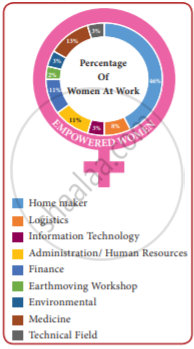
Choose the correct answer.
What is the difference between the percentage of women working in logistics and Medicine?
What are the skills/values a teacher should teach their students to live in this competitive world?
Which mode of transport did Fogg choose?
Read the following lines and answer the questions.
It’s part of his hours, his days and his years,
Back of his smiles and behind his tears.
What does ‘tears’ mean?
Flag day is observed on the _________.
Find the rhyming word from the poem.
Country - ______.
How will you treat your guest?
Read the passage three times and colour a spacesuit for each time.
A spacesuit is like a spaceship built for one. A spacesuit lets us work and live in space. It protects us from the heat and the cold. It gives us air to breathe. The suit is made of many parts and has water to drink. It even has a built-in toilet, if you need to use it.
Meena studied in ______ standard.
Find words from the passage which are antonyms of the following.
- artificially (para 1)
- strength (para 2)
What should parents do to ensure the safety of children in cyber space?
