Advertisements
Advertisements
प्रश्न
Indian society has moved a long way from the way the marriage is arranged in the story. Discuss.
Advertisements
उत्तर
A model answer has been provided for students' reference.
It is strongly recommended that students prepare the answer on their own.
It is true that the Indian society has evolved way beyond what has been portrayed in the story. The way Shyama arranged Ranga's marriage is not how it happens in the modern times. Children today do not want to stay dependent on their parents or elders to chose their life partners. They now want to take control of their lives. They take the lead and decide themselves who they want to spend their lives with. The society has opened up to love marriages. However, it should be noted that love marriages are not modern, this culture has existed since times immemorial. Many cases of love marriage can be traced back in the history. Shakuntala did love marriage (gandharva vivah), Sita and Draupadi chose their partners on their own (swayamavar). Hence, it is difficult to say whether arranged marriage is an old tradition or love marriage. Now that we have been independent for decades and have moved far ahead of Medieval and Modern India, it can be observed that the culture of arranged marriage is returning. Hence, we can be sure of at least one thing that these are trends that come and go and people follow what is in fashion.
संबंधित प्रश्न
Attempt the following in 150-200 words.
Write a character sketch of Bishop Brooks as he appears in Helen Keller's − The Story of My Life.
On the basis of your understanding of the above passage, make notes on it using headings and subheadings. Use recognizable abbreviations (wherever necessary – minimum four) and a format you consider suitable. Also supply an appropriate title to it.
Read the following passage carefully and complete the activities given below :
A.1) Complete the web :
Write the words from the passage on the web. 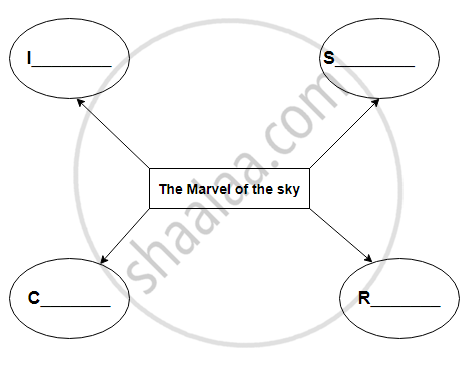
We saw small bits of grass peeping through the small cracks in concrete pavement. It left us thinking: however impossible things may look, there is always an opening…………
We saw a tree bare of all leaves in the cold winter months. We thought its chapter was over. But three months passed, spring set in and the tree was back to its green majesty once again, full of leaves, flowers, birds, and life. What if we too had the conviction that, however difficult things are right now, it will not remain so forever. Remember, this too shall pass.
We saw an army of ants lugging a fly which was at least ten times the ant’s size. The ants organized themselves around the fly, lifted it on frail feelers and carried it to quite a distance. Their teamwork and perseverance were impressive. What if we too are consistent, organized, focused ……… Spider webs are delicate, yet very strong. A rainbow colors the entire sky. Oysters take in a grain of sand they open up with a pearl. Innumerable stars shine across the infinite sky. Clouds take new shapes with every passing moment. The wind makes trees dance with unhindered passion. Water, without a hint of ego, changes its form according to the dictates of the sun and the wind. When we see a caterpillar turn into a butterfly, a flower turns into a fruit, we experience the alchemy of nature ………. We touch it and become gold ourselves.
A.2) Finding meanings :
Write what you mean by :
(i) _______ there is always an opening.
(ii) _______ its chapter was over.
(iii) _______ the tree was back to its green majesty.
(iv) _______ this too shall pass.
A.3) Matching :
Match the words in Column ‘A’ with their synonyms in Column ‘B’:
| Column 'A' | Column'B" | ||
| (i) | conviction | (a) | strong feeling |
| (ii) | alchemy | (b) | delicate |
| (iii) | frail | (c) | mysterious/magical power |
| (iv) | passion | (d) | strong belief |
A.4) Language study :
Rewrite the sentence using the correct question tag given in the brackets :
(i) Water changes its form. (does it?, do it?, do they?, doesn’t it)
(ii) However impossible things may look, there is always an opening. (Rewrite using ‘but’)
A.5) Personal Response :
Nature is the best teacher. Explain.
Answer the following question in 200-250 words:
Helen had a great love for animals and birds. Write about this aspect of her character.
'The Address' is a story of human predicament that follows war. Comment
Do you think that the ruled always adopts the language of the ruler?
What do you think are the reasons for the references made to the English people and the British monarchy?
Paul's final bet his family richer but cost him his life. Explain.
What were the attempts made by the author to get his watch repaired?
Explain the metaphor in the line: ‘Poets are the mirrors of gigantic shadows that futurity casts on the present’.
The text is an excerpt from Sesame and Lilies which consists of two essays, primarily, written for delivery as public lectures in 1864. Identify the features that fit the speech mode. Notice the sentence patterns.
How is colour highlighted in the poem and why? List all the words in the poem that suggest colour.
Read the extract and state whether the following statement is true or false. Correct the false statement.
Newer hybrid crops have a great appetite for chemicals.
Fill in the blank.
Baban’s father and some elders mentioned the name of __________.
Say why the speaker of the poem wishes to be a-
hawker
Find evidence from the lesson and write in your own words.
India has many amazing success stories.
For preparing questions based on the poem, an overall understanding of the poem is a must. Discuss with your partner and prepare a set of five questions.
For example:
- What is the name of the bridge?
- ________________________________
- ________________________________
- ________________________________
- ________________________________
- ________________________________
Say WHY. . . . . .
Ramanujan had to be hospitalized.
Imagine you are the Crane. What actions and words of the Peacock would you not like? Write about it in short.
Form groups and discuss the following question:
Why are the clothes compared to living things?
Have you seen non-commercial advertisements - those that are not ‘selling’ anything but are only giving people useful information?
Apart from the stone, how many things go into the soup?
Write a recipe for the stone soup.
Who was Sushruta?
Link the items in the three columns properly.
| A | B | C |
| The past | A sea beneath a cloudless sun | A pleasant time which has ended |
| The present hour | A soft and mild autumn evening | An exciting, thrilling time which has no end. |
| The future | A green and flowery spray Where a young bird sits | A time, full of life in which you gather strength |
Explain the idea of ‘Conservation of Nature through Livelihood’ briefly, using the example given here.
Fill in the following blanks with reference to the poem.
'In time of rain when spring and life are ______, the butterflies lift ______ wings to catch a ______ cry and trees put forth ______ leaves to sing in ______ beneath the sky as ______ boys and girls too ______ singing down the roadway'.
Turn the story into a play as a group activity and present the scenes in the classroom.
Complete the following sentence with reference to the passage.
Nobody knows for certain who ___________________.
List the lines that begin with 'Here' or 'And here'.
Also, list the sentences or phrases that begin with ‘And there’.
These phrases and sentences tell us about things that appear one after the other as the carriage moves. Can we tell which ones are closer to the train and which ones are at a distance? How?
Rewrite in your own words.
One event from the story.
Which other things in nature can say –
'For men may come and men may go,
But I go on for ever.'
Fill in the blank choosing the appropriate word/idiom from the lesson.
The ______ solved the mysterious crime.
List and say whether the following statement agrees with the passage or not.
If you don’t understand something, don’t let the others know about it.
Identify the character or speaker
He repented and implored his brother’s forgiveness.
Which gift did Anne value the most?
Hamid’s heart sank because the price of the tongs was______for him.
Underline the words or phrases that tell you what the wind does to the village.
Why does Alice drink from the bottle that says ‘DRINK ME’ and why does she eat from the cake that says ‘EAT ME’?
Read the line and answer the question.
I must go down to the sea again, to the lonely sea and the sky
Where does the poet want to go?
Identify the speaker/character.
He felt something moving along his body almost up to his chin.
Discuss in groups. Retell the story in your own words. Each one should say one sentence.
You can begin like this:
Gulliver was travelling in a ship. One stormy night, the ship was wrecked...
The little bird broadened the hole with her______.
What is the setting of the story?
Find the rhyming word from the poem.
Language - ______.
What happened to the two girls at the end of the war?
Mother nature gives everything for all ______.
Some words sound the same but their spelling and meaning are different. Such words are called homophones. There are many homophones.
Did Nandhini have fever?
Moles trap worms and store them.
Tenzin is from ______.
The king looked for a______.
In real the plate was made of ______.
Choose the correct one.
Rooster

What did Bala want to learn?
Write the word with same meaning.

chips- ______
Replace the bold word/words with a word from the quiver and re-write the sentence –
In no time she hit the object she aimed at.
Choose the right word.
Chintha Chettu is a tamarind ______.
Read the passage given below and answer the questions that follow
Humans have long been fascinated by fiction. We experience excitement in assigning supernatural power to imaginary characters in fictional stories – and so we have Spider man, Batman, He–man, Titans and many more. The ‘Cyborg’ was an offshoot of such wild imagination of humans to invest our species with superhuman powers. Today, the Cyborg is no more an imaginary organism. We are living in a world where a sizeable population of humans have merged their bodies with technological implants. The term ‘Cyborg’, short for ‘cybernetic organism’, was coined to describe a man, whose body is implanted with technological devices to supplement and substitute body functions.
Cyborgs include people with cardiac pacemakers, contact lenses, bionic ears and eyes, prosthetics and so on. In other words, a cyborg is partly human and partly machine. The technological innovations in the field of medicine and healthcare augment humans with machines, producing a beta version of the human body. The advent of brain machine interfaces is certain to blur the boundary between humans and machines. Scientists are working hard to find a technique for age reversal too. People do not want to die, so mankind is striving to get to the final frontier, which is development of machines and devices that would accord man immortality.
The needs of humans are not limited. As time passes, food habits change, thinking patterns change, and even appearances change. We are about to travel by driverless, fully automated vehicles. Computers and smart phones have become our masters. The more we depend and merge with technological advancements, the more the humanness in us slowly erodes. Intelligence is sought to be infused into machines and robotics are designed in such a way to give man a virtual human companion. The field of artificial intelligence is overtaking the human brain and many fear that it could even harm the human race. Despite certain limitations and potential threats, many believe that cyborgs will be the next step in the evolution of mankind. The amalgamation of man and machine is sure to add a new dimension to the life of mankind and this will prove to be the ‘biggest evolution in Biology’ since the emergence of life, four billion years ago.
Questions:
a) Account for the popularity of characters with supernatural powers.
b) Who is referred to as a ‘Cyborg’?
c) What is expected to happen with the advent of the brain machine interface?
d) The needs of humans are not limited. How is this statement elaborated in the passage?
e) How can a machine turn into a virtual companion for humans?
f) Explain the flipside of the rapid technological advancement.
g) Identify the word in para 1 which means ‘everlasting life’.
h) Which of the following words is synonymous with ‘amalgamation’?
- recreation
- integration
- exploration
- proposition
i) Which of the following options is the antonym of the word ‘advent’?
- drawback
- dispute
- departure
- danger
j) Find out the word which is the antonym of ‘natural’ in para 3.
