Advertisements
Advertisements
प्रश्न
Why do we ask questions?
Advertisements
उत्तर
We ask questions to gain knowledge, clarify doubts, and understand things better.
संबंधित प्रश्न
Answer the following in 120-150 words :
Within a few days of his arrival in Iping, people became suspicious of Griffin. Why?
Mention the three phases of the author’s relationship with his grandmother before he left the country to study abroad.
Indian society has moved a long way from the way the marriage is arranged in the story. Discuss.
Why is the speaker’s childhood described as ‘a forgotten boredom’?
Make a list of the preparations made for an assault on Tiger Hill.
Bofors guns _____________.
Discuss with your partner and complete the web, highlighting the sad and gloomy aspects of life mentioned in the first part of the poem.

Johnsy realised that her thinking was wrong.
Go through the poem and state whether the following statement is true or false.
The newly planned city looks modern and amazingly beautiful.
Read the following conversation and complete the activities given below:
| Minnie: | Exams are over. I feel so relaxed! Let us plan something interesting. |
| Ritu: | How about a movie? |
| Paddy: | Great! Let’s go for “Aladdin”! |
| Minnie: | Oh, no! I have seen it. It has only a ‘one star’ rating. |
| Ritu: | How about that new release ummm... yes, “Harry Potter? |
| Della: | It is boring. I have read the review this morning. I don’t want to waste my time. |
| Paddy: | Wait, friends. I will check. Let’s decide later. |
(i) Choose the correct alternative from the following-
From one star given to the movie we conclude that-
- The movie is very short.
- The movie is not worth watching.
- The movie is serious.
- The movie is in black and white.
(ii) Discuss with your teacher how/why are ‘stars’ given to a movie.
(iii) The word ‘Review’ is different from summarizing and appeal writing. Choose the correct statements of the following.
- A film review is an expression of your personal views towards a particular film, documentary or movie.
- A film review gives you an opportunity to express opinions about the movie, including its characters, plot and background.
- A film review gives appealing sentences that make your reader curious or anxious about the film.
- A review means explanation of each and every event of the film.
Comment on the given statement after reading the given dialogue -
It’s a pity some honest man not to be better of that ________________________________________________.
Divide the story into different sections to show the different events and time periods in it. Give a suitable title to each section.
Write a conversation between a donkey and a dog.
Write a conversation between a donkey and a horse.
Complete the following sentence with reference to the passage:
Gautama, the Buddha, was born over two thousand five hundred years ago, as ______.
Discuss:
In the story, human settlements are mentioned but not cities or villages. Why is it so?
Answer the following question and write in short, why the parody sounds funny.
Is the bee a gentle creature? Is the crocodile gentle?
Put the following events in proper order.
- Holmes and others go to the bank.
- Clay digs a tunnel.
- Ross closes the office of the 'Red-headed League'.
- Holmes catches the criminal Clay.
- Clay and Ross enter the cellar to steal the gold.
- The bank received a lot of gold from the Bank of France.
- Holmes visits the area around Mr. Wilson’s shop.
Name a few other things that people often count. (At least 5.)
Guess the meaning of the following word.
pleasing
Read the following line from the poem and answer the question that follow.
My heart will keep the courage of the quest And hope the road's last turn will be the best.
|
My heart will keep the courage of the quest, And hope the road's last turn will be the best. |
- What kind of quest does the poet seek here?
- What is the poet’s hope?
Title summarises the story. Each paragraph is a part of the story. Look at the following expressions and find out the paragraphs that best suit these expressions.
- Oh, No! But it happens!
- Don’t let out your travelling dates
- Anyway, people will be people
- Search begins
- Things are not that easy
- Hurry invites worry
ashen – pale
His face was ashen.
Work in pairs and answer the following.
Pick out the alliterated words.
Identify the speaker/character.
"Don't let us down now, Gulliver; we need your help."
Who is the wisest of all? Why?
The bird-catcher decided to sit under the ________.
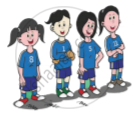
Write the events won by these players.
 |
______ |
 |
______ |
 |
______ |
Write the rhyming word.
goat
Meena went to ______ her father.
The brush ______ to her will.
