Advertisements
Advertisements
Question
Adi Song for the Recovery of Lost Health' is in Miri Agom while Adi Agom is the Adi community's language for routine conversation. How does this reflect upon the high level of language sensitivity of the Adi? Can you think of other parallels in modern languages between the literary variety and the colloquial variety?
Advertisements
Solution
The ' Adi song for the recovery of lost Health' is in Miri Agom. This language is not used in day to day conversation. It is applied in chanting during rituals. Miri Agom is a highly rhythmic language. The existence of these two different languages testify to the high level of language sensitivity of the Adi tribe. We find such parallels in modern languages also. The Hindi language , the Bangla language, the English language all have two variety of languages – one literary variety and the colloquial variety.
APPEARS IN
RELATED QUESTIONS
Write a character sketch of Mr. Barrymore in about 125 words
Read the following extract and do the given activities:
B.1) Fill in the Balloons with suitable ideas from the poem:
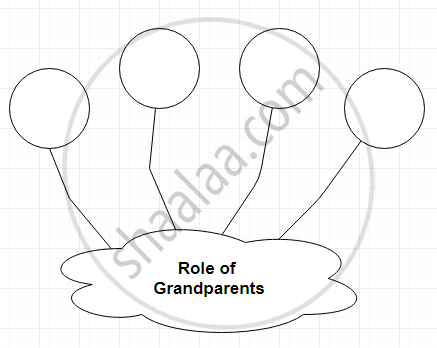 “Oh, the value of the elderly! How could anyone not know?
They hold so many keys, so many things they can show.
We all will read the other side this I firmly believe
And the elderly are closest oh what clues we could retrieve.
For their characters are closest to how we’ll be on high.
They are the ones most developed, you can see it if you try.
They’ve let go of the frivolous and kept things that are dear
The memories of so sweet, of loved ones that were near.
As a nation, we are missing our greatest true resource,
To get to know our elders and let them guide our course.”
B.2) Find Evidence:
Pick out the line from the extract which supports the given ideas:
(i) The elders have many things to share.
(ii) Everybody knows the value of elderly people.
(iii) The elderly people have vast experience.
(iv) The elderly people are a boon to the nation.
B.3) Write a pair from the extract that rhymes with the given word:
| Fear | ........................... | .......................... |
Does the poem talk of an exclusively personal experience or is it fairly universal?
What does the word ‘cardboard’ denote in the poem? Why has this word been used?
Give reasons for the following statement.
Tibetan mastiffs were popular in China’s imperial courts.
How has the author linked the symbol of the rocking-horse to Paul's triumphs at the races?
Identify the common characteristics shared by tribal communities all over the world.
The peacock is a colourful bird. How does the poem capture the various colours that its plumage displays?
How did the author feel about her mother's passion to make her a dancer?
Read the following statement and mark those that apply to you.
I have a small group of close friends and have no wish to interact with anyone else.
Answer in your own words.
How did the plants react to the fast rhythmic music?
A small thought, put in action, led to a great achievement. Pick out the lines from the beginning and end of the poem and explain their significance.
Say where the image from nature given in the poem exists.
AIR / LAND / WATER
beneath the boughs
Expand the idea inherent in the following proverb :
Fools rush in where angels fear to tread - Alexander Pope.
Say WHY. . . . . .
Hardy invited Littlewood for a discussion.
How are fabrics used in our daily life? List all the things that are made up of fabrics in your home. (At least 25)
Comment on the given statement after reading the given dialogue -
And if we get him itself, nothing but abuse on our heads for it from the people, and maybe from our own relations -
you may begin like this
We do not think about society at large _________________________________________________.
Find sentences from the play related to the given points.
The tension between different loyalties
- It’s little we get but abuse from the people, and no choice but to obey our orders.
- ________________________________
- ________________________________
- ________________________________
Discuss the following question after you have seen a presentation of the ‘ad’.
What would happen if you ate proper meals like rice and dal or dal-roti?
Write a short monologue using one of the following ideas. Write down the monologue and present it in the class.
Yonamine’s father worrying about getting her married.
Complete the following sentence with reference to the passage:
The king was determined to prevent his beloved son from ____________.
If you were to draw a landscape on the basis of this poem, what elements will you show in it? What colours will you use?
Discuss:
In the story, human settlements are mentioned but not cities or villages. Why is it so?
Answer the following question and write in short, why the parody sounds funny.
What does the bee stand for?
Write the rhyme scheme of the poem (Autumn).
What do you like better - the original poem or the parody? Why?
Find the words that mean the following from the first stanza.
- Gold hammered into a flat, thin shape: ______
- show off proudly: ______
- tilt, move at an angle: ______
- across, especially in a slanting direction: ______
Complete the following phrases with the help of the poem.
- ______ music
- ______ rivers
- ______ breeze
- ______ lake
- ______ citron-trees
Read the lines of the following poem. Guess and fill in suitable words to make the lines rhyme -
Golden Glow
Soon after dawn, rises the _________________.
It wakes and enlivens every _________________.
It scares away the long, dark _________________.
The shining stars go out of _________________.
From tree to tree birds flit and, _________________.
Searching for food, with a sharp _________________.
The buds that open now show their, _________________
As flowers, they dance with beauty and _________________.
The hill slope wears a grassy green,_________________
The curved sparkling river, it's gold _________________.
The cock then crows to give a loud, _________________
Come on! wake up, folks! One and _________________.
I, then wake up, ‘Good Morning’ to,_________________
Let’s all look forward to a golden _________________.
Using the information given in the passage, write a short note on the following in your mother tongue.
Gond art
Read the poem again. Does it have a uniform rhyme scheme throughout?
Write down the rhyme scheme of every stanza separately.
- 1st stanza ______
- 2nd stanza ______
- 3rd stanza ______
- 4th stanza ______.
The Principal turned out to be a very ______ lady.
The poet uses a free, conversational style in his poem. It is also called Colloquial style.
Pick out and write down such lines or expressions that support the above statement.
- ______ you have not done what I asked.
- _______________________.
- _______________________.
- _______________________.
- _______________________.
- _______________________.
In what way can we help to reduce or minimize waste generation?
Discuss the issue in groups of 4 or 5 and note down all good suggestions.
Resolve to follow them yourself. Some have been given below for your reference.
- Don’t waste food.
- Take as much as you want but finish everything that’s on your plate.
- Don’t throw away broken or half-used things. Repair them and use them.
- Avoid things which can be used only once.
For example: thermocol (polysterene) cups, plastic glasses, etc. - Reuse!
- Recycle!
Why did he spill the milk?
What are search engines?
What is meant by being ‘online’?
Guess the meaning of the following word.
magnificent
____________ raised a dreadful storm.
From the poem ‘The Grumble Family’ what kind of behavior does the poet want the readers to possess?
When and where was the first ATM installed?
With their treasure, the boys would buy ______ in Eidgah.
Read the poem and fill in the blanks with the correct option.
It is better far to rule by ______, than ______.
- soft
- vain
- fear
- joy
- love
- heard
- toiled
- mild
- good
- sand
- life
- harsh
Take a stanza from the poem. Write it in the blanks and find the rhyme scheme.
| Lines from the poem | Rhyme scheme (a/b/c/d) |
Why was the elephant owner happy with the deal?
Read the line and answer the question.
And all I ask is a windy day with the white clouds flying
Why does the poet ask for a windy day?
Sea turtles come to the shore to ______.
A school-going girl writes the diary account.
Nilavan unknowingly started the space shuttle.
Why did Santhosh forget to watch television or play video games?
Try your own.
What were the people excited about?
The brown sparrow laid ________eggs.
______always stays to the last in our needs.
Kani and Teddy were in the garden at _____.
What is the main idea of the text?
The king shouted at Ani.
Write the word with same meaning.

Sink
Read the given sentence and underline the 'no' word.
Nobody is at home.
Based on the poet’s idea of true success, think of four people in your surroundings - your family, neighbours, friends, teachers, classmates, etc. who have achieved true success. Write, in short, what makes them successful.
