Advertisements
Advertisements
Question
Give reasons for the following statement.
The author’s experience at Hor was in stark contrast to earlier accounts of the place.
Advertisements
Solution
Hor was a grim, miserable place. The dust and rocks were scattered everywhere in abundance; there was little vegetation. The place seemed unfortunate and dejected, though it sat on the shore of the Lake Manasarovar. The author was flabbergasted to realise the contrast in his experience to that of the earlier read accounts. A Japanese monk, Ekai Kawaguchi, who had arrived there in 1990, was so moved by the sanctity of the lake t hat he burst into tears. The hallowed waters had a similar effect on Sven Hedin, a Swede who was not prone to sentimental outbursts. However, for the author, when he reached Hor, first he had to get two punctures mended. The only relaxation was the tea served by a Chinese youth in the only café in the town, which was constructed from badly painted concrete and had three broken windows. The good view of the lake through one of them helped to compensate however.
APPEARS IN
RELATED QUESTIONS
Big male elephants throw logs at electric fences because
Read the following extract carefully and complete the activities given below :
A1 Complete the following :
(i) Books were found on the _____________ and ____________.
(ii) The tales are described as ______________ and __________.
|
Have you forgotten? Don't you know?
We'll say it very loud and slow:
THEY ... USED ... TO ... READ! They'd READ and READ,
AND READ and READ, and then proceed
To READ some more. Great Scott! Gadzooks!
One-half of their lives was reading books!
The nursery shelves held books galore!
Books cluttered up the nursery floor!
And in the bedroom, by the bed,
More books were waiting to be read!
Such wondrous, fine, fantastic tales
Of dragons, gypsies, queens, and whales
And treasure isles, and distant shores
Where smugglers rowed with muffled oars,
And pirates wearing purple pants,
And sailing ships and elephants,
And cannibals crouching 'round the pot,
Stirring away at something hot.
(It smells so good, what can it be?
Good gracious, it's Penelope.)
|
Answer the following question in 200-250 words:
How did Kitty help Anne overcome her loneliness?
Notice this expression in the text. Infer their meaning from the context.
the thought was almost revolting
Briefly comment on:
Tsetan’s support to the author during the journey.
Put down the images that come to your mind immediately when you see the words in the box.
| Cat cupboard wall pond bird |
Why do you think Professor Gaitonde decided never to preside over meetings again?
Explain the metaphor in the line: ‘Poets are the mirrors of gigantic shadows that futurity casts on the present’.
Why do you think the poet has used so many 'negatives' to make his statement?
How did Kumudini react to her mother's death?
Divide the class into 5 groups. Each group can prepare a decorative chart/poster using an epigrammatic line from the poem. You may use calligraphy/painting/or Paint program on a computer. (With permission, put up these charts in your school.)
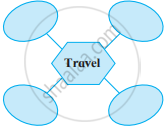
Pick out words from the poem to fill in the web diagram. They should be related to the theme in the web.
Read the Preamble of the Constitution of India given in your textbook. Pick out a word that refers to the following.
Brotherhood
Find evidence from the lesson and write in your own words.
It is time to see ourselves as a developed nation.
Have you heard of birds that fly from one part of the world to another in small or large flocks?
They are called Migratory birds.
Discuss and write down two reasons why they migrate and return.
Write 3 to 4 lines about the following in your own words.
First Neurosurgeon
Expand the idea inherent in the following proverb :
One should eat to live, not live to eat - Franklin.
Answer the following question in short.
What do you learn about Pundits of Vijaynagar?
Find more information about the Indian Armed Forces - the Army, the Navy, and the Air Force with the help of your teacher.
What is described in the poem?
Choose the odd one out :
Bottom, Moth, Mustardseed, Cobweb.
Read the given extract (Act III)
Complete the following table.
| Sr. No. | Character | Supportive Character | Incident |
| 1. | Dr. Stockmann | (a) ................................. (b) ................................ |
(a) ................................. (b) ................................ |
| 2. | Peter Stockmann | (a) ................................. (b) ................................ (c) ................................. |
(a) ................................. (b) ................................ (c) ................................. |
| 3. | Aslaksen | (a) ................................. (b) ................................ |
(a) ................................. (b) ................................ |
Visit a library:
Read more stories from Japan, China, and Korea.
The wheel, which was probably invented more than 6000 years ago, is thought of as one of the greatest technological advances made by man. Why do you think the wheel is so important in human civilization?
Write a conversation between a donkey and a horse.
Shylock was not at all generous.
Read the passage. Underline the new words. Guess their meaning from the context. Verify it from a good dictionary.
Talk about the good qualities of any one person you do not like. (You need not name the person.)
From the poem, find three lines that use comparisons.
• ______ • ______ • ______
What plans did the wife make?
Choose a suitable heading for each announcement from those given below.
(Change in School Hours, Cleanliness, Story-telling Competition, Lost and Found, Warning, Football Match)
1.
|
6 July 2015 It has been observed by the Head Boy and Head Girl that certain classes do not clean up their classrooms before leaving. If any class is found untidy and littered after school, that class will be detained the next day after school hours up to 4 pm. Please take note of this. |
2.
| Tomorrow, that is, on the 10th of July, the school will close an hour earlier, as the teachers have to attend an important P. T. A. meeting. So please inform your parents to arrange to pick you up at 2 pm instead of 3 pm. |
3.
| On Sunday, 12th July 2015 there is a football match between classes VIII and IX, on the school ground. The match will begin at 9 am. All students are invited to come and cheer their favorite team. Please come on time, so that the players are not distracted. |
4.
|
The school has organized a Story-telling Competition for Classes V, VI, and VII from 21st to 25th of July. The competition will be held in the school hall at 10 in the morning. Children may select -
Three prizes will be given for each category. The time limit is 3-5 minutes. Those who wish to participate may contact Mrs. Sanjana Mohite for other details. They must register their names with her before the 16th of July. |
5.
|
Construction work to extend the school building will start next week. All students are cautioned not to cross over the fence at the construction site. It is dangerous and may cause you injury. Please stay away from that fence. |
6.
| A cycle key with a blue key chain has been found on the ground. Whoever has lost it can contact the clerk Mrs. Neena Pinto and see if it belongs to him/her. |
Think of other funny names for imaginary creatures. Write any 3 of them.
What was the businessman looking for? Why?
What are the complaints of the animals?
What did the Judge tell Ahmad?
How were offerings carried during the ancient period?
Which gift did Anne value the most?
Why do we need trees? List four reasons that Grandfather gives.
Why did the author help his Grandfather plant trees?
What does the teak tree give us?
They all stood around the little jewel of blue means______.
Name the vegetables harvested in the vegetation hab.
The man didn’t want to get up because he was tired as he wcoas thrown into the ditch.
Flag day is observed on the _________.
Where is the key?
Vicky's dad bought a ______ robot.
Choose the odd one out.
What would we do when we are happy or sad?
The old man is _____.
Fill in the blank
At the end of the festival , Kamali and Senthil saved______.
Many may lie and______.
Write the word with same meaning.

eraser- ______.
What happens when the day is over?
How did the tree help the boy earn money?
How did the animals know that the king was just a jackal?
Should children be discouraged from playing online games?
Mention any three details that should not be revealed in public domain.
Write the compound words from the picture.
 |
 |
| ______ | |
Arrange a ‘Jokes’ session in the classroom where each student tells a joke. The jokes must be told in English.
