Advertisements
Advertisements
Question
Have you known someone like the author’s grandmother? Do you feel the same sense of loss with regard to someone whom you have loved and lost?
Advertisements
Solution
Yes, I knew someone like the author’s grandmother. It was my own grandmother who passed away recently. The intense sense of loss is very heart-wrenching as I spent almost fifteen years of my life with her.
Or
No, I have never known someone the way the author knew his grandmother. Thus, I have never felt a sense of grief presented in the story.
(A model answer has been provided for students' reference. It is strongly recommended that students prepare the answer on their own.)
APPEARS IN
RELATED QUESTIONS
Anne describes herself as a 'little bundle of contradictions'. Why? Explain in your own words.
Answer the following in 200-250 words :
Describe the relationship between Anne and Margot?
The author’s grandmother was a religious person. What are the different ways in which we come to know this?
Notice these expression in the text. Infer their meaning from the context.
salt flats
Give reasons for the following statement.
The author’s experience at Hor was in stark contrast to earlier accounts of the place.
Briefly comment on:
The author’s meeting with Norbu.
Discuss the following statement in groups of two pairs, each pair in a group taking opposite points of view.
The methods of inquiry of history, science, and philosophy are similar.
In which language do you think Gangadharpant and Khan Sahib talked to each other? Which language did Gangadharpant use to talk to the English receptionist?
Discuss in pairs or groups of four.
Replacing old machines with new is better than getting them repaired.
There are intervals of silence in the interaction between the landlady and the prospective tenant. What are the reasons for this?
Many sentences and paragraphs in the excerpt begin with the word ‘And’. To what extent does this contribute to the rhetorical style of the lecture?
Divide the class into 5 groups. Each group can prepare a decorative chart/poster using an epigrammatic line from the poem. You may use calligraphy/painting/or Paint program on a computer. (With permission, put up these charts in your school.)
Guess the types of hardships they must have faced in their childhood and youth.
What message does this story bring out for youngsters?
The word 'report' means -
(a) Give a spoken or written account of something.
(b) Cover an event or subject as a journalist or reporter.
‘Dull would he be of soul who could pass by.’
This line of the poem can be rewritten as:
'He would be of a dull soul.'
The figure of speech is known as ‘Inversion’.
Find out one more example of Inversion from the poem.
Write any five illnesses of the animals in the poem that you find most amusing / laughable.
How do we realize that animals are not feeling well?
Who gives medicine/treatment to sick animals and birds?
Read the lesson and name the following.
The world’s most advanced surgical robot ______
From the internet or other sources, find the other names by which Kabaddi is known in different parts of our country and the world.
Visit a library:
This story is a fable. Find two more fables. Share them with your friends.
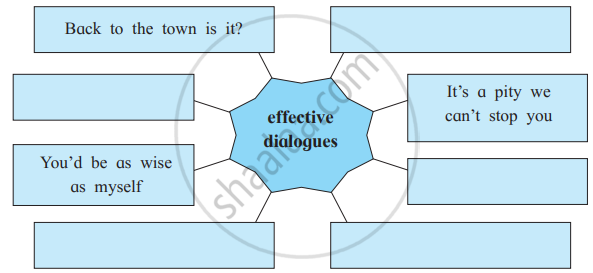
There are some dialogues that are short, but quite effective. They give us enjoyment and add beauty to the main story. Find some more from the text.
“A Midsummer-Night’s Dream” is one of the best examples of Shakespeare’s Comedy of Errors. Comment.
Explain the following statement with reference to the context.
From now on The Herald shall be my artillery.
Discuss the following question after you have seen a presentation of the ‘ad’.
What would happen if you never ate Krispy Krunchy?
Apart from the stone, how many things go into the soup?
Portia had many brothers and sisters.
Read the passage aloud playing the roles of the different characters.
Read the passage and answer the following:
Why is the tollbooth called a ‘phantom’ tollbooth?
Prepare similar word chains using the following ideas.
size - small _______________.
Gather information about your favourite great historical personality. You may use the internet. You may also gather photographs, pictures, etc. Prepare a collage using the pictures, inspirational quotes, and a brief description of the person’s importance. Hold an exhibition of your collages in the classroom.
Gather more information about the following from your Science textbook, the internet, and other sources.
Gravitational force
Prepare a ‘PowerPoint’ presentation, using one slide for each of the above points. Present your review in a PPT format in the classroom.
Form groups of 4-5. Read the following sentences aloud. Using your imagination and with the help of group discussion, write other situations in which the sentences can be used.
- The outcome: disappointment and anger.
- The hour of battle had sounded
- What a chase!
- This was our chance, .........
Write in your own words.
How should that person sing?
Write in your own words.
What does the poet hope for?
Fill in the blank choosing the appropriate word/idiom from the lesson.
While arguing with his elders he had ______.
Write what the following do, with the help of the poem.
ripples
Where was the well situated?
List all the pairs of antonyms you find in the passage.
Read the following line from the poem and answer the question that follow.
In the dim past, nor holding back in fear From what the future veils; but with a whole And happy heart, that pays its toll To Youth and Age, and travels on with cheer.
- What does the poet mean by the phrase ‘in the dim past’?
- Is the poet afraid of future?
- How can one travel on with cheer?
Miranda was brought to the island ____________ years ago.
What was Mrs. Krishnan busy with?
Read the letter again and write a few lines on each of the following.
- things that the coach taught….
- transformation in the child……..
- things that amazed the writer……..
Tom lay thinking. Presently it occurred to him that he wished he was sick; then he could stay home from school. He examined himself. He found no symptoms or sickness, and he investigated again. This time he felt he had a stomach ache, but it soon grew feeble, and presently died wholly away. He reflected further.
What was the result of Tom’s self-examination?
Vasantha could not see the rescue operation because ______
The hatchlings use a tiny egg-tooth to come out of the eggs.
Read the poem aloud in pairs.
How should we treat everyone?
Read the passage three times and colour a bull for each time.
Mr. Murugan is a farmer. He has a small piece of land and two bulls. He takes good care of his bulls as they help him in farming. Every morning, he takes the bulls for grazing. When it rains he ploughs the land with the bulls. As he has no one to help he starts sowing the seed before sunrise. He irrigates the crop till it grows. He reaps and binds the crop then takes it to thrash the paddy. Finally, with the help of the bulls, he takes the paddy to his house.

Who disguised himself as an old man?
Write the word under the correct group and divide it.
bullet
candle
bat
title
ball
tiffin
 |
 |
 |
Three waves hit the village.
______is next to parents in care.
Pick out the rhyming words and write.
| green | |
| human | |
| will | |
| welfare |
The tank in Divya’s village was almost ______.
Name the pictures and match it with the rhyming words.
 |
dancer | |
 |
floor | |
 |
will | |
 |
rush |
Why did the animals think that the jackal was a king?
According to Tagore, when will India get the opportunity to win the gift of freedom?
