Advertisements
Advertisements
Question
Notice the following uses of the word ‘tell’ in the text.
1. Her fingers were busy telling the beads of her rosary.
2. I would tell her English words and little things about Western science and learning.
3. At her age, one could never tell.
4. She told us that her end was near.
Given below are four different senses of the word ‘tell’. Match the meanings to the uses listed above.
1. make something known to someone in spoken or written words
2. count while reciting
3. be sure
4. give information to somebody
Advertisements
Solution
1. Make something known to someone in spoken or written words: I would tell her English words and little things of western science and learning.
2. Count while reciting: Her fingers were busy telling the beads of her rosary.
3. Be sure: At her age, one could never tell.
4. Give information to somebody: She told us that her end was near.
APPEARS IN
RELATED QUESTIONS
Answer the following in 30-40 words each:
(a) Why do you think the booking clerk refused to accept the money? Why did the narrator get out so fast?
(b) Why could the Russian research vessel, ‘The Akademik Shokaskiy’ not move any further? What did the captain decide then?
(c) What sort of hunts did the Maharaja offer to organize for the high-ranking British officer? What trait of the officer does it reveal?
(d) What did Jo want the wizard to do when Mommy Skunk approached him?
What was Mr. Otto Frank's major contribution to the world?
How do chimps drink water from the waterholes?
When and how did the people of Iping grow suspicious of the invisible man ?
The poet’s mother laughed at the snapshot. What did this laugh indicate?
The story is called ‘The Adventure’. Compare it with the adventure described in ‘We’re Not Afraid to Die...’
What impression of the character of Iona do you get from this story?
Narrate 'The Tale of Melon City' in your own words.
What does the line 'I never writ, nor no man ever loved' imply?
Explain the phrase.
Time's fool
What do you understand of the three voices in response to the question 'What does a novel do' ?
The title, 'Refugee Blues' encapsulates the theme of the poem. Comment.
Read the extract and state whether the following statement is true or false. Correct the false statement.
The aroma of the ‘desi’ rice would spread around the village.
Think, choose and fill up the labels with what a ‘sunrise’ symbolizes.
(jewellery/art/hope/birth/anger/new opportunities/good manners/inspiration/new achievements/happiness/misery/bright moments/new aims/money/new surprises)

Make groups and discuss the following:
What inspired them to spend the best part of their lives to research and share their findings?
Answer in your own words.
What helped Revathi to claim her plants - her belief in magic or the belief in her convictions? Explain your choice.
Complete the following sentence.
Sujoy reported about ___________________.
There are different types of short stories. Use a dictionary/internet and find out what each of the following types refers to.
- fable:
- anecdote:
- fairy tale:
- parable:
- tragedy:
- humorous story:
- detective story:
- myth:
Read the poem below and fill in the gaps, choosing appropriate pairs of rhyming words, to make them meaningful.
|
Little things Little drops of water, Thus the little minutes, Little deeds of kindness, |
(love - above / sand - land / be - eternity)
Read the story and choose the appropriate meaning.
Wielded the brush ____________.
Behrman did not know anything about the last leaf on the ivy.
The drone is given a death sentence because he ______.
Say WHY. . . . . .
Mother agreed to send Ramanujan to England.
Answer the following question in short.
Why did Pundit Shahane visit Vijaynagar?
Birbal thought Akbar was greater than God.
Read the passage and answer the following question:
What is 'Param Vir Chakra'?
What do fairy-tale witches do?
Write a short note on the following:
The living world on Rakata
Answer the following question in one sentence.
What does the man who misses all the fun do?
Read the poem aloud with the proper rhythm. What does the rhythm remind you of?
Choose the appropriate phrase to insert in the gap, to make the sentence meaningful. Use the appropriate form of the verb.
I ______ just as I was to receive my Report Card.
Using the information given in the passage, write a short note on the following in your mother tongue.
Gond art
Did Gopal Bhand have a field?
Have you ever seen or used a computer?
Give an instance that shows the pathetic condition of the young bird.
Based on your understanding of the poem, complete the following passage by the using the phrases given in the box.
| youth to old age | up or down the hill | to hurry nor move away | |
| high adventure | joyful | mourn | looking ahead |
The poet wants to live his life __________, willing to do something. He neither wants __________from his goal. He does not want to _______ the things he has lost, not hold back for fear of the future. He instead prefers to live his life with a whole and happy heart which cheerfully travels from __________. Therefore, it does not matter to him whether the path goes __________, rough or smooth, the journey will be __________. He will continue to seek what he wanted as a boy - new friendship, __________ and a crown (prize). His heart will remain courageous and pursue his desires. He hopes that every turn in his life's journey will be the best.
What do Tamil Nadu folk dances and folk arts represent?
The parents noticed some changes in the child. What were they?
Usha went to visit her______ house after shopping in the market.
Write down the word that alliterate in the poetic line below
That spreads treasures on a tree.
Why does Alice drink from the bottle that says ‘DRINK ME’ and why does she eat from the cake that says ‘EAT ME’?
A turtle’s flippers help it to ______.
The little bird broadened the hole with her______.
What robot will you make? Why?
Some words sound the same but their spelling and meaning are different. Such words are called homophones. There are many homophones.
Who was Akilan’s inspiration?
How did the girl seem?
Try your own.
Did Nandhini have fever?
Recite any 4 lines of the poem with intonation.
Moles dig ______ to catch earth worms.
Write the word with same meaning.

eraser- ______.
The brush ______ to her will.
One day Chris tried to draw a ______.
What strange things did Alice see?
Who was burning with curiosity?
What did Helen learn when the teacher put her hand into running water?
Read the following passage and do the activities.
A1. State whether the following sentences are True or false. [2]
- The king’s temperament also changed.
- The king was happy with prediction of the astrologer.
- The courtiers sought an audience with Tenali Raman.
- Courtiers advised the king to regulate his diet.
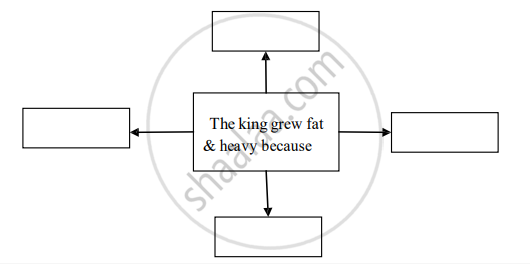
A2. Complete the web. [2]
|
King Krishnadeva Raya would perform heavy exercises every morning. He regularly applied oil on his body and thereafter worked out till all the oil came out with the sweat. This was followed by a long ride on his horse. Once the king started leading a sedentary lifestyle, and he stopped exercising. He no longer went horse-riding either. The king overate and as a result grew fat and heavy. The king‟s temperament also underwent a sea change. Noticing this, the royal physicians cautioned the king against the ill effects of overeating and explained to him the risks posed by obesity. They advised the king to regulate his diet, exercise, and take care of his health. The repeated advice he got from the physicians to eat less made him so angry that one day he announced a reward for anyone who could find him an easy cure. But there was one condition: those who failed would have their heads off. None dared to advise the king in this regard. The situation became precarious and as usual Tenali Raman was approached by the courtiers for a remedy. Tenali heard the problem and assured the courtiers of a viable solution. The next day, an astrologer predicted that the king had only a month left to live. When the king came to know of this, he was furious. The astrologer was ordered by the king to be imprisoned for a month so that his prediction could be put to test and so the hapless forecaster was sent to prison. |
A3. Find out describing words from the passage for the words given below. [2]
- exercise - ...........
- lifestyle - ...........
- ride - ...........
- physician - ...........
A4. Do as directed. [2]
- King Krishnadeva Raya would perform heavy exercises every morning.
(Use ‘used to’) - They advised the king to regulate his diet. (Pick out the infinitive)
A5. What are the benefits of daily exercise? [2]
What are the details not to be revealed in public domain?
Being a bachelor, the stranger had no patience with children.
