Advertisements
Advertisements
प्रश्न
Notice the following uses of the word ‘tell’ in the text.
1. Her fingers were busy telling the beads of her rosary.
2. I would tell her English words and little things about Western science and learning.
3. At her age, one could never tell.
4. She told us that her end was near.
Given below are four different senses of the word ‘tell’. Match the meanings to the uses listed above.
1. make something known to someone in spoken or written words
2. count while reciting
3. be sure
4. give information to somebody
Advertisements
उत्तर
1. Make something known to someone in spoken or written words: I would tell her English words and little things of western science and learning.
2. Count while reciting: Her fingers were busy telling the beads of her rosary.
3. Be sure: At her age, one could never tell.
4. Give information to somebody: She told us that her end was near.
APPEARS IN
संबंधित प्रश्न
Answer the following question in 200-250 words:
What is the main theme of 'The Diary of a Young Girl'?
Tick the item that is closest in meaning to the following phrase.
to take issue with
What are the cues that signal the presence of the peacock in the vicinity?
Think and answer in your own words.
What could be the age group of the speaker in the poem?
Behrman was a hard-hearted person.
Discuss in groups and share with one another.
When you go for a picnic, what and how do you enjoy?
Discuss in your class.
How can we take help of robots in our daily life?
Read the lesson and name the following.
The world’s most advanced surgical robot ______
Say WHY. . . . . .
Ramanujan found the number 1729 very interesting.
Find at least five other Akbar and Birbal stories and share them with your friends. Make a list of the stories collected by the entire class. Put your list in alphabetical order.
Complete the following statements with the help of the text.
To learn about meditation, you have to see ____________________________________________________________ Watch your thinking. Do not ________________________ Do not ____________________________________ Begin to learn ______________________________ Just watch thought. Do not ____________________________________________________.
Give reasons :
Oberon and Titania fight for the custody of the Indian boy because - Oberon wants __________________.
Write a short monologue using one of the following ideas. Write down the monologue and present it in the class.
Bushi disguised as a bandit.
Hold a mock trial for the following offence. There should be a complainant, a defendant, and lawyers to argue the case on behalf of them. The whole class can vote to pass the judgment. On what occasions will you plead for justice? What punishment will you suggest? When will you plead for mercy?
A young man was injured in a road accident due to another man’s careless driving.
To whom is the poem addressed?
Read the passage and answer the following:
Why is the tollbooth called a ‘phantom’ tollbooth?
In the novel, the Lethargarians give a whole day’s time table of their activities. Can you guess what it would be like?
Use your own ideas and prepare their time table.
Write your own impressions about the news items given in (a), (b), (c), and (d) in the table below.
| News item | Good news Bad news | Reliable Unreliable | Interesting Uninteresting Boring | Others |
| (a) | ||||
| (b) | ||||
| (c) | ||||
| (d) |
Pick out three examples of interrogation (rhetorical questions) from the poem.
Explain in your own words the point that each one makes.
| Interrogation | Explanation |
| (1) | |
| (2) | |
| (3) |
Fill in the blank choosing the appropriate word/idiom from the lesson.
The ______ solved the mysterious crime.
Name the following.
Scored the first goal in the match.
Write other meaningful words that begin/end with anywhere.
When do the parents feel sorry and become unhappy?
What does the poet want to know from the goldfish?
How did the parents support and encourage the young seagull’s brothers and sister?
Mahatma Gandhi, Che Guevera, Guru Nanak, and Gauthama Buddha are some of the famous personalities and thinkers who made extensive journeys to understand life. Do you think journeys can be life-changing?
In New York, Mr. Scotti left the plane because he thought he.
What were the children doing beside the stone wall?
What do you need to learn to live a good life in this world?
Identify the character/speaker.
Oh no, I'll never get back to the right size.
Look at the number pattern. Fill the blank in the middle of the series or end of the series.
FAG, GAF, HAI, IAH, ______
Give a picturesque view through which the train travels.
The hatchlings use a tiny egg-tooth to come out of the eggs.
What does the phrase ‘presence of mind’ mean? Explain the phrase using Muthu’s action.
What does ‘charges along like troops in a battle’ mean?
_____ is called the red planet.
Why don’t we use chemicals?
Why did Yazhini want to join the military?
Arrange the pictures by using numbers.
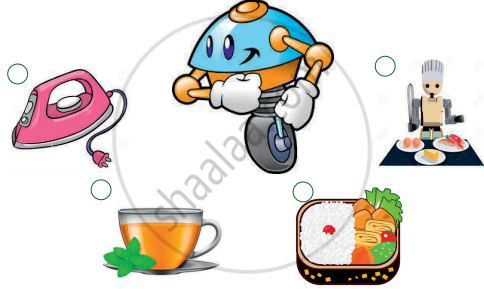
_______ is our culture.
Some words sound the same but their spelling and meaning are different. Such words are called homophones. There are many homophones.
What was his master’s advice?
Why did everyone ridicule the boy?
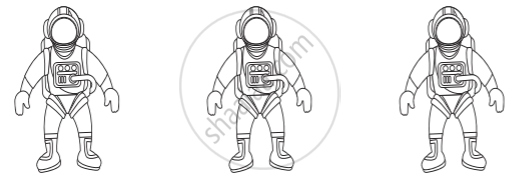
Read the passage three times and colour a spacesuit for each time.
A spacesuit is like a spaceship built for one. A spacesuit lets us work and live in space. It protects us from the heat and the cold. It gives us air to breathe. The suit is made of many parts and has water to drink. It even has a built-in toilet, if you need to use it.
They fed fish with______.
Who disguised himself as an old man?
Where does the scene take place?
Match the rhyming words.
| 1. | flow | know |
| 2. | grow | week |
| 3. | seek | blow |
Choose the correct answer.

Recite the poem 'A Voyage' with correct intonation.
______always stays to the last in our needs.
In early days, Amir left the tap opened.
Humans give importance to save______.
Do you think Ani will be a good leader? Why?
Choose the correct one.
Rooster

______ had made Math easy for Bala.
What does she paint?
Match the words with similar meaning.
| truck | subway |
| underground | lorry |
| tap | wallet |
| purse | faucet |
Who was Nokomis?
Where did the naughty boy go?
