Advertisements
Advertisements
प्रश्न
Give reasons for the following statement.
The article has been titled ‘Silk Road.’
Advertisements
उत्तर
The title of the article has been named on the historic silk road or routes. The network connected the Afro-Eurasian landmass. It established trade of Chinese silk, spices, teas and porcelain; Indian textiles, precious stones and pepper; and the Roman Empire's gold, silver, fine glassware, wine, carpets and jewels. The road was named Silk Road largely because of the silk trade with China. In the chapter the author travels to Mount Kailash, exploring the Himalayan belt in Tibet. Since the author explored this region, the chapter is titled as Silk Road.
APPEARS IN
संबंधित प्रश्न
Describe Miss Stapleton's first encounter with Sir Henry in about 125 words
What does “this circumstance” refer to?
What was the reason for young Paul's restlessness at the beginning of the story? How did it find expression?
Identify the common characteristics shared by tribal communities all over the world.
How is the idyllic juxtaposed with the pedestrian in the poem?
Read the following statement and mark those that apply to you.
I have cordial relationships with all but I cannot connect with anyone.
Pick out words that refer to ‘means of living’ and fill them in the Web.
(profession/recreation/occupation/job/ pastime/employment/hobby/career/entertainment/mission/trade/buisness/sports/retirement/placement)
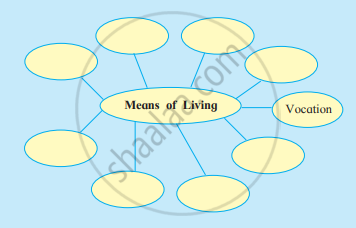
In our country engineering, teaching, and medical fields are much sought after. Other professions, occupations though they make a significant contribution to society, do not get their due.
| (a) | Farmer | highly unpredictable economic gains |
| (b) | Conservancy workers | ________________ |
| (c) | ________________ | ________________ |
| (d) | ________________ | ________________ |
| (e) | ________________ | ________________ |
Go through the poem and state whether the following statement is true or false.
The newly planned city looks modern and amazingly beautiful.
Who gives medicine/treatment to sick animals and birds?
Write 3 to 4 lines about the following in your own words.
The Robotic Surgery
Discuss orally in your class.
In what subjects is knowledge of mathematics used, at school level, and college/university level? Name them.
Did you know maths is used in music and poetry also? Can you tell how?
Answer the following question in short.
Why was Tenali Raman summoned to the court?
With the help of the internet and other sources, obtain more information about the critically endangered birds and animals in India. Find the names of their sanctuaries.
Draw a picture of the scene described in the poem.
Form pairs. Present in the class, the conversation between Thiruvalluvar and the young man.
Find sentences from the play related to the given points.
The tension between different loyalties
- It’s little we get but abuse from the people, and no choice but to obey our orders.
- ________________________________
- ________________________________
- ________________________________
Name the type of fabric closely associated with Mahatma Gandhi, the Father of the Nation. Why did Gandhiji want all of us to use this fabric?
Read aloud with the leader: Form groups of five. Read the passage aloud in groups. The leader begins every sentence and stops after a few words. The other members complete the sentence, reading it aloud in the chorus.
Collect as many pictures as you can, or draw diagrams of all the sources you have listed above. Make a scrapbook using them.
Apart from class/school, where else are you likely to find a time table useful?
Find the pairs of rhyming words used at the end of the lines in the poem.
Sayali made a hasty purchase.
What do you like better - the original poem or the parody? Why?
From the poem, find the old word used for each of the following :
- towards
- here
- does
The Principal turned out to be a very ______ lady.
Form groups of five. Discuss how you can complete the rest of the story without referring to Part II of the story.
List 5 of the sounds that you like.
List and say whether the following statement agrees with the passage or not.
You should try to talk most of the time whenever there is a discussion.
Helen Keller’s life is the story of ______.
Your parents sometimes behave like the young bird’s parents. They may seem cruel and unrelenting. Does it mean that they do not care for you? Explain your views about it with reference from the story
‘Finally the day had come’. Here the day refers to ______.
What do you infer about speaking with others from this poem?
Pick out the words which rhyme with the given words and write similar rhyming words on your own.
| 1. | far | ||
| 2. | fear | ||
| 3. | low | ||
| 4. | kind | ||
| 5. | remain | ||
| 6. | they |
Why did Alice follow the rabbit?
Listen to your teacher read the first part of the story. Many things described in the story can be seen in the picture. Find and name them.
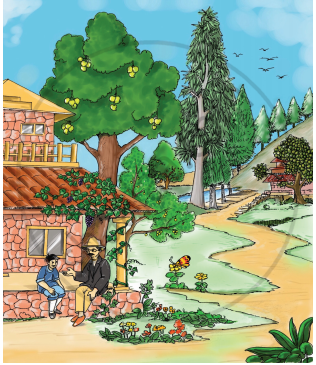
What is as sharp as a blade?
Selvi asked, 'Did they come in an aeroplane?' because she______.
Complete the sentence given below with word/phrase.
The wild dogs came to the spot to catch______.
_____ is called the red planet.
How does Patna differ from Delhi?
Kaliyan worked in a ______.
Look at the picture and Choose the correct word.

Choose the correct option from the given homophones.
The wind ______off the leaves.
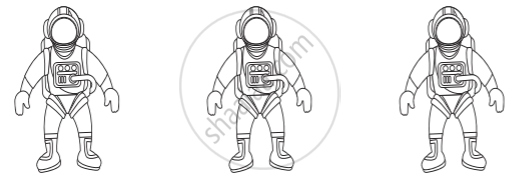
Read the passage three times and colour a spacesuit for each time.
A spacesuit is like a spaceship built for one. A spacesuit lets us work and live in space. It protects us from the heat and the cold. It gives us air to breathe. The suit is made of many parts and has water to drink. It even has a built-in toilet, if you need to use it.
They use ______ as bait.
Write the rhyming word.
goat
All the children wished to go to the______.
Guess how would the sparrow pull the elephant and the crocodile.
What was the reason behind Nandhini’s dullness?
What did Kani realize in the story?
What do you save? Why it is needed?
Kamali gave her savings to______.
Mugund learnt the art from his ______.
Write the correct word.
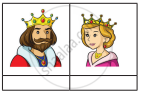
| rooster, king, hen, tiger, queen, tigress. |
What does the poet want us to do at night?
“Something is wrong,” said Helen’s mother. What was wrong with Helen?
Bertha was very good but very proud too.
