Advertisements
Advertisements
प्रश्न
Give reasons for the following statement.
Tibetan mastiffs were popular in China’s imperial courts.
Advertisements
उत्तर
The Tibetan mastiffs are big headed beasts who fix their hunting eyes and cock their heads on a stranger approaching. As one draws closer, they explode into action, darting like a bullet from a gun and nearly as fast. They usually wear bright red collars adding to their ferocious dark black look. They barked furiously with their massive jaws. They are completely fearless of any entity and shoot straight to any advancing stranger. They do not ease off before a chase of at least a hundred metres or so. Thus, it is not difficult to understand why these ferocious Tibetan mastiffs became popular in China's imperial courts as hunting dogs.
APPEARS IN
संबंधित प्रश्न
How does Anne criticize the attitude of the grown-ups in her diary?
How did the air raids disrupt the Dutch public life?
Discuss in groups of four.
The sensitive behaviour of hill-folk.
Read the following statement and mark those that apply to you.
I wish to be friends with someone but my friendship is rejected.
Find proof from the poem for the following.
The poet’s minute observations of the steady growth of the cherry tree.
Pick out a word from the poem to complete the sentence meaningfully.
The Government made a ______ (announcement) about their new taxation policy.
Read the story and choose the appropriate meaning.
Palette __________________.
Correct the following statement.
Sue ignored Johnsy completely.
Say where . . . . . . .
______ does Beauty’s smile begin?
Read the poem aloud. Recite any stanza of your choice from memory.
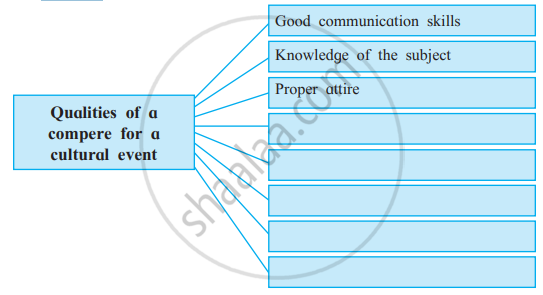
Imagine that you wish to organize a cultural event at your college. Prepare your own web-chart to indicate the qualities that you expect to have in a compere.
Explain the term plot.
Name the type of fabric closely associated with Mahatma Gandhi, the Father of the Nation. Why did Gandhiji want all of us to use this fabric?
Read aloud with the leader: Form groups of five. Read the passage aloud in groups. The leader begins every sentence and stops after a few words. The other members complete the sentence, reading it aloud in the chorus.
Write a conversation between a donkey and a school boy.
Complete the following sentence with reference to the passage:
To this day, we venerate this tree as ____________.
Write a short note on the following:
Prince Siddharth’s protected life.
Using your imagination, write more sentences in the same pattern:
- But the more the lion had, the more he wanted.
- Whenever he took a walk, they followed him.
- To be king is good. But to be kind is better.
Answer in your own words.
What did Neel realise from his encounter with his ancestors?
Choose the appropriate phrase to insert in the gap, to make the sentence meaningful. Use the appropriate form of the verb.
After I took the medicine, I ______ ______ the pain.
Discuss the following in group.
What can we do to get rid of bad habits?
Read the following.
- Skipper: captain of a ship or boat.
- Dipper: This word has two meanings. Dipper means a container for taking out water. Also, there are two constellations called Little Dipper (Little Bear) and Big Dipper (Big Bear) in the sky.
- Milky Way: The band of light consisting of stars that spreads across the sky at night.
Helen Keller’s life is the story of ______.
Guess the meaning of the following word.
coarse grained
Discuss, why it was considered as an adventurous and dangerous thing to travel in those days?
____________ raised a dreadful storm.
Identify the character or speaker
I must finish my task before I take my rest.”
What woke up the mother?
Why were the policeman prevented from entering grandfather's room?
Look at the following expressions from the text. With the help of your teacher rewrite them in standard English. One has been done for you.
| 1. ‘Musta got away – whatt’d he like? | Must got away - what was he like?’ |
| 2. ‘Looky here, Joe | |
| 3. ‘No sign o’ nothing’ | |
| 4. ‘Back t’ the lines ye goodaam | |
| 5. ‘What was the idea of all them cops tarryhootin’ round the house last night. |
‘My tongs are like a tiger among toys.’ It means ______
Teachers help me to learn ______ things.
- new
- bad
- difficult
What kind of a life do you want to lead in this world?
Write down the word that alliterate in the poetic line below
Festival of Flowers.
Look at the number pattern. Fill the blank in the middle of the series or end of the series.
ELFA, GLHA, ILJA, ______, MLNA
Neerja had a sour marriage due to______.
Work in groups of five. Tell the story in ten sentences.
You can begin the story like this:
The author’s Grandfather served in the Indian Forest Service.
After his retirement he built ______ Now continue the story. Each one should say one sentence.
Mother called ______.
A day in Mars is called ______.
We get water by burning _______.
_________ is the memorial for the soldiers.
Flag day is observed on the _________.
Where is Jaswantgarh located?
The battle of Nauranang lasted for three days.
Robot asked Vicky to sell him to an ______ master.
Where did Anitha go?
Match the rhyming words.
| mars | crime |
| bed | cars |
| time | head |
Uthaman was skilled in _____.
What did the archer want to show to the crowd?
______ over heard her father’s talking on the phone about the robbery.
Choose and write the adverbs to complete the sentence.

My dog barks ______.
Why did Tenzin cry every day?
Divya loved solving _______.
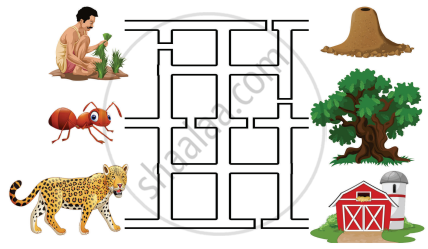
Match with their storing places.
Whose word are these? Name the character.
“Utensils made of brass and tin for sale!”
Why did the headmaster give Megala a special prize?
Which creatures wake up in the morning before the child does?
Why did Nasruddin take someone else’s name each time he missed the target?
Where did the rabbit go?
Read the following passage carefully and answer the following questions.
Pollution is the introduction of contaminants into the environment that cause harm to the ecosystem. The different kinds of pollution are air pollution, water pollution and land pollution. The release of various gases, finely divided solid particles, or liquid droplets that escape into the atmosphere to disperse and dilute in the environment is called air pollution. Modern society is also concerned about specific types of pollutants, such as noise pollution, light pollution, and plastic pollution.
Particulate Matter (PM), also known as particle pollution, is a complex mixture of extremely small particles and liquid droplets that get into the air. These particles if inhaled can affect health. The impact of PM 2.5 is particularly high in South Asia. Outdoor pollution is caused by a variety of pollutants like public and private vehicles, waste burning in the open, power production industries and construction and even cigarette smoking in public places.
Presently, air pollution is a major and growing risk factor for ill health in India. Delhi is one of the most air polluted cities in India. The air in the city as well as areas surrounding it has worsened to extremely hazardous levels in the recent years. This year’s pollution level is the worst in four years. Several studies have shown that poor air quality is a cause for many health issues among people with lower respiratory disorders with symptoms like dry cough, breathlessness, wheezing, chest discomfort, serious lung infections and cardio vascular diseases. Some studies throw light on the fact that about 16 per cent of the deaths worldwide in 2015 were due to pollution.
Air Masks are an option to protect oneself outdoor. Air masks can be used while commuting or while one is exposed to a polluted area. Some of these masks also include a layer of Activated carbon to filter the air. They protect us from suspended air particles and particulate matter up to the size of 2.5 microns and above. Their usage is limited to some days and should be disposed off after their prescribed duration of usage. The price for air masks starts from Rs 100 and can go up to Rs 500 and more.
We have to take active measures to control pollution and protect ourselves to lead a healthy and pollution free life.
- What is meant by pollution? Mention the different kinds of pollution.
- How does Particulate Matter cause air pollution?
- Identify three major causes of pollution in air
- Name the types of pollution we encounter now.
- What sort of health issues do people face due to air pollution?
- How can we protect ourselves outdoor from air pollution?
- Suggest a suitable title to the passage.
- Identify the meaning of the word similar to the one used in the fourth para:
- emerging
- filtering
- floating
- falling
