Advertisements
Advertisements
प्रश्न
Look at the number pattern. Fill the blank in the middle of the series or end of the series.
ELFA, GLHA, ILJA, ______, MLNA
विकल्प
OLPA
KLMA
LLMA
KLLA
Advertisements
उत्तर
ELFA, GLHA, ILJA, KLLA, MLNA
APPEARS IN
संबंधित प्रश्न
Write a character sketch of Mrs. Van Daan.
What strategy do chimps use to open hard shells and fruits ?
The soldier-bees carry home ______.
Guess the meaning of the following from the context.
The meadow is wrapped in shadow.
If you were to grow very tiny like a Lilliputian, what are the things you would like to do? Write about any three of these things.
Based on your reading, rearrange the following sentences in the correct sequence.
- Since all her methods failed, finally she gave him a pain-killer.
- He told his aunt that Peter had no aunt, so he gave him the medicine.
- The pain-killer triggered adverse reactions on Peter.
- It jumped out of the open window.
- Tom was dull and depressed.
- This incident upset Aunt Polly and she questioned him.
- But, Tom gave that painkiller to the cat Peter.
- So, Aunt Polly tried different types of remedies on him.
Work in pairs and answer the following.
Pick out the rhyming words.
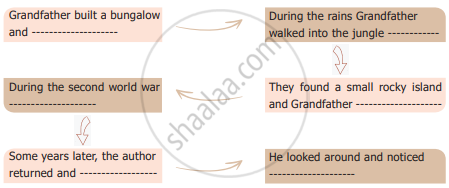
Read the story on your own. Discuss in a group and complete the story map below.
| A story map is the main events of the story given in a flow chart. |
Leafcutter ants drink______.
Read the following sentence.
‘A very wise man once remarked that of the unspoken word, you are a master; of the spoken word, you are a slave.’
The sentence has two pairs of opposites - spoken and unspoken, and master and slave. The contrasting ideas make the sentence more effective. Putting together opposite or contrasting ideas in one sentence is a literary device. It is called antithesis.
Read the following examples of antithesis.
- Give every man thy ear, but few thy voice.
- Man proposes and God disposes.
- Speech is silver, but silence is gold.
- Patience is bitter, but it has a sweet fruit.
