Advertisements
Advertisements
प्रश्न
What is the central argument of the speaker?
Advertisements
उत्तर
The author G.N. Devy, through his essay ‘Tribal Verse’ attempts to familiarise people with some aspects of the enormous wealth of oral tribal literature. It begins with an extract from an essay by G.N. Devy in which he discusses the need to create a space for the study of tribal literature within the framework of canonized written texts. He argues for a new method to identify and read literature in which orality is not dismissed as casual utterances in different dialects.
APPEARS IN
संबंधित प्रश्न
Attempt a character sketch of Mr Gilman as a teacher.
Answer any three of the following in 30-40 words each:
(a) Why has the poet’s mother been compared to the ‘late winter’s moon’?
(b) The poet says, ‘And yet, for these Children, these windows, not this map, their world.’ Which world do these children belong to? Which world is inaccessible to them?
(c) What was the plea of the folk who had put up the roadside stand?
(d) What will happen to Aunt Jennifer’s tigers when she is dead?
Answer any four of the following questions in 30 - 40 words each:
(a) What does the poet's smile in the poem, 'My Mother at Sixty-six' show?
(b) Listening to them, I see two distinct worlds ... ." In the context of Mukesh, the bangle maker's son, which two worlds is Anees Jung referring to ?
(c) Though the sharecroppers of Champaran received only one-fourth of the compensation, how can the Champaran struggle still be termed a huge success and victory?
(d) Which article in McLeery's suitcase played perhaps the most significant role in Evans' escape and how?
(e) Why does Derry’s mother not want him to go back to visit Mr. Lamb?
(f) What considerations influenced the Tiger King to get married?
What does the word ‘cardboard’ denote in the poem? Why has this word been used?
The narrative has many phrases to describe the scenic beauty of the mountainside like:
A flawless half-moon flated in a perfect blue sky.
Scan the text to locate other such picturesque phrases.
You will probably agree that this story does not have breathless adventure and exciting action. Then what in your opinion makes it interesting?
What do you think is the message that the author seems to convey through the story?
“I have done something; oh, God! I've done something real at last.” Why does Andrew say this? What does it mean?
Why is the quality of pity earth-bound while the other two passions are elevating?
The power of poetry lies in suggestion and understatement. Discuss this with reference to the poem.
Discuss with your partner and describe the atmosphere in the woods when Mrs. Adis didn’t hand over Peter Crouch to the keepers because -
- _________________
- _________________
- _________________
Think of one of your favourite stories. Fill in the following facts about the story.
- Name of the story:
- Type of story:
- Setting (time and place):
- Important characters:
- Theme/Plot:
- Conflict/Dilemma:
- Solution:
- End:
Discuss the activities carried out by a farmer.

Refer to a good dictionary that carries phonetic transcriptions printed next to words. The word below is familiar to you. Copy the phonetic transcription from the dictionary and say it aloud as you write.
work ........
Use the following phrases in your own words.
- roam around
- again and again
- bring something back
- there and then
The description of the character is given below. Identify the character from the play. Find some sentences which support your choice.
He is the centre of the play.
Write short note on the following:
The 1883 eruption
Does the traveller really have a magic stone?
An activity:
Speak fast, think faster! Form groups of 4-6. Discuss each of the following topics. Then each person in the group should choose a topic and speak about it for one minute. Try to say as many sentences as you can in that time
What is not likely to happen or will never happen...
‘It won’t rain in the classroom... I won’t ever see a live dinosaur... The sun will never set in the east...’ etc.
Form groups of five and discuss:
There are many things that seem small, minor, or insignificant to some people but the same may be the cause of great pain, suffering for others. Can you list such things? What can you do to provide help on those occasions?
Talk about your favourite season. (A one-minute activity.)
Prepare similar word chains using the following ideas.
size - big _______________.
Find three lines, that contain images of nature in the autumn season.
At night
- ______________________
- ______________________
- ______________________
Answer the following question and write in short, why the parody sounds funny.
Why does the crocodile work?
Answer in your own words.
How many chores did the ancestor from 1800 have to do?
Form groups of five. Discuss how you can complete the rest of the story without referring to Part II of the story.
Say whether you agree or disagree.
The prince had rare, uncommon likes and dislikes.
Discuss how you will measure the worth of a friend.
In what way can we help to reduce or minimize waste generation?
Discuss the issue in groups of 4 or 5 and note down all good suggestions.
Resolve to follow them yourself. Some have been given below for your reference.
- Don’t waste food.
- Take as much as you want but finish everything that’s on your plate.
- Don’t throw away broken or half-used things. Repair them and use them.
- Avoid things which can be used only once.
For example: thermocol (polysterene) cups, plastic glasses, etc. - Reuse!
- Recycle!
Read the following.
- Skipper: captain of a ship or boat.
- Dipper: This word has two meanings. Dipper means a container for taking out water. Also, there are two constellations called Little Dipper (Little Bear) and Big Dipper (Big Bear) in the sky.
- Milky Way: The band of light consisting of stars that spreads across the sky at night.
Show the major events in the story of Pheidippides on a ‘time-line’.
____________ raised a dreadful storm.
Identify the character or speaker.
He was the chief of all spirits.
Bring out a few differences between the two art forms: Therukoothu and Bommalattam.
Complete the following table with information from the anecdote about Mr. Scotti’s short trip.
| Name | Nicholas Scotti |
| Occupation | |
| Reason for his trip | |
| Means of transport | |
| Destination |
Read the data below and answer the following question.
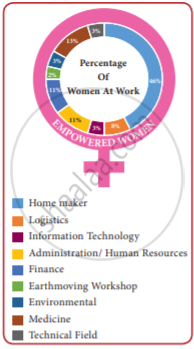
Choose the correct answer.
Identify the three jobs where the same percentage of women work.
Hamid’s granny scolded him for buying iron tongs. Then she understood that Hamid had bought it ______.
Find a sentence/word from the text which express the following.
Words related to prize.
Read these lines and answer the question given below.
The laughter and beauty of women long dead;
Explain the meaning of the above line.
Read the line and answer the question.
And all I ask is a merry yarn from a laughing fellow rover.
What kind of human company does the poet want?
Sea turtles come to the shore to ______.
According to the author the tendril was moving towards grandfather because it______.
What is as sharp as a blade?
Name the vegetables harvested in the vegetation hab.
The aliens gave a new shuttle to them.
How did the second daughter use the grain?
Why should we read?
What will you do if someone ensnares birds?
Take out the correct rhyming pair from the poem and match with the given word.
| 1. | tall | |
| 2. | light | |
| 3. | might |
Uthaman was skilled in _____.
Kani and Teddy were in the garden at _____.
What did the grandfather announce?
Appa weaves beautiful sarees with______.
______ is a great risk to the environment.
The fir tree was not happy with the gold leaves ______.
Why did Nasruddin say, “It was my aim,” the third time?
List three questions that the little boy asks.
- ______
- ______
- ______
Are these sentence TRUE or FALSE
The poet tells the child to be afraid when it is dark.
Are these sentence TRUE or FALSE
The poet tells the child to think of friends after it is dark.
Being a bachelor, the stranger had no patience with children.
