Advertisements
Advertisements
प्रश्न
“I have done something; oh, God! I've done something real at last.” Why does Andrew say this? What does it mean?
Advertisements
उत्तर
A model answer has been provided for students' reference.
It is strongly recommended that students prepare the answer on their own.
Andrew, the protagonist of the story Birth, utters these words as he is able to bring a still born child back to life which seemed impossible in the beginning. The child is born still to the wife of Joe Morgan. The child is the first child of the couple who has been married for nearly twenty years. The child is born under critical condition. Both the child and the mother are in critical condition requiring urgent attention. The nurse dumps the child thinking it to be still born.
Andrew takes care of the mother first and seeing her in the recovery path turns his attention to the child. Andrew pulls the child out. It is a perfectly formed boy. Its limp white body is white and soft. Its head is hanging loosely on the thin neck. Andrew at once understands that it is a case of asphyxia pallida. He orders the nurse to get him cold water and hot water and basins. He lays the child upon a blanket and begins the special method of respiration. Fifteen minutes passes but no breath comes from the body of the child. In sheer desperation, he rubs the child with a towel, crushes and relaxes the chest with both hands. Then a miracle happens. The little chest gives a short, convulsive heave and then another. Andrew redoubles his effort. The child is now gasping, deeper and still deeper. Then comes the child's cry. He hands over the child to the nurse and climbs down the stair. He utters the quoted words out of deep satisfaction on achieving the seemingly impossible task.
It means that Andrew has been able to do something wonderful. He has been able to apply what ever he learnt in the medical textbooks and even beyond that. It is really a great achievement for Andrew. The above words mean that a doctor is a medium through which God or Almighty grants life to the patients. The miracle happened by the grace of the Almighty. Andrew acknowledges this fact in the above quoted words. These words bring home the fact that saving the life of a patient is the most coveted achievement of a doctor.
APPEARS IN
संबंधित प्रश्न
There were many reasons for Helen Keller's embittered childhood. What were they and how were they overcome?
How did a story book, 'Little Lord Fauntleroy' open a window of knowledge to Helen and help to shape her career?
Aunt Jennifer's tigers prance across a screen,
Bright topaz denizens of a world of green.
They do not fear the men beneath the tree;
They pace in sleek chivalric certainty.
(a) Why are the tigers called Aunt Jennifer's tigers?
(b) How are they described here?
(c) How are they different from Aunt Jennifer?
(d) What does the word, 'chivalric' mean?
Answer any four of the following questions in 30 – 40 words each :
(a) After initial reluctance why did the lawyers tell Gandhiji that they were ready to follow him into jail?
(b) What is Mukesh's attitude towards the family business of making bangles?
(c) How does the poet show the futility of Aunt Jennifer's efforts?
(d) Stephen Spender in his poem, 'An Elementary School Classroom in a Slum' paints a dismal picture of poverty. Comment.
(e) Jackson went through the contents of Rev. McLeery's suitcase. Which object therein puzzled him sorely? What was his comment on that?
(f) How did the servants react when they realized that Dr. Sadao was going to save the life of an enemy?
What strategy do chimps use to open hard shells and fruits ?
Briefly comment on:
The author’s physical condition in Darchen.
Tick the statement that is true.
The story tries to relate history to Science.
Do you think that the ruled always adopts the language of the ruler?
What was the reason for the anxiety of Paul's mother as he grew older?
Discuss the following in pairs or in groups of four:
“Tribal arts are not specifically meant for sale.” Does this help or hamper their growth and preservation?
Discuss in pairs or in small groups
What does a novel do?
Bring out the parallel suggested between the predatory instincts of the bird and human behaviour.
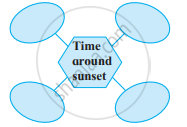
Pick out words from the poem to fill in the web diagram. They should be related to the theme in the web.
There are different types of short stories. Use a dictionary/internet and find out what each of the following types refers to.
- fable:
- anecdote:
- fairy tale:
- parable:
- tragedy:
- humorous story:
- detective story:
- myth:
The two best things the servants brought to God were gold and jewel stones.
Pick out a word from the poem to complete the sentence meaningfully.
Everyone stood ______ (horrified) when the terrible accident took place.
Discuss in groups and share with one another.
The daily routine of your mother and father on working days.
Go through the poem and state whether the following statement is true or false.
Planners are concerned about the environment of the area.
Refer to a good dictionary that carries phonetic transcriptions printed next to words. The word below is familiar to you. Copy the phonetic transcription from the dictionary and say it aloud as you write.
work ........
Read the description of the Kabaddi match and do the following:
Choose any one event and draw a diagram to show what happened.
Describe the following with the help of the story.
The fabric is woven by Thiruvalluvar
State a type of drama each from any four periods of history.
Find out the different processes by which fabrics are made. Find illustrations and write a few lines on each process.
Form groups and hold debates on the following topic. Make bulleted lists of points in favour of the topic (pros) and those against it (cons). (3-6 points each).
Boys cannot cook or do any housework.
Apart from the stone, how many things go into the soup?
What were the three things that Sushruta discovered?
Explain the meaning of the following phrase:
An eagle’s eye
What did Mr. Gizare appreciate the most?
What does the poet want to do?
Complete the following table.
| No. | Utterance | Who said it | To whom | When |
| (a) | I touched it in the hall at the ministry. | ___________ | ___________ | ___________ |
| (b) | It will give us time to look some more. | ___________ | ___________ | ___________ |
| (c) | I might have needed it. | ___________ | ___________ | ___________ |
| (d) | You must have made a mistake. | ___________ | ___________ | ___________ |
| (e) | Well, I lost it. | ___________ | ___________ | ___________ |
| (f) | Mine was an imitation. | ___________ | ___________ | ___________ |
Using the information given in the passage, write a short note on the following in your mother tongue.
Gond art
Write the symbol that is used in the poem to represent the following idea.
I made a rare choice.
From any collection of classic poetry or the internet, find another famous poem by Robert Frost titled ‘Stopping by the Woods on a Snowy Evening’. Try to understand the symbolism used in that poem in 8-10 lines.
Rohan and Muk entered the garden at midnight ______.
Describe Gulliver’s walk around the city.
Write any one of these stories, not as told by Gulliver, but by some other person.
Find two examples of the following from the lesson.
A Statement
In what way can we help to reduce or minimize waste generation?
Discuss the issue in groups of 4 or 5 and note down all good suggestions.
Resolve to follow them yourself. Some have been given below for your reference.
- Don’t waste food.
- Take as much as you want but finish everything that’s on your plate.
- Don’t throw away broken or half-used things. Repair them and use them.
- Avoid things which can be used only once.
For example: thermocol (polysterene) cups, plastic glasses, etc. - Reuse!
- Recycle!
Guess the meaning of the following word in the poem.
lined
Guess the meaning of the following word.
fragrant
Why did Herman and the author slam the doors?
| soft | vain | fear | joy | love | heard | toiled | mild | good | sand | life | harsh |
The ______, the______, which it may bring.
Identify the character/speaker.
Oh no, I'll never get back to the right size.
Read the following article about the amazing similarities between the assassination of John F. Kennedy and Abraham Lincoln; then underline the passive forms.
Abraham Lincoln was elected to Congress in 1846. Voters elected John F. Kennedy to Congress in 1946.
Lincoln was elected president in 1860. Voters elected Kennedy president in 1960.
Both men were particularly concerned with civil rights.
Both wives lost their children while living in the White House.
Lincoln was shot on a Friday. Someone shot Kennedy on a Friday.
Lincoln was shot in the head. The gunman shot Kennedy in the head.
Lincoln’s secretary was called Kennedy. Kennedy’s secretary was called Lincoln.
Lincoln was assassinated by a Southerner. A Southerner assassinated Kennedy.
Lincoln was succeeded by a Southerner named Johnson. A Southerner named Johnson succeeded Kennedy.
Andrew Johnson, who succeeded Lincoln, was born in 1808.
Lyndon Johnson, who succeeded Kennedy, was born in 1908.
John Wilkes Booth, who assassinated Lincoln, was born in 1839. Lee Harvey Oswald, who assassinated Kennedy, was born in 1939.
Both assassins were known by their three names and both names are composed of fifteen letters.
Lincoln was shot at a theatre named “Ford”. The gunman shot Kennedy in a car called a “Lincoln” that the company Ford made.
Booth ran from the theatre and was caught in a warehouse. Oswald ran from a warehouse and the police caught him in a theatre.
Booth was assassinated before his trial. Someone assassinated Oswald before his trial.
Match the following.
| treat everyone | love each of her child |
| nation | no inner boundaries |
| kind | not divided as people |
| country | alike |
Name the character or speaker.
"The robot will do all your work."
Who was Akilan’s inspiration?
The old man put _____ on the mouth of the gourd.
The official and his wife liked______.
Ani valued honesty.
What will help us grow?
Choose the correct one.
Elephant

How does she move the brush?
Read the passage 3 times and colour the trees for each time.
Trees help us in many ways. The colour green is calming and heals your worries. By planting and caring for trees, we help improve our surroundings, as they give fresh air. When air is dirty the people of Delhi suffered a lot. But people of Madhubani district in Bihar have shown how art can be used to make our air clean. So that people made paintings on trees to stop people from cutting the trees.

The brush ______ to her will.
Is there something that you will struggle for? why?
Who wins the world at the end?
When should we not water the plants?
Read the passage and write a summary of it. Suggest a suitable title for the summary.
|
A sparrow is a small bird which is found throughout the world. There are many different species of sparrows. Sparrows are only about four to six inches in length. Many people appreciate their beautiful songs. Sparrows prefer to build their nests in low places-usually on the ground clumps of grass low trees and low bushes. In cities, they build their nests in building nooks or holes. They rarely build their nests in high places. They build their nests out of twigs grasses and plant fibers. Their nests are usually small and well-built structures. Female sparrows lay four to six eggs at a time. The eggs are white with reddish-brown spots. They hatch within eleven to fourteen days. Both the male and female parents care for the young. Insects are fed to the young after hatching. The large feet of the sparrows are used for scratching seeds. Adult sparrows mainly eat seeds. Sparrows can be found almost everywhere where there are humans. Many people throughout the world enjoy these delightful birds. The sparrows are some of the few birds that engage in dust bathing. Sparrows will first scratch a hole in the ground with their feet then lie in it and fling dirt or sand over their bodies with flicks of their wings. They will also bathe in water or in dry or melting snow. Water bathing is similar to dust bathing with the sparrow standing in shallow water and flicking water over its back with its wings also ducking its head under the water. Both activities are social with up to a hundred birds participating at once and are followed by preening and sometimes group singing. |
What should parents do to ensure the safety of children in cyber space?
