Advertisements
Advertisements
प्रश्न
There lies a great difference between text book medicine and the world of practising physician. Discuss.
Advertisements
उत्तर
A model answer has been provided for students' reference.
It is strongly recommended that students prepare the answer on their own.
There lies a great difference between text book medicine and the world of practising physician. Text book medicine is purely a Science whereas treating a patient is an art. The world of practising physician requires a different set of skills and knowledge. Text book medicine no doubt provides the conceptual framework for treatment but no doctor can treat a patient without the use of his or her intuitive practices. In the story Birth the way Andrew brings back life in the still born child is a testimony to this fact. The nurse at first dumps the child thinking it to be dead. But Andrews takes a chance and the miracle happens. He in the beginning applies his text book knowledge but the child does not recover. He doesnot lose heart. He applies his own intuitive method and the miracle then happened. Treatment is Science and beyond. It is both a science and an art. The story Birth is a realistic fiction. In other words, the elements of the story has been taken from real life experiences and woven in the fabric of fiction.
APPEARS IN
संबंधित प्रश्न
How is the social life at Raveloe different from that at Lantern Yard ?
Answer the following question in 150-200 words:
Why did Anne like her father more than she liked her mother?
Talk to your partner about the following.
The author’s grandmother was a religious person. What are the different ways in which we come to know this?
Comment on the graphic detail with which the various passengers who took Iona's cab are described.
What does the phrase ‘as if he were on needles’ mean? Can you think of another phrase with a similar meaning substituting the word ‘needles’?
Examine the communication channels in the story between Basset and Paul's uncle.
How have the three passions contributed to the quality of Russell's life?
What do you understand of the three voices in response to the question 'What does a novel do' ?
Discuss the importance of time in the narration of a story.
The poem has a literal level and a figurative level. Why has the poet chosen 'tigers' and 'sheep' to convey his message?
Find proof from the poem for the following.
The colour imagery in the poem.
Discuss in groups, reasons/ consequences/ effects:
The life of the cherry tree was threatened.
Read the poem below and fill in the gaps, choosing appropriate pairs of rhyming words, to make them meaningful.
|
Little things Little drops of water, Thus the little minutes, Little deeds of kindness, |
(love - above / sand - land / be - eternity)
Read the story and choose the appropriate meaning.
Struggling artists ____________
Read the descriptions of the following from the story and describe any one of them using your own words.
- The ivy vine
- Behrman
- The last leaf that Johnsy saw
In the following sentence, point out the Main Clause and Subordinate Clause. Encircle the Subordinator.
Old Behrman was a painter, who lived on the ground floor.
Read the lesson and name the following.
The world’s most advanced surgical robot ______
State a type of drama each from any four periods of history.
Name the type of fabric closely associated with Mahatma Gandhi, the Father of the Nation. Why did Gandhiji want all of us to use this fabric?
Show the three categories of volcanoes using the following tree diagram structure.
List the characters in the play and write one or two lines about each.
Write a recipe for the stone soup.
Antonio had gone on a long voyage.
What themes would you like to add to the themes given in this passage?
Who is the speaker in the poem?
Read the passage and answer the following:
Who is the main character in the story?
Discuss:
Is it necessary to develop a good accent? Why? What efforts can you take to improve your pronunciation? With your teacher’s help, find out how to use online dictionaries for the purpose.
Find the pairs of rhyming words used at the end of the lines in the poem.
Find out the following with the help of your teacher and the internet.
Rain in countries like the UK which experience spring-summer-autumn-winter.
Read the following:
- Charging along like troops in a battle.
- Fly as thick as driving rain.
Using your imagination, write one or two comparisons each with -
- like ______
- as ______ as
Find one example of the following given below from the poem: Simile.
What did the husband want to buy?
Do you long to be something else? Write about your longing.
Who were on the ship? How were they related to Prospero?
Read the incident again and answer the following question.
What is the humour element in the above incident?
Few articles are missing in the given passage. Edit the passage given below by adding suitable articles where ever necessary.
My neighbourhood is very interesting place. My house is located in apartment building downtown near many stores and offices. There is small supermarket across street, where my family likes to go shopping. There is also post office and bank near our home. In our neighbourhood there is small, Green Park where my friends and I like to play on weekends and holidays. There is small pond near park and there are many ducks in park. We always have great time. In addition there is elementary school close to our home where my little brother studies in third grade. There are so many things to see and do in my neighbourhood that’s why I like it. It’s really great place.
Read the data below and answer the following question.
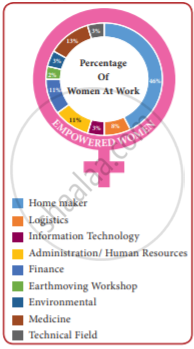
Choose the correct answer.
In which field of work is women’s involvement the second highest?
Write the name of the toys against each picture.

What did Hamid buy at the fair? And for whom?
“Was it just the wind?”– What do you think Usha thought it was? Why?
What are the skills/values a teacher should teach their students to live in this competitive world?
What are the disadvantages of speaking harshly?
Identify the character/speaker.
One side makes you big, the other side makes you small.
The war between the two kingdoms ended in peace.
The boar slept until the fading sun told him it was time to get up. What does the phrase until the fading sun mean?
What is our core?
Vicky pleaded his father to buy a robot.
Name the character or speaker.
“Learn well, live well!”
Who was Akilan’s inspiration?
What did the archer want to show to the crowd?
Try your own.
Pablo was the dog of ______.
Match the rhyming words.
| 1. | flow | know |
| 2. | grow | week |
| 3. | seek | blow |
Circle and write the adverbs.
I'm waiting here. ______
Kani and Teddy were in the garden at _____.
When does the world become green?
In real, the test is for______.
Write the word with same meaning.

Torch
Although Helen could not hear or see, what kind of girl was she?
Write the related words as shown in the example: