Advertisements
Advertisements
प्रश्न
Do you know of any incident when someone has been brought back to life from the brink of death through medical help. Discuss medical procedures such as organ transplant and organ regeneration that are used to save human life.
Advertisements
उत्तर
Medical science has taken a long stride. Advancement in surgery has brought a revolution in the lives of human beings. People have been brought back to life from the jaws of death through prompt medical help. Organ transplantation and organ regeneration are some of the new medical procedures. They are frequently used to save human lives.
Instances of kidney transplantation are quite common.
I remember one incident where a kidney transplantation saved a human life. There was an appeal from a kidney patient in all the leading newspapers. Both of his kidneys had failed. Prompt transplantation of a healthy kidney could save his life. At last, the man found a donor. The operation was successful. The organ transplantation brought him back to life from the brink of death.
APPEARS IN
संबंधित प्रश्न
Answer any three of the following in 30-40 words each:
(a) Why has the poet’s mother been compared to the ‘late winter’s moon’?
(b) The poet says, ‘And yet, for these Children, these windows, not this map, their world.’ Which world do these children belong to? Which world is inaccessible to them?
(c) What was the plea of the folk who had put up the roadside stand?
(d) What will happen to Aunt Jennifer’s tigers when she is dead?
How did a story book, 'Little Lord Fauntleroy' open a window of knowledge to Helen and help to shape her career?
How did Helen benefit when Dr. Graham Bell accompanied her to the World Fair?
In ‘The Diary of a Young Girl’ how did the Franks and others celebrate two festivals, Hanukkah and St. Nicholas Day in the Annexe ?
Tick the item that is closest in meaning to the following phrase.
to meet one's match
Make a list of the expressions that imbue the watch with human attributes.
In English, the peacock is associated with pride. ‘As proud as a peacock’ is a commonly used simile. With what qualities is the peacock associated with the literature of your language?
Discuss in pairs
Ruskin's insistence on looking intensely at words, and assuring oneself of meaning, syllable by syllable – nay, letter by letter.
Comment on the use of the phrase ‘fresh-peeled voice’.
What, according to the poet, are human beings out of tune with?
Guess the types of hardships they must have faced in their childhood and youth.
Read the story and complete the following.
When Revathi played her favourite raga, the plants began to move because, ____________.
Using a dictionary/internet note down the main difference between farm and granary.
‘Never mind faded forests, Austin’. The word ‘faded’ means to become dim or faint. The word describes the forests that have become faint or dim in appearance. Now go through the poem again and complete the table.
| Describing word | Object | Explanation |
| 1. faded | forests | The forests have become faint or dim in appearance. |
| 2. silent | ||
| 3. unfading | ||
| 4. bright |
Justify the verdict delivered in the poem.
I can support my answer with the help of the following suitable arguments:
- _______________________
- _______________________
- _______________________
What is the Rhyme scheme of stanzas 1 to 3 and the last two stanzas?
How does it differ in the remaining stanzas 4 to 7?
Think deeply and write. Is the poet really discouraging the youth from becoming vets? Explain your response.
Go through the poem and state whether the following statement is true or false.
The newly planned city looks modern and amazingly beautiful.
Read the lesson and name the following.
The Father of modern neurosurgery ______
Say WHY. . . . . .
Hardy invited Littlewood for a discussion.
Fill in the gap, choosing a word from the bracket to make an appropriate comparison.
(tall / quiet / humble / merry / busy / slippery / fast / sly / slow / big)
as ______ as a deer
Give reasons :
Oberon and Titania fight for the custody of the Indian boy because - Titania wants ______________________.
Write a conversation between a donkey and a dog.
What characteristics of Mr. Nobody do we learn about from this poem?
Use the following expressions in your own sentences:
- We all agree that
- It is he/she who
- Don’t you see
- None of us
Read the passage and name the following.
He was killed by a poisoned arrow that entered his heel.
Find the words that mean the following from the first stanza.
- Gold hammered into a flat, thin shape: ______
- show off proudly: ______
- tilt, move at an angle: ______
- across, especially in a slanting direction: ______
Read: ‘The Open Window’ by H. H. Munro (Saki).
Guess the meaning of the following word.
fruitless
List and say whether the following statement agrees with the passage or not.
In a discussion, you should share your ideas with others.
Write any one of these stories, not as told by Gulliver, but by some other person.
What methods did Anshuman's parents use to warn Anshuman about his bad habits?
Find a word that has a similar meaning.
unfair
Read the following line from the poem and answer the question that follow.
Let me but live my life from year to year, With forward face and unreluctant soul; Not hurrying to, nor turning from the goal; Not mourning for the things that disappear.
Identify the rhyme scheme of the given lines.
Why did Prospero set Ferdinand a severe task to perform?
What did Granny say about Hamid’s parents?
What are the disadvantages of speaking harshly?
Read the line and answer the question.
And quiet sleep and a sweet dream when the long trick’s over
What does the poet want to do after his voyage is over?
The land was wet and green.
The eggs hatched and the babies flew away.
Why did the crowd gather by the side of the pond?
Work in pair, find answer for the question and share in the class.
Why does the poet say the ‘ Spring is pretty’?
Did Santhosh enjoy his morning walk? How do you know?
Anitha's friends wanted a______ robot in their houses.
Match their hobbies.
 |
swimming |
 |
cycling |
 |
gardening |
Karate makes me brave and bold. Would you like to learn it?
Look at the picture and tick Choose the correct word.

Why did he grow crops?
Fill in the blank
Do you like apple______ orange?
Circle and write the adverbs.
I drink coffee thrice a day. ______
What makes him fall?
What will help you say the truth?
Choose the word with same meaning.
Foot hills- ______
Chris enjoyed doing all sorts of things except, writing and ______.art
The pretty little fir tree was happy with gold leaves but______.
While listening to the story, what did Alice see?
Choose the right word.
Chintha Chettu is a tamarind ______.
Read the following passage and do the activities:
A1. Fill in the blanks: (2)
- ______ percent of our daily communication is non-verbal.
- Eye contact is another type of ______ communication.
- Frequent blinking is a sign of the person feeling ______.
- One can readily detect _______.
|
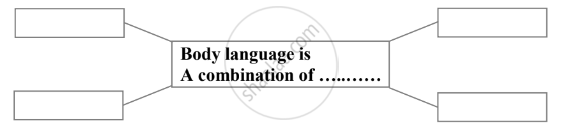
According to some experts, a staggering 93 percent of our daily communication is non-verbal. Facial expressions are easy to decipher. One can readily detect happiness, sadness, anger. Physicians can tell a patient is doing well (or not) by looking at his/her face. Eye contact is another type of non-verbal communication, which can tell a lot about the other person. The eyes convey a range of emotions-happiness, sadness, boredom, surprise, confidence .......... even emotional interest. Staring at someone's forehead may intimidate the recipient, staring at the mouth is sometimes interpretated as a sign of emotional interest. In fact, staring into someone's eyes is a sign of lying, and so is looking away. In certain cultures, lack of eye contact is taken as a sign of respect. If body language is to be defined, it is a combination of facial expression, gestures, eye contact, body movements and posture and voice. Frequent blinking is a sign of the person feeling distressed or uncomfortable. If the pupils are dilated, it ofter indicates interest, even emotional interest. The lips also reflect our body language, and lip biting indicates worry and/or anxiety; tightening of the lips may be an indication of disapproval. Slightly turned-up lips indicate happiness and slightly turned-down lips indicate sadness. |
A2.
A3. Find the antonyms of: (2)
- verbal × ______
- entertaining × ______
- sender × ______
- comfortable × ______
A4. Do as Directed: (2)
- The eyes convey a range of emotions. (Frame a 'Wh' question in order to get the underlined part as answer).
- Physicians can tell about a patient's wellness. (Rewrite using 'able to')
A5. Personal Response: (2)
Non-verbal communication plays an important role in our daily life. Comment.
Enact any one anecdote in the classroom.
Form groups of four to six.
Discuss whether and how you can improve English spelling.
