Advertisements
Advertisements
Question
Do you know of any incident when someone has been brought back to life from the brink of death through medical help. Discuss medical procedures such as organ transplant and organ regeneration that are used to save human life.
Advertisements
Solution
Medical science has taken a long stride. Advancement in surgery has brought a revolution in the lives of human beings. People have been brought back to life from the jaws of death through prompt medical help. Organ transplantation and organ regeneration are some of the new medical procedures. They are frequently used to save human lives.
Instances of kidney transplantation are quite common.
I remember one incident where a kidney transplantation saved a human life. There was an appeal from a kidney patient in all the leading newspapers. Both of his kidneys had failed. Prompt transplantation of a healthy kidney could save his life. At last, the man found a donor. The operation was successful. The organ transplantation brought him back to life from the brink of death.
APPEARS IN
RELATED QUESTIONS
Helen's statement, "We worked hard and faithfully, yet we did not quite reach our goal" tells us about her failure to achieve the goal at the Wright-Humason School in New York City. What was the goal that she failed to achieve there?
Answer the following question in 120 – 150 words:
How do you perceive Dr. Kemp based on his interaction with Griffin ? (The Invisible Man)
Describe the shifts in the narration of the events as indicated in the three sections of the text. Give a subtitle to each section.
What does the phrase 'as if he were on needles' mean? Can you think of another phrase with a similar meaning substituting the word 'needless'?
What do you think is the message that the author seems to convey through the story?
We 'draw up a deed'. Complete the following phrase with an appropriate word.
________ends meet
Why do you think Paul's mother was not satisfied with the yearly birthday gift of 1,000 pounds for five years.
'Luck is necessary for success in life'.
Examine the communication channels in the story between Basset and Paul's uncle.
Explain the significance of the lines ‘I tie this Ridin creeper To fasten your soul to your body.’
Explain the phrase.
Time's fool
Make groups and discuss the following:
What fatal dangers/problems did mankind face centuries ago, but are no longer a threat today?
Find proof from the poem for the following.
The struggle of the cherry tree for survival.
Make a list of words related to agriculture.
'Uttarayana' starts from Makar Sankranti onwards.
You will come across many blogs written by famous personalities on different topics and issues. Read and make a list of at least ten blogs available on the internet. Read and summarise a blog and present it before the class.
| Sr.No. | The topic of the Blog | Name of the Blogger |
| 1. | Don’t teach kids how to read, teach them why. (https://www.teachthought.com/literacy stop-teaching-kids-how-to-read-reading-practice/) | Terry Heick |
| 2. | ||
| 3. | ||
| 4. | ||
| 5. |
Akbar wanted to punish the person who pulled his moustache.
Form a pair. Write at least one short dialogue for the following expression.
I agree.
Visit a library:
Read the stories of King Arthur and his Knights of the Round Table.
Read the passage and name the following.
He was killed by a poisoned arrow that entered his heel.
Find the different units of measurement mentioned in the passage and get more information about them from the internet.
Read the story ‘Lord Emsworth and the Girl Friend’ by P. G. Wodehouse.
Make groups. One person in the group chooses an announcement. Everyone in the group reads that announcement silently but carefully and closes their books. Then that person presents the announcement, changing one of the details in the announcement. Others spot the change. For example, you might say ‘red’ key chain instead of ‘blue’ in the last announcement.
Read the highlighted words. They are adverbs.
- I was pulling hard.
- They ran away.
- Later, I was taken to the city.
- I went very carefully.
- They were greatly pleased.
Write what you can do to welcome birds in your surroundings.
Do you agree with the poet’s thoughts? Why?
Read the following and say whether the statement tells you about a fact or whether it is imaginary.
There is a man in the Moon.
How did Helen Keller help other blind people?
Describe the struggles underwent by the young seagull to overcome its fear of flying.
Title summarises the story. Each paragraph is a part of the story. Look at the following expressions and find out the paragraphs that best suit these expressions.
- Oh, No! But it happens!
- Don’t let out your travelling dates
- Anyway, people will be people
- Search begins
- Things are not that easy
- Hurry invites worry
Few articles are missing in the given passage. Edit the passage given below by adding suitable articles where ever necessary.
My neighbourhood is very interesting place. My house is located in apartment building downtown near many stores and offices. There is small supermarket across street, where my family likes to go shopping. There is also post office and bank near our home. In our neighbourhood there is small, Green Park where my friends and I like to play on weekends and holidays. There is small pond near park and there are many ducks in park. We always have great time. In addition there is elementary school close to our home where my little brother studies in third grade. There are so many things to see and do in my neighbourhood that’s why I like it. It’s really great place.
Why did Dr. Ashok’s cousin call him?
Hamid’s friends enjoyed the ride in the merry-go-round. But Hamid didn’t go on it. Why?
What do you think are the two most important lessons that the speaker mentions?
Why was Sir Francis angry?
Fill in the table given below.
| S. No | Problems faced by the hatchlings | Effect | Solution |
| 1. | Pollution | Survival of sea turtles becomes difficult. | Reduce the usage of plastics. |
| 2. | Predators | ||
| 3. | Human Activities |
Women should not be compared with men in cricket, says Mithali.
Fruits, vegetables, and water in the Mars are not ______.
Try your own.
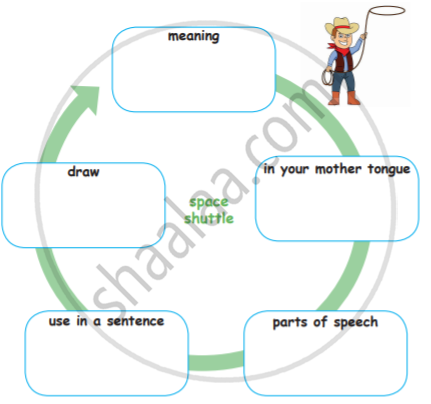
Match the dialogue to the character.
| "I will do all the work myself." |  |
| "First, you charge my battery." |  |
| "I have bought you a robot." |  |
What is the use of mechanical parts?
Choose the odd one out.
Why should we read?
What wins the hearts?
How did the girl seem?
What made him frightened?
People ran off when the seawater receded.
Circle and write the adverbs.
Suddenly the old man fainted. ______
Number the pictures in the correct order of the story.

______are the real wealth.
Speak and win.
Join in any group. Support or oppose using 4 to 5 sentences to win.
| I support Divya. | I oppose Divya. |
Let us learn a few more word by joining the dots. Join the dots and fill the table below.
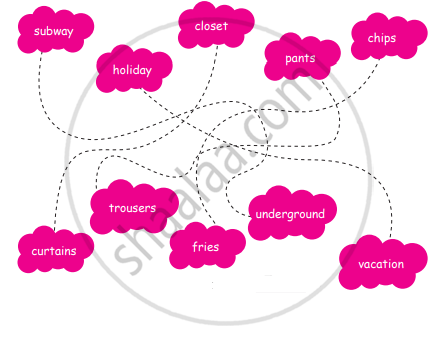
| subway | |
| holiday | |
| closet | |
| pants | |
| chips |
The brush ______ to her will.
One day Chris tried to draw a ______.
What did Helen learn when the teacher put her hand into running water?
How did the boy enjoy the company of the tree?
The passage given below is on Kabbadi. Read the passage and complete the activities that follow.
Kabbadi (கபடி - in Tamil) is a contact team sport that originated in Tamil Nadu, India. It is the national sport of Bangladesh. It is also popular in South Asia and is the state game of the Indian states of Tamil Nadu, Kerala, Andhra Pradesh, Bihar, Haryana, Karnataka, Maharashtra, Punjab, and Telangana.
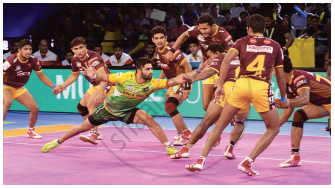
Kabbadi is played between two teams of seven players: the objective of the game is for a single player on offence referred to as a 'raider', to run in to the opposing teams half of a court, tag out as many of their defenders as possible, and return to their own half of the court–all without being tackled by the defenders. Points are scored for each player tagged by the raider, while the opposing team earns a point for stopping the raider. Players are taken out of the game if they are tagged or tackled, but can be 'revived' for each point scored by their team from a tag or tackle. The raider should hold his breath and utter the words like 'kabbadi kabbadi, hututu hututu, chadu kudu' etc. while the opponents try to catch him. If he stops uttering these words, he is considered out.
The game is known by its regional names in different parts of the subcontinent, such as Kabbadi or Chedugudu in Andhra Pradesh, Kabbadi in Kerala and Telangana, Hadudu in Bangladesh, Bhavatik in Maldives, Kauddi or Kabbadi in the Punjab Region, Hu-Tu-Tu in Western India and Hu-Do-Do in Eastern India and Chadakudu in South India. The highest governing body of Kabbadi is the International Kabbadi Federation.
Given below is the visual presentation of the first paragraph.
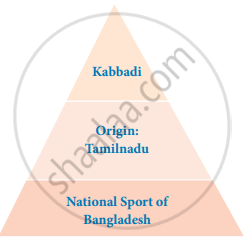
i) Represent the other paragraphs in a visual form of your choice(flow chart, mind-map, pie-chart, etc.).
ii) Choose the correct option.
1. A contact sport usually involves a ______contact between players.
- violent
- gentle
- physical
2. Kabbadi is a game played between ______.
- seven teams of two players
- two teams of seven players
- four teams of seven players
3. A single ______.
- player on offence is referred to as a raider
- offence is referred to as a raider
- raider is an offence by the player
iii) Answer the following.
- How does a raider score points for his team?
- When does a raider concede a point to the opponent team?
- Can a player be revived when he/she is out of the game? Explain your answer.
- Kabbadi is called by different names in different parts of India. Do you know how Pallankuzhi is called in Karnataka, Andhra Pradesh and Kerala?
Read the extract and complete the activities given below:
|
“I don’t believe in taking the right decisions. I take decisions, I take decisions and then make them right:” One of them make them right. One of Ratan Tata’s inspiring words which made me dream beyond shadows. I feel fortunate that I discovered him in the early stage of my life, and now I am using his teachings to mould my future the way I want. Even though Ratan Tata was born into a very posh family in India, he never took money and power for granted. He graduated from Riverdale country from New York, Ratan Tata began his career in the Tata Group working on the shop floor of Tata Steel. After working for almost 10 years, he was appointed as the director-in-charge of the National Radio and Electronics Company Limited (NELCO) in order to help its struggling finances. He worked hard to build a better consumer electronics division, but the economic recession and union strikes prevented him from achieving success, and this success helped Tata to be appointed as the chairman of the Tata Group of companies. He started with a very basic job in his father’s company, and today he owns a billion-dollar company. The tag of greatness does not come without making any sacrifices, and this tag on Ratan Tata suits to its best. Tata Group launched its passenger car Tata Indica in the year 1998 but Tata Indica was a failure in its first year, and the experiment seemed to be failing. Many people started advising Ratan Tata that he should sell the passenger car business. Ratan Tata also agreed to this, and a proposal was given to Ford; they showed interest too. The three-hour meeting at Ford headquarters in Detroit, chairman of Ford (Bill Ford) said to Ratan Tata, “Why did you enter in the passenger car business when you were not knowing of it. It will be a favour if we buy this business from you.” Ratan Tata decided to move back home. While travelling, he was very tense as the feeling of being insulted was on his mind. After earlier failures, Tata Motors did well with its business of passenger cars but in the same period, Ford did very bad. In 2008 when Ford was on it way of bankruptcy, Tata Group offered Ford to buy its luxury car brand, Jaguar Land Rover. Ford arrived in Mumbai for the meeting. In the meeting, Bill Ford said to Ratan Tata, you are doing a big favour for us by buying-Jaguar-Land Rover is now owned by Tata Group and is currently making profits. |
A1. Rewrite the following sentences as per their occurrence in the extract: (2)
- He was appointed as the Director-in-charge of the National Radio and Electronics Company Limited.
- Tata Group launched its passenger car “Tata Indica” in the year 1998.
- Billi Ford said to Ratan Tata, "You are doing a big favour for us by buying Jaguar-Land Rover."
- He graduated from Riverdale country from New York.
A2. Explain: (2)
The writer says, "I don't believe in taking right decisions. I take decisions and then make them right."
A3. Give reasons: (2)
Ratan Tata decided to sell his passenger car business.
A4. Personal Response: (2)
Right decision at the right time is important success. Express your opinion.
A5. Grammar: (2)
Do as directed:
- He worked hard building a better consumer electronics division.
(Rewrite the sentence using the infinitive form of the underlined word) - Tata Group launched the passenger car Tata Indica.
(Rewrite it beginning with 'The passenger car Tata Indica......')
A6. Vocabulary:
Give antonyms.
- Profit × ______
- Prevent × ______
Read the passage below:
| 1. | Our history makes it evident that the Indian Plastics Industry made a vigorous beginning in 1957 but it took more than 30 years for it to pervade Indian lifestyles. In 1979, "the market for plastics' was just being seeded by the state-owned Indian Petro-Chemicals and it was only in 1994 that plastic soft drink bottles became a visible source of annoyance. |
| 2. | In the same year, people in other cities were concerned about the state of public sanitation and also urged regulatory bodies to ban the production, distribution and use of plastic bags. However, the challenge was greater than it appeared at first. |
| 3. |
The massive generation of plastic waste in India is due to rapid urbanisation, spread of retail chains, plastic packaging from grocery to food and vegetable products, to consumer items and cosmetics. The projected high growth rates of GDP and continuing rapid urbanisation suggest that India's trajectory of plastic consumption and plastic waste is likely to increase.
|
| 4. | According to the United Nations Environment Programme (UNEP) report of 2018, India stands among few other countries like France, Mongolia and several African countries that have initiated total or partial nationallevel bans on plastics in their jurisdictions. On World Environment Day in 2018, India vowed to phase out single-use plastics by 2022, which gave a much needed impetus to bring this change |
| 5. | In this context, thereafter ten states (Andhra Pradesh, Chhattisgarh, Gujarat, Himachal Pradesh, Karnataka, Madhya Pradesh, Meghalaya, Odisha, Rajasthan and Tamil Nadu) are currently sending their collected waste to cement plants for co-processing, twelve other states/UTs are using plastic waste for polymer bitumen road construction and still four other states are using the plastic waste for waste-to-energy plants and oil production. A world of greater possibilities has now opened up to initiate appropriate and concrete actions to build up the necessary institutions and systems before oceans turn, irreversibly into a thin soup of plastic. |
| 6. | However there is no one single masterstroke to counter the challenges witnessed by the staggering plastic waste management in the country. The time is now to formulate robust and inclusive National Action Plans and while doing so, the country will establish greater transparency to combat the plastic jeopardy in a more sustainable and holistic way. |

Based on your understanding of the passage answer any six out of the seven questions given below:
- What does the writer mean by 'visible source of annoyance'?
- Why did people demand a ban on plastics?
- What created a demand for plastics in India?
- With reference to the graph write one conclusion that can be drawn about the production of plastics in 2019 (approximately).
- What does the upward trend of the graph indicate?
- What does the line, oceans turning 'irreversibly into a thin soup of plastic', suggest?
- What step must be taken to combat the challenges of plastic waste management? What will be its impact?
Based on the poet’s idea of true success, think of four people in your surroundings - your family, neighbours, friends, teachers, classmates, etc. who have achieved true success. Write, in short, what makes them successful.
