Advertisements
Advertisements
Question
Study each of the following sentences and notice the balance between its parts. Pick out other sentences in the text that reflect this kind of balance
a. It is right that a false Latin quantity should excite a smile in the House of Commons; but it is wrong that a false English meaning should not excite a frown there.
b. Let the accent of words be watched, by all means, but let the meaning be watched more closely still, and fewer will do the work.
Advertisements
Solution
1. A book is essentially not a talked thing but a written thing; and written, not with the view of more communication, but of permanence.
2. They do not give it to you by way of help, but of reward, and will make themselves sure that you deserve it before they allow you to reach it.
3. You may dig long and find none; you must dig painfully to find any.
4. You might read all the books in the British Museum (if you could live long enough), and remain an utterly ‘illiterate’, uneducated person; but that if you read ten pages of a good book, letter by letter that is to say, with real accuracy you are forever more in some measure with an educated person.
APPEARS IN
RELATED QUESTIONS
Answer the following in 200-250 words :
Describe the relationship between Anne and Margot?
Tick the statement that is true.
The story hinges on a particular historical event.
This play, written in the 1950s, is a humorous and satirical depiction of the status of the mother in the family.
What are the issues it raises?
complete the following sentence.
Ajoy reported about ________________.
Make a list of the preparations made for an assault on Tiger Hill.
After confirming the multidirectional assault as the best strategy the commanding officer ________________.
Make a list of the preparations made for an assault on Tiger Hill.
Bofors guns _____________.
Think and answer in your own words in your notebook.
Does the poem urge us to protect only worms? What is the general message conveyed through this poem?
A small thought, put in action, led to a great achievement. Pick out the lines from the beginning and end of the poem and explain their significance.
Correct the following statement.
The real ivy leaf did not fall off at all.
‘The city now, doth, like garment wear’. The poet imagines that the city is wearing a beautiful garment. Hence, the figure of speech is personification. Find out more examples of personification from the poem.
Say where . . . . . . .
______ do the cows and sheep stand?
Say where . . . . . . .
______ does Beauty’s smile begin?
Write a sentence each about three of your friends. Each time you should say what your friend cannot do, and yet, pay a compliment to your friend.
Draw a picture of the scene described in the poem.
What could have happened to the one who flew away? Who was she?
Comment on the given statement after reading the given dialogue -
And if we get him itself, nothing but abuse on our heads for it from the people, and maybe from our own relations -
you may begin like this
We do not think about society at large _________________________________________________.
Write short note on the following:
The 1883 eruption
Are there any stories/legends about the moon or special names for the moon in your language? Talk to your friends and family members and collect this information.
Discuss and write 1-2 lines about the following,
Yonamine’s ideas about marriage.
Find the meaning of ‘Charity begins at home’. Find other sayings which have a similar meaning.
We all follow a class time table made by the school. Imagine for a minute what will happen if there was no time table for your class.
Read the following sentence aloud. Write who said it and to whom.
“Would you lend me this, just this?”
Think and answer:
Are the boys and girls happy that it is raining?
Complete the following sentence with reference to the passage.
At the back rose the high peak of Mount Ida, from which _______________.
From the poem, find three lines that use comparisons.
• ______ • ______ • ______
‘And calls our Best away’ is a gentle way of expressing the unpleasant idea of a loved one dying. It is an example of euphemism. Think and write down 3 or 4 ways in which we can express the idea of ‘death’ in a tactful and gentle manner.
- _________________
- _________________
- _________________
- _________________
List the various ways of avoiding the errors mentioned in the passage.
Listen carefully and guess how the sentence would end.
This step is broken. Please be ______.
What does a farmer need most for his fields?
What did Ahmad tell Kasim when he dug a channel and began to draw water?
Why should we speak gently?
They may have______ in______.
- soft
- vain
- fear
- joy
- love
- heard
- toiled
- mild
- good
- sand
- life
- harsh
Look at the number pattern. Fill the blank in the middle of the series or end of the series.
ELFA, GLHA, ILJA, ______, MLNA
Look at the number pattern. Fill the blank in the middle of the series or end of the series.
QPO, NML, KJI, ______, EDC
Neerja leapt into action when she______.
Give an example for dazzling light.
Work in pairs and answer the following.
Write the rhyme scheme of the poem.
Read the lines and answer the question given below.
Here is a child who clambers and scrambles,
All by himself and gathering brambles;
- Where do you think the child is?
- What does ‘gathering brambles’ mean?
Identify the speaker/character.
They somehow managed to put him on the platform.
You don’t need ______ and ______ in the Earth.
Name the planets the poet flies through.
What is our core?
Try your own.
Vicky's dad bought a ______ robot.
Who sews the cloth?
The old man helped ______ and ______.
Look at the picture and Choose the correct word.

Choose what the elephant did.
______hem the border.
Why did he grow crops?
______ over heard her father’s talking on the phone about the robbery.
Moles dig ______ to catch earth worms.
Leafcutter ants can carry leaves that weigh ______ times of their body weight.
Why do the leafcutter ants grow the fungus?
Kamali gave her savings to______.
Recite the poem The Painter with correct intonation.
Read the passage carefully and complete the activities:
A1. Complete the following sentences. [2]
- Female sparrows lay ______.
- Sparrows build their nest out of ______.
- The eggs are ______.
- In cities, sparrows build their nest in ______.
|
A sparrow is a small bird which is found throughout the world. There are many different species of sparrows. Sparrows are only about four to six inches in length. Many people appreciate their beautiful songs. Sparrows prefer to build their nests in low places-usually on the ground clumps of grass low trees and low bushes. In cities, they build their nests in building nooks or holes. They rarely build their nests in high places. They build their nests out of twigs grasses and plant fibers. Their nests are usually small and well-built structures. Female sparrows lay four to six eggs at a time. The eggs are white with reddish-brown spots. They hatch within eleven to fourteen days. Both the male and female parents care for the young. Insects are fed to the young after hatching. The large feet of the sparrows are used for scratching seeds. Adult sparrows mainly eat seeds. Sparrows can be found almost everywhere where there are humans. Many people throughout the world enjoy these delightful birds. The sparrows are some of the few birds that engage in dust bathing. Sparrows will first scratch a hole in the ground with their feet then lie in it and fling dirt or sand over their bodies with flicks of their wings. They will also bathe in water or in dry or melting snow. Water bathing is similar to dust bathing with the sparrow standing in shallow water and flicking water over its back with its wings also ducking its head under the water. Both activities are social with up to a hundred birds participating at once and are followed by preening and sometimes group singing. |
A2. How do sparrows take a bath? [2]
A3. Find out adjectives for the following nouns from the passage. [2]
- ______ Song
- ______ Water
- ______ Bird
- ______ species
A4. Do as directed. [2]
- A sparrow is a small bird which is found throughout the world.
(Underline the subordinate clause) - Female sparrows lay four to six eggs at a time.
(Frame a ‘wh’ type question to get the underlined part as an answer.)
A5. ‘We have to save the birds.’ Do you agree with this statement? Why? [2]
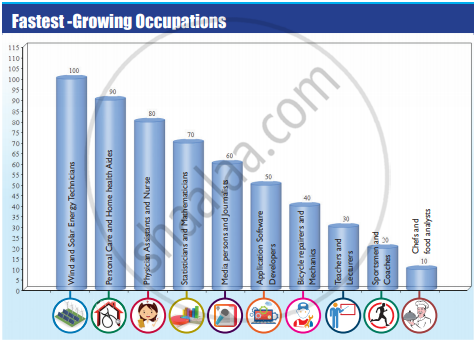
Look at the following non-verbal representation. Based on your understanding and inference, write a paragraph on career trends in the next decade.
Arrange a ‘Jokes’ session in the classroom where each student tells a joke. The jokes must be told in English.
