Advertisements
Advertisements
प्रश्न
Study each of the following sentences and notice the balance between its parts. Pick out other sentences in the text that reflect this kind of balance
a. It is right that a false Latin quantity should excite a smile in the House of Commons; but it is wrong that a false English meaning should not excite a frown there.
b. Let the accent of words be watched, by all means, but let the meaning be watched more closely still, and fewer will do the work.
Advertisements
उत्तर
1. A book is essentially not a talked thing but a written thing; and written, not with the view of more communication, but of permanence.
2. They do not give it to you by way of help, but of reward, and will make themselves sure that you deserve it before they allow you to reach it.
3. You may dig long and find none; you must dig painfully to find any.
4. You might read all the books in the British Museum (if you could live long enough), and remain an utterly ‘illiterate’, uneducated person; but that if you read ten pages of a good book, letter by letter that is to say, with real accuracy you are forever more in some measure with an educated person.
APPEARS IN
संबंधित प्रश्न
He asked. Boy, did he ask! First he asked me for a chance, then he asked nearly all the people he came across if they wanted to buy a telephone system from him. And his asking paid off. As he likes to put it, “Even a blind hog finds an acorn every once in a while.” That simply means that if you ask enough, eventually someone will say ‘yes’.
He cared. He cared about me and his customers. He discovered that when he cared more about taking care of his customers than he cared about taking care of himself, it wasn’t long before he didn’t have to worry about taking care of himself.
Most of all, Cowboy started every day as a winner! He hit the front door expecting something good to happen. He believed that things were going to go his way regardless of what happened. He had no expectation of failure, only an expectation of success. And I’ve found that when you expect success and take action on that expectation, you almost always get success.
Cowboy has made millions of dollars. He has also lost it all, only to get it all back again. In his life as in mine, it has been that once you know and practice the principles of success, they will work for you again and again.
He can also be an inspiration to you. He is proof that it’s not environment or education or technical skills and ability that make you success. He proves that it takes more: it takes the principles we so often overlook or take for granted. These are the principles of that Ya Gotta’s for success.
Question:
(1) What was the cowboy’s motto?
(2) What did the cowboy learn after he lost millions of dollars?
(3) Why did the cowboy firmly believe that asking would pay off?
(4) When you expect success and take action on that expectation you almost always succeed. [Name the part of speech of the underlined words]
(5)
(a) He cared about me and his customers. [Rewrite using ‘not only ……………….but also’’]
(b) Cowboy has made millions of dollars [Add a question tag]
(6) In what way is the cowboy a source of inspiration for you?
Read the extract and do the activities that follow:
The duke senior and his follower were sitting down to a meal one day when Orlando rushed out from among the trees, his sword in his hand. ‘Stop, and cat no more!’ he cried. The Duke and his friends asked him what he wanted.
‘Food,’ said Orlando. ‘I am almost dying of hunger’. They asked him to sit down and eat, but he would not do so. He told them that his old servant was in the woods, dying of hunger. ‘I will not eat a bite until he has been fed,’ Orlando said.
So the good Duke and his followers helped him to bring Adam to their hiding-place, and Orlando and the old man were fed and taken care of. When the Duke learned that Orlando was a son of his old friend sir Rowland de Boys, he welcomed him gladly to his forest court.
Orlando lived happily with the Duke and his friends, but he had not forgotten the lovely Rosalind. She was always in his thoughts andevery day he wrote poetry about her pinning it on the trees in the forest. ‘These trees shall be my books,’ he said, ‘so that everyone who looks in the forest will be able to read how sweet and good Rosalind is’.
Rosalind and Celia found some of these poems pinned on the trees. At first they were puzzled, wondering who could have written them; but one day Celia came in from a walk with the news that she had seen Orlando sleeping under a tree, and she and Rosalind guessed that he must be the poet. Rosalind was happy to think that Orlando had not forggoten her, because she loved him as much as he loved her.
A1. Complete - (2)
Complete the following sentences:
(i) Rosalind was happy to think _______
(ii) The Duke and his followers helped Orlando to bring _________
(iii) Orlando pinned the poems written about Rosalind on ______
(iv) When the Duke cam to know that Orlando was a son of his old friend, he _________
A2. Write a gist: (2)
Write a gist of the above given extract in about 50 words.
Read the following extract and do the given activities:
B.1) Fill in the Balloons with suitable ideas from the poem:
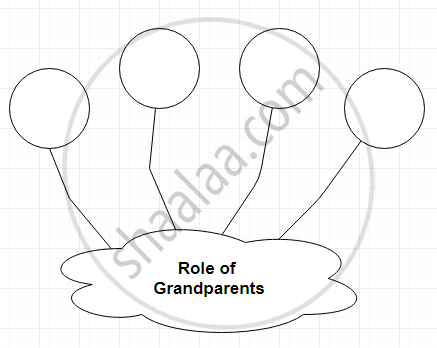 “Oh, the value of the elderly! How could anyone not know?
They hold so many keys, so many things they can show.
We all will read the other side this I firmly believe
And the elderly are closest oh what clues we could retrieve.
For their characters are closest to how we’ll be on high.
They are the ones most developed, you can see it if you try.
They’ve let go of the frivolous and kept things that are dear
The memories of so sweet, of loved ones that were near.
As a nation, we are missing our greatest true resource,
To get to know our elders and let them guide our course.”
B.2) Find Evidence:
Pick out the line from the extract which supports the given ideas:
(i) The elders have many things to share.
(ii) Everybody knows the value of elderly people.
(iii) The elderly people have vast experience.
(iv) The elderly people are a boon to the nation.
B.3) Write a pair from the extract that rhymes with the given word:
| Fear | ........................... | .......................... |
Answer the following question in 150-200 words:
How did Miss Sullivan help Helen Keller when she was studying at Cambridge School?
Give reasons for the following statement.
Tibetan mastiffs were popular in China’s imperial courts.
Look at the words given in the box below
|
snigger |
wriggle |
sneak |
squeak |
|
squawk |
titter |
pant |
chuckle |
|
giggle |
jeer |
chortle |
guffaw |
|
sigh |
sidle |
boo |
shriek |
|
scramble |
croak |
straggle |
plod |
|
gasp |
|
|
|
Now classify them according to their closeness in meaning to the words given below
|
A |
B |
C |
D |
E |
|
snigger |
wriggle |
squeak |
jeer |
sigh |
The episode has been narrated in a light vein. What social mores does the author seem to ridicule?
We 'draw up a deed'. Complete the following phrase with an appropriate word.
________one's word
What impression would you form of a state where the King was 'just and placid'?
What would you say are 'the finer growths' that the story supports in a novel?
Read the poem and write 3 qualities of the following.
Answer in your own words.
What did Revathi discover about her balsam plants?
Make a list of the preparations made for an assault on Tiger Hill.
Bofors guns _____________.
The poem expresses feelings of serenity. Pick out expressions from the above poem that express the same.
Discuss in your class.
Name some gadgets and appliances that we use in day-to-day life?
Honey-bees live an organized life like human beings. Discuss what work the following honey-bees do, as per the poem. Write it down in your own words, in your notebook.
- King/Emperor bee
- Magistrate bees
- Merchant bees
- Soldier bees
- Mason bees
- Civilian bees
- Porter bees
- Judge bee
Say WHY. . . . . .
Ramanujan had to be hospitalized.
Guess the meaning of the following words and phrases:
untold wealth, closest to the Emperor’s heart, grave offence, banish.
Apart from the children, no other human beings are mentioned in the poem. However, many natural elements are shown to act like persons. Name them and also write what they do.
Suggest what you would do in the following situation:
You are going through a crisis that is making you short-tempered and impatient, due to which you end up causing harm to your family and friends. They have started complaining about it quite often.
What is described in the poem?
The description of the character is given below. Identify the character from the play. Find some sentences which support your choice.
He is a brave but irresponsible person.
What question did Shalihotra ask Sushruta?
Write a short note on the following:
Utilization of animal by-products in the ancient world.
Name the white and bright things mentioned in the poem.
Listen and complete:
Close your books. The teacher will dictate some lines from the poem. She will say the first half and you have to write the entire line/verse.
- I know a funny ____________ As quiet as a ____________ Who does the mischief that is done ____________.
- There’s no one ever sees his face, And yet we all ____________ That every plate we break was ____________ By ____________.
Write about what you would like to do if ‘Time’ was your friend.
Form groups of five and discuss:
There are many things that seem small, minor, or insignificant to some people but the same may be the cause of great pain, suffering for others. Can you list such things? What can you do to provide help on those occasions?
Sayali was travelling in space for the first time.
Which other things in nature can say –
'For men may come and men may go,
But I go on for ever.'
Write in your own words.
In which professions is a person forced to stay away from his home/ homeland for a long time? Try to guess why the poet is forced to stay away from his home?
List the insects, birds, trees and plants mentioned in the poem.
List the characters in the story and write a few lines about each of them.
Draw a diagram to explain the idea of Internet.
Guess the meaning of the following word.
fragrant
Miranda was brought to the island ____________ years ago.
How was Gonzalo helpful to Prospero when he left Milan?
The rich man was from...
What other various pets did Somu have?
How were offerings carried during the ancient period?
Rearrange the following jumbled sentences in the correct order.
- Payal’s house was a home for abandoned animals.
- It was a small ball of brown and grey.
- She found an owlet in one corner.
- Payal’s mother picked her up gently.
- Payal’s mother opened the carton.
- One day they got a carton.
Who is Muthu?
Women should not be compared with men in cricket, says Mithali.
They went out through the broken windows.
What did Anandhan want to become?
What is our core?
Choose the correct option from the given homophones.
The wind ______off the leaves.
Write the rhyming word.
Nature - ______.
______ over heard her father’s talking on the phone about the robbery.
Who is incharge of this case?
Read the advertisement and answer the question given below.

What is the advertisement about?
Teddy took his pillow as a sign of ______ them.
What did Kani realize in the story?
Moles trap worms and store them.
What are things that we can save? Why should we save them?
Rani thought of herself as a _______ engineer.
Senthil bought a ______ from his savings.
What did the animals do when they saw the blue jackal?
Who according to Gandhi, can fight against evil and how?
