Advertisements
Advertisements
प्रश्न
Why do you think Paul's mother was not satisfied with the yearly birthday gift of 1,000 pounds for five years.
Advertisements
उत्तर
The incident defines a great deal of the character of Hester, Paul's mother. A beautiful woman though she was, who started with all advantages, had no luck. Thus, dissatisfied as she was for her husband not being able to fulfill her desires for a lavish lifestyle. She felt that her household and her children had been thrust upon her and should not love them. Thus, Paul did for her what his father could not do. He earned her money through his luck. He was desperate to prove it to her that he was worthy of it. So, he decided to give her mother his hard-earned 5,000 pounds discretely. Uncle Oscar and Paul brought up a scheme that they would give Hester 1000 pounds for five years on her birthday. However, as the mother was under debt, rather than trying to discover who was being generous towards her, she asked for the 5,000 pounds all in once to end her debt. It seems that Hester was not the one to learn from her lessons and so she returned to her lavish lifestyle not treading carefully and did not save anything for a rainy day. She was not a lady to be satisfied. She knew from the beginning that she and her husband had a little income and thus should have altered their lifestyle. However, she blamed it all on her husband for being unlucky and never loved or supported her family.
APPEARS IN
संबंधित प्रश्न
Answer the following in 30-40 words each:
(a) Why do you think the booking clerk refused to accept the money? Why did the narrator get out so fast?
(b) Why could the Russian research vessel, ‘The Akademik Shokaskiy’ not move any further? What did the captain decide then?
(c) What sort of hunts did the Maharaja offer to organize for the high-ranking British officer? What trait of the officer does it reveal?
(d) What did Jo want the wizard to do when Mommy Skunk approached him?
Answer the following question in 120-150 words :
Mrs. Hall is greedy but efficient in her business.
Attempt a character sketch of Mrs. Hall.
A1 Web :
Complete the following web with the help of the passage :
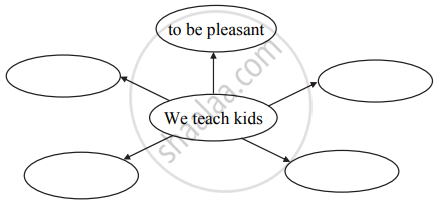
My dictionary tells me that personality is the “Personal or individual quality that makes one person be different and act differently from another.” Personality is, “the total physical, intellectual and emotional structure of an individual, including abilities, interests, and attitudes.”
There are many benefits to having a pleasant personality. There is only one opportunity to make a first impression, and all of us instinctively make decisions or judgments about an individual within the first few seconds of crossing paths. With that in mind, I believe when we teach our kids to smile, to be pleasant and cheerful, to be courteous and respectful of others, to pleasantly respond to requests or questions, we are helping them develop a personality that will open many doors for them. Once the doors are opened, the character will keep them open; but personality, not character, is on display in the first few seconds. Therefore, it’s important to develop a pleasant personality and use it for life.
A2 Personality :
Personality of an individual is recognized by :
(i) _______ (ii) _______
(iii) _______ (iv) _______
A3 Vocabulary :
Find out words for the following from the passage and write:
(i) polite =
(ii) relating to feelings =
(iii) to do anything naturally without thinking =
(iv) a chance to do something =
A4 Complete the following table :
| Noun | Adjective | Adverb |
| – | different | differently |
| Instinct | – | instinctively |
Select any word from the table and use it meaningfully in a sentence of your own.
A5 Personal Response :
Why do you thing, personality development is necessary?
Comment on the influence of English – the language and the way of life – on Indian life as reflected in the story. What is the narrator's attitude to English?
Discuss the following in pairs or in groups of four:
Because India's tribal communities are basically bilingual there is a danger of dismissing their languages as dialects of India's major tongues.
Why did Ajamil refuse to meet the sheepdog's eyes?
Name the world-famous personality who reached great heights despite of humble circumstances.

In Gujarat, the kite - festival is celebrated to welcome the Spring.
Write a short note on Emperor Akbar.
Visit a library:
Read the biographies of other Indian Saints. Share at least one story from their life with your friends. What message does it contain?
Draw a character sketch of Oberon as an enemy of his wife but a friend of the lovers.
Mayor Peter Stockmann is a contrast to Dr. Thomas Stockmann. Justify.
Have you seen a newborn young one of an animal?
What do the following event/action tell us about the characters? Discuss.
Arthur agreed to bring Sir Kay a sword at once.
Find the meaning of the following word.
thee
Prepare similar word chains using the following ideas.
wind - breeze __________________.
Read the passage and name the following.
He persuaded Helen to elope with him.
Talk about the good qualities of any one person you do not like. (You need not name the person.)
Choose the appropriate phrase to insert in the gap, to make the sentence meaningful. Use the appropriate form of the verb.
After I took the medicine, I ______ ______ the pain.
Find from the Internet and write down.
From which play is this song extracted?
Put the following events in proper order.
- Holmes and others go to the bank.
- Clay digs a tunnel.
- Ross closes the office of the 'Red-headed League'.
- Holmes catches the criminal Clay.
- Clay and Ross enter the cellar to steal the gold.
- The bank received a lot of gold from the Bank of France.
- Holmes visits the area around Mr. Wilson’s shop.
Using the following points frame a character sketch of the narrator. Support each character trait with instances from the lesson.
- Diffident and timid
- Unusual behavior
- Ignorant about banking
- Nervous and careless
- Economical.
Find out how the following game is played.
Hockey
Write other meaningful words that begin/end with springtime.
Write other meaningful words that begin/end with gentle-hearted.
What difficulties do the people in the play face in the morning?
Write what the poet is doing.
Does the poet like the experience?
Write the line which tells us about it.
Find out the difference between the fingerspelling method, sign language and Braille.
Read the following line from the poem and answer the question that follow.
Let me but live my life from year to year, With forward face and unreluctant soul; Not hurrying to, nor turning from the goal; Not mourning for the things that disappear.
Identify the rhyme scheme of the given lines.
Who were on the ship? How were they related to Prospero?
Who am I?
Who Am I? is a guessing game where players use ‘yes’ or ‘no’ questions to guess the identity of a famous person. Questions are based upon the traits and characteristics of a person everyone will be able to identify.
Divide the class into groups. One group should decide the personality while the other group should ask ‘yes’ or ‘no’ type questions. To win the game, a team needs to find out the person within 10 clues.
Sample questions to ask. Answers must be ‘yes’ or ‘no’ only
- Are you a male (female)?
- Are you a famous personality?
- Are you a singer (dancer, actor)?
- Are you a historical figure?
- Are you young (old)?
- Are you alive now?
- Does your name start with ‘___’?
- Is he/she ____ ?
What story did grandfather tell them about the haunted hill?
| soft | vain | fear | joy | love | heard | toiled | mild | good | sand | life | harsh |
The ______, the______, which it may bring.
Why did Alice follow the rabbit?
Tackling the Issues
Ask the class to discuss solutions to an issue that plagues contemporary society at large or just your community—for example, homelessness, violence, environmental degradation, hunger.
Half the class should mention idealistic solutions to the chosen issue; the other half should mention only realistic approaches to solving the problem.
See if, in listening to both sides, someone can come up with a proposal that is both realistic and unconventional—an idea that hasn't been tried yet.
Olive Ridleys are the only sea turtles seen on Indian shores.
Grandmother had wanted the peepul tree cut down because______.
Mithali is one of the women players to score seven consecutive 50s.
What did Anandhan want to become?
How can we make our nation proud?
Where was the old man sleeping?
Mother nature gives everything for all ______.
The hen-pigeon returned home when it started to _______.
The bird-catcher had a pigeon in his _______.
What made him frightened?
Uthaman was skilled in _____.
Divide the following word.
man
Circle and write the adverbs.
We will leave today. ______
Circle and write the adverbs.
Suddenly the old man fainted. ______
Pick out the rhyming words and write.
| green | |
| human | |
| will | |
| welfare |
Bala's home doesn't have ______.
What did Bala teach Nithin?
Mugund did not cut the raw wood.
Who was burning with curiosity?
Although Helen could not hear or see, what kind of girl was she?
What was the most important thing that Helen finally understood?
Choose the right word.
Tansen was a famous ______.
Pick out word which mean the same as
not protected (para 2)
Pick out word which mean the same as
keep a check on (para 3)
Make groups of 10-15. In this game, each person writes three sentences about himself/herself, two of which are true and the third one is a lie. Read aloud your sentences, while others guess which two are true and which is a lie.
Examples: Hello, everyone! I am Sonali. I have a brother and a sister. I live in Amalner. We have a pet dog at home.
In the game ‘Two Truths, One Lie!’, it is necessary to use details which can be verified to see whether they are true or false. For example, you cannot use sentences like ‘I once had a blue sweater.’
