Advertisements
Advertisements
प्रश्न
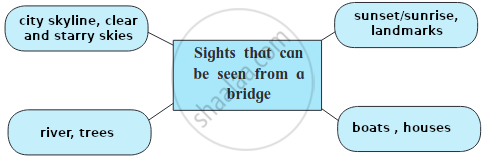
You might have visited a bridge. Complete the web describing the sights you could see from the bridge.
Advertisements
उत्तर

APPEARS IN
संबंधित प्रश्न
Read the passage and complete the activities given below
B1 Complete the table :
A few facts about the Mehendi rituals during marriage ceremonies are given below :
Write them into appropriate columns :
(i) A simple family affair.
(ii) Song and dance performances accompanied by lavish food and entertainment.
(iii) Creative family members, apply Mehendi to the bride.
(iv) Beauticians are appointed to apply Mehendi to the bride.
Fill in the table as :
| Yesteryears | Present times |
| (i) | (i) |
| (ii) | (ii) |
Mehendi enjoys special attention during the wedding. In India, the day before the wedding is devoted exclusively to the elaborate ritual of applying Mehendi on the hands and feet of the bride. This practice is followed in Arab countries as well, except that it is held a few days prior to the wedding day. Songs are woven around the healing properties and lucky omens associated with mehndi are sung by the bride’s family and friends. An age-old belief handed down to generations lays great emphasis on the color of the bride’s Mehendi – a darker color suggests bountiful love and affection from the future in-laws and husband, and for this reason, brides take the pain to ensure that only the best quality henna is used for her wedding day.
The ritual of adorning the bride with henna is a sacred one and in some communities requires the initiation by the mother-in-law. A popular game during marriage function is the search for their names, by the bride and groom hidden within the elaborate pattern on the bride’s hands.
In certain parts of India, the bridegroom has his hands decorated with henna. The Mehendi function during marriages has evolved from simple family affairs of yesteryears to elaborate events of today. A lavish spread of food and entertainment in the form of song and dance performances have transformed it from a small function to a gala prelude. In earlier days, the task of applying Mehendi on the bride was the sole prerogative of creative family members. The demand for intricate and different style now, sees this job outsourced to beauticians skilled in this art. Beauty salons charge according to the style and complexity of pattern desired by the clients.
B2 What is the age-old belief related to the bride’s Mehendi color and its significance?
B3 Find the words :
Find the words from the passage :
| Noun | Verd | Adjectives |
| (i) attention | attend | _______________ |
| (ii) creation | _________________ | creative |
A lot of money is spent nowadays on marriage ceremonies. What is your opinion about it?
Read the following extract carefully and complete the activities given below :
A1 Complete the following :
(i) Books were found on the _____________ and ____________.
(ii) The tales are described as ______________ and __________.
|
Have you forgotten? Don't you know?
We'll say it very loud and slow:
THEY ... USED ... TO ... READ! They'd READ and READ,
AND READ and READ, and then proceed
To READ some more. Great Scott! Gadzooks!
One-half of their lives was reading books!
The nursery shelves held books galore!
Books cluttered up the nursery floor!
And in the bedroom, by the bed,
More books were waiting to be read!
Such wondrous, fine, fantastic tales
Of dragons, gypsies, queens, and whales
And treasure isles, and distant shores
Where smugglers rowed with muffled oars,
And pirates wearing purple pants,
And sailing ships and elephants,
And cannibals crouching 'round the pot,
Stirring away at something hot.
(It smells so good, what can it be?
Good gracious, it's Penelope.)
|
Answer the following question in 200-250 words:
Helen had a great love for animals and birds. Write about this aspect of her character.
Discuss the following statement in groups of two pairs, each pair in a group taking opposite points of view.
Why do you think Professor Gaitonde decided never to preside over meetings again?
This short story revolves around a single important event. Discuss how the narrative is woven around this central fact.
Comment on the way in which the theme of the story has been introduced.
Discuss in pairs or groups of four.
Replacing old machines with new is better than getting them repaired.
'Poets are the unacknowledged legislators of the world'.
People with foibles are often not conscious of them.
How does G. N. Devy bring out the importance of the oral literary tradition?
Read the extract and state whether the following statement is true or false. Correct the false statement.
The author is an example of ‘reverse migration’.
What message does this story bring out for youngsters?
Read the story and complete the following.
When Revathi played her favourite raga, the plants began to move because, ____________.
Read the story and complete the following.
Revathi was confident of proving her ownership of her pot of plants because, ____________.
A small thought, put in action, led to a great achievement. Pick out the lines from the beginning and end of the poem and explain their significance.
Discuss in groups and share with one another.
How your family relaxes on weekends.
Read the first and second stanza of the poem. We understand that the poet wants to suggest the powerful dominance of the planners who shape the town according to their selfish desires. Make a list of such expressions. You may begin with -
- All the spaces are gridded, filled with permutations of possibilities.
- ________________________________
- ________________________________
- ________________________________
Read the lesson and name the following.
The First surgeon to perform operations ______
Fill in the gap, choosing a word from the bracket to make an appropriate comparison.
(tall / quiet / humble / merry / busy / slippery / fast / sly / slow / big)
as ______ as an elephant
What are the clothes compared to? Give two examples.
Correct the given sentence with justification.
Since there is a reference to the Indian boy, there are some scenes from India too.
Show the stages in the process in which Krakatoa collapsed and then Anak Krakatoa formed in the course of volcanic eruptions. Use the flowchart given below.
Write the following:
The sights mentioned in the third stanza.
Form groups of 5-8. This passage tells us only what the compère says. Try to visualize and write what the other people on the dais must have said in their speeches (Write only the main points.)
- The School Principal
- The Chief Guest
- The Art teacher who offered a vote of thanks
Spot and write any three alliterative phrases or sentences from the poem.
(Alliterative phrases/sentences are those in which the same sound is repeated.)
Which other things in nature can say –
'For men may come and men may go,
But I go on for ever.'
Put the following events in proper order.
- Holmes and others go to the bank.
- Clay digs a tunnel.
- Ross closes the office of the 'Red-headed League'.
- Holmes catches the criminal Clay.
- Clay and Ross enter the cellar to steal the gold.
- The bank received a lot of gold from the Bank of France.
- Holmes visits the area around Mr. Wilson’s shop.
Correct the following sentence and rewrite it.
Papa Panov saw the sweeper, the young mother, and the beggars he had helped only once in the morning.
How was Gulliver taken to the city?
Find two examples of the following from the lesson.
A Statement
Find two examples of the following from the lesson.
An Exclamation
Who is a ‘netizen’?
Guess the meaning of the following word.
coarse grained
Read the following line from the poem and answer the question given below.
They growl at that and they growl at this;
Whatever comes, there is something amiss;
- What does the word ‘growl’ mean here?
- Why do they find everything amiss?
What was Mrs. Krishnan busy with?
The parents noticed some changes in the child. What were they?
Read the letter again and write a few lines on each of the following.
- things that the coach taught….
- transformation in the child……..
- things that amazed the writer……..
The wind hurried and passed through the ______
What kind of a life do you want to lead in this world?
If you are a flight attendant how will you deal with the hijackers?
Write a summary based on the flow chart.

Sea turtles come to the shore to ______.
A tiny bird looked for a place to lay her eggs.
_____ is called the red planet.
The boy was rather unsympathetic to his sister.
Jaswant was helped by __________ tribal girls.
Try your own.

Name the character or speaker.
"Why don't you do that yourself?"
Circle the animals which are in the voyage.

Choose the champion of the year.
Match the following.
| pale | ![]() |
| tremble | ![]() |
| fainted | ![]() |
Did they find a new country?
Kani and Teddy were in the garden at _____.
Write the word with same meaning.

tap- ______
How does she move the brush?
Mugund learnt the art from his ______.
Why does the poet feel that the nose is a funny thing?
What was the most important thing that Helen finally understood?
Read the passage given below and answer the questions that follow
Humans have long been fascinated by fiction. We experience excitement in assigning supernatural power to imaginary characters in fictional stories – and so we have Spider man, Batman, He–man, Titans and many more. The ‘Cyborg’ was an offshoot of such wild imagination of humans to invest our species with superhuman powers. Today, the Cyborg is no more an imaginary organism. We are living in a world where a sizeable population of humans have merged their bodies with technological implants. The term ‘Cyborg’, short for ‘cybernetic organism’, was coined to describe a man, whose body is implanted with technological devices to supplement and substitute body functions.
Cyborgs include people with cardiac pacemakers, contact lenses, bionic ears and eyes, prosthetics and so on. In other words, a cyborg is partly human and partly machine. The technological innovations in the field of medicine and healthcare augment humans with machines, producing a beta version of the human body. The advent of brain machine interfaces is certain to blur the boundary between humans and machines. Scientists are working hard to find a technique for age reversal too. People do not want to die, so mankind is striving to get to the final frontier, which is development of machines and devices that would accord man immortality.
The needs of humans are not limited. As time passes, food habits change, thinking patterns change, and even appearances change. We are about to travel by driverless, fully automated vehicles. Computers and smart phones have become our masters. The more we depend and merge with technological advancements, the more the humanness in us slowly erodes. Intelligence is sought to be infused into machines and robotics are designed in such a way to give man a virtual human companion. The field of artificial intelligence is overtaking the human brain and many fear that it could even harm the human race. Despite certain limitations and potential threats, many believe that cyborgs will be the next step in the evolution of mankind. The amalgamation of man and machine is sure to add a new dimension to the life of mankind and this will prove to be the ‘biggest evolution in Biology’ since the emergence of life, four billion years ago.
Questions:
a) Account for the popularity of characters with supernatural powers.
b) Who is referred to as a ‘Cyborg’?
c) What is expected to happen with the advent of the brain machine interface?
d) The needs of humans are not limited. How is this statement elaborated in the passage?
e) How can a machine turn into a virtual companion for humans?
f) Explain the flipside of the rapid technological advancement.
g) Identify the word in para 1 which means ‘everlasting life’.
h) Which of the following words is synonymous with ‘amalgamation’?
- recreation
- integration
- exploration
- proposition
i) Which of the following options is the antonym of the word ‘advent’?
- drawback
- dispute
- departure
- danger
j) Find out the word which is the antonym of ‘natural’ in para 3.
Look up the following entries in the Language Study pages given at the end.
- stress
- intonation
- sound
- consonant
- vowel