Advertisements
Advertisements
प्रश्न
Why is the speaker’s childhood described as ‘a forgotten boredom’?
Advertisements
उत्तर
The autobiographical element makes a reader curious to know about Larkin's childhood. His parents were very loving and affectionate. However, he recalls his childhood as a dejected one. He talks of himself in depreciating terms. It appears that the poet had a very poor concept of himself. It is also known that Philip suffered a slight stammer in childhood that endured for the rest of his life, though reduced. If the reader pays attention, argues John Woley, it is not difficult to note the contradiction in the term “forgotten boredom”. I like Larkin says, he has forgotten his childhood, the question is, how can he comment so confidently that it was a bored one? However, it may be concluded that Larkin's childhood did not have any memories that he was fond of. He even remarked once that his biography could begin when he was 21, which implies that nothing spectacular happened before that. Thus, Philip Larkin recalls his childhood as “forgotten boredom”.
APPEARS IN
संबंधित प्रश्न
Answer the following question in 120-150 words:
How does Dr. Cuss's encounter with Griffin end in a disaster?
Read the passage given below and answer the questions that follow:
The term dietary fibres refers collectively to indigestible carbohydrates present in plant foods. The importance of these dietary fibres came into the picture when it was observed that the people having diet rich in these fibres, had low incidence of coronary heart disease, irritable bowel syndrome, dental caries and gall stones.
The foodstuffs rich in these dietary fibres are cereals and grains, legumes, fruits with seeds, citrus fruits, carrots, cabbage, green leafy vegetables, apples, melons, peaches, pears etc.
These dietary fibres are not digested by the enzymes of the stomach and the small intestine whereas most of other carbohydrates like starch and sugar are digested and absorbed. The dietary fibres have the property of holding water and because of it, these get swollen and behave like a sponge as these pass through the gastrointestinal tract. The fibres add bulk to the diet and increase transit time in the gut. Some of these fibres may undergo fermentation in the colon.
In recent years, it has been considered essential to have some amount of fibres in the diet. Their beneficial effects lie in preventing coronary heart disease, and decreasing cholesterol level. The fibres like gums and pectin are reported to decrease postprandial (after meals) glucose level in blood. These types of dietary fibres are recommended for the management of certain types of diabetes. Recent studies have shown that the fenugreek (Methi) seeds, which contain 40 per cent gum, are effective in decreasing blood glucose and cholesterol levels as compared to other gum containing vegetables.
Some dietary fibres increase transit time and decrease the time of release of ingested food in colon. The diet having less fibres is associated with colon cancer and the dietary fibres may play a role in decreasing the risk of it.
The dietary fibres hold water so that stools are soft, bulky and readily eliminated. Therefore high fibre intake prevents or relieves constipation.
The fibres increase motility of the small intestine and the colon and by decreasing the transit time there is less time for exposure of the mucosa to harmful toxic substances. Therefore, there is a less desire to eat and the energy intake can be maintained within the range of requirement. This phenomenon helps in keeping a check on obesity. Another reason in helping to decrease obesity is that the high-fibre diets have somewhat lower coefficients of digestibility.
The dietary fibres may have some adverse effects on nutrition by binding some trace metals like calcium, magnesium, phosphorus, zinc and others and therefore preventing their proper absorption. This may pose a possibility of nutritional deficiency especially when diets contain marginal levels of mineral elements. This may become important constraints on increasing dietary fibres. It is suggested that an intake of 40 grams dietary fibres per day is desirable.
(Extracted from ‘The Tribune’)
(a) On the basis of your reading of the above passage make notes on it in points only, using recognizable abbreviations wherever necessary. Also suggest a suitable title.
(b) Write a summary of the above in about 80 words.
Read the follow ing extract and answer the questions given below:
Not gold but only men can make
A people great and strong;
Men who for truth and honor's sake
Stand fast and suffer long.
Brave men who work while others sleep,
Who dare while others fly...
They build a nation's pillars deep
And lift them to the sky.
(1) What makes a nation strong?
(2) According to you, what makes India a strong and powerful nation?.
(3) Write down the rhyme scheme used in the extract.
(4) What does the phrase 'others fly ... ' mean?
With reference to ‘The Story of My Life’, describe how a teacher can positively impact a child’s life ?
Tick the statement that is true.
The story is an account of real events.
What impressions of Shahid do you gather from the piece?
While tribal communities may not seem to possess the scientific temper,there are many ideas from tribal conventions that could enrich modern societies.
What were the lessons of life learnt in her younger days that Kumudini carried into her adult life?
Make a list of the preparations made for an assault on Tiger Hill.
Throughout the last week of June 1999, 18 Grenadiers ____________.
Rearrange the following in the proper order and insert them into a flow chart as per the poem.
- The plate turned to lead when it was gifted to false-hearted claimants.
- Many claimants donated their wealth to receive the plate of gold.
- For almost two years, no claimants received the plate of gold.
- A plate of gold fell in a temple from Heaven.
- The peasant offered comfort and courage to a blind miserable beggar, whom all had ignored.
- The priests announced that the one who loved God most of all would receive the gift from Heaven.
- When the priest gave the plate of gold to that peasant, it shone with thrice its luster.
- A simple peasant, who had nothing to offer, came to that temple.
Go through the poem and state whether the following statement is true or false.
The newly planned city looks modern and amazingly beautiful.
Go through the poem and state whether the following statement is true or false.
Planners make tactful changes so that citizens do not recognize familiar landmarks.
Discuss orally in your class.
In what subjects is knowledge of mathematics used, at school level, and college/university level? Name them.
Did you know maths is used in music and poetry also? Can you tell how?
Find at least five other Akbar and Birbal stories and share them with your friends. Make a list of the stories collected by the entire class. Put your list in alphabetical order.
The description of the character is given below. Identify the character from the play. Find some sentences which support your choice.
He is the centre of the play.
Discuss the following question after you have seen a presentation of the ‘ad’.
What would happen if you ate proper meals like rice and dal or dal-roti?
What were the three things that Sushruta discovered?
Write a conversation between a donkey and a horse.
Write a conversation between a donkey and a school boy.
What is your favourite time of the day? Describe it in detail.
Read aloud a paragraph of your choice from the passage.
Draw word webs for the following. Begin with the given word and go on writing as many other words associated with it, as you can. Use these words to write other related words to form a word web.

Turn the story into a play as a group activity and present the scenes in the classroom.
Read the passage and name the following.
He led the defense of Troy for nine years.
List the lines that begin with 'Here' or 'And here'.
Also, list the sentences or phrases that begin with ‘And there’.
These phrases and sentences tell us about things that appear one after the other as the carriage moves. Can we tell which ones are closer to the train and which ones are at a distance? How?
You want to start human settlement somewhere else other than the earth, in the universe. Will you select a star or a planet? Why? What features supporting life will you look for? Try to find answers to such questions and make a presentation using scientific information and your imagination.
Note that most of the time well-known works are parodied, because people can enjoy the parody better when they know the original. Try to find more examples of parodies in English or other languages.
Observe the picture and the labels carefully. Then match the words and the meanings given in the following table.
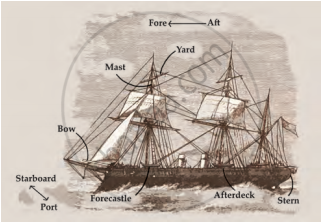
| Words | Meaning |
| 1. yard | (a) a floor, flat area built on a ship |
| 2. mast | (b) the forward part of the main body of a ship |
| 3. bow | (c) the forward part of a deck |
| 4. deck | (d) tall, upright pole on a ship |
| 5. forecastle | (e) a pole slung across a ship’s mast. A sail hangs from a yard. |
| 6. starboard | (f) the rearmost (back) part of a ship |
| 7. stern | (g) the part which is always at the front while the ship is sailing. |
| 8. afterdeck | (h) the right-hand side of a ship as one faces forward |
| 9. fore | (i) an open deck near the back |
Who is the speaker in this poem?
Be a poet. Try to complete the following poem with words that rhyme with each other.
| I’d love to live a life that’s ______ Relax under a shady t______ And fall into a dreamy s______p, With no strict hours, forced to k______ And sing aloud a merry ______, Untrodden paths, as I walk a______g. You ask me what I’d get to ______? Fruits and nuts and berries sw______ You ask me with whom I’d get to p______ Birds and animals, happy and g______ And if a woodcutter put a c______p Firmly, I would put a st______ So that’s the life I’d like l______d Free from worries, free from gr______d |
Find a word that has a similar meaning.
Sorry
What is meant by browsing or surfing?
How did Helen overcome her handicaps?
The parents noticed some changes in the child. What were they?
Match the following.
| 1. | A man of ease | Emanuel |
| 2. | John’s trainer | Lalli and Lolly |
| 3. | Mathew’s secretary | John Mathew |
| 4. | John’s chef | Louise |
| 5. | Mathew’s friends | Basky |
Read the story and fill in the grid by ticking each character’s qualities.
Discuss in pairs to rate the characteristic and give marks from 1 to 10 depending on the grade of each quality.
Justify your views in one or two sentences.
| Characteristics | Jane Eyre | Mrs. Reed | Bessie | Helen Burns | Miss. Temple |
| arrogant | |||||
| bitter | |||||
| caring | |||||
| courageous | |||||
| cruel | |||||
| emotional | |||||
| friendly | |||||
| kind | |||||
| sensitive | |||||
| rich | |||||
| poor | |||||
| patient | |||||
| self-disciplined | |||||
| unjust |
Narrate the story based on the story map
The ________ are trying to terraform Mars.
In this story, what happened to the Earth?
How did the aliens know the boys' language?
Find the rhyming word from the poem.
Country - ______.
Read scene I of the play carefully and answer the question below.
List the characters that appear in the scene. What human characteristics do they exhibit?
Read scene I of the play carefully and answer the question below.
Whom does Mother Wolf talk about? How does she describe him?
Kaliyan worked in a ______.
Write the rhyming word.
Nature - ______.
Akilan’s passion is to learn ______.
Name the character or speaker.
“How did I win the competition with a single stroke?”
Why was the fish floating on top?
Pablo was the dog of ______.
Name the character or speaker.
"Why does Nandhini look so sad?"
Why did Jana’s friends stop her from going near the tree?
Pick out the rhyming words and write.
| green | |
| human | |
| will | |
| welfare |
Why did Manju’s parents leave the village?
What did Kamali get as gift?
Read the passage three times on your own. Colour a Piggy bank each time you read.
Piggy bank is a coin box used by children. The real use of a piggy bank is to store coins. Piggy banks look like pigs. They come in many shapes and sizes. In Tamil, they are known as Hundial. It is a red, mud pot. We can drop the coins into the pot. Once the pot is full, we must break the pot and use the coins. Start saving with your hundial today!

Why did the king want a leader who knows to grow a plant?
Let us learn a few more word by joining the dots. Join the dots and fill the table below.
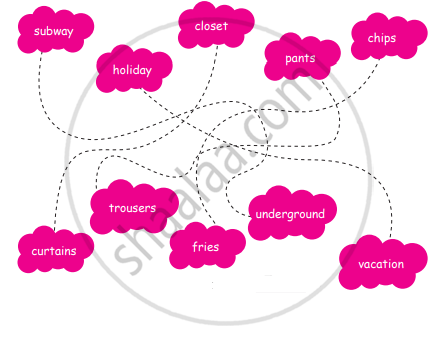
| subway | |
| holiday | |
| closet | |
| pants | |
| chips |
How did Mugund’s mother die?
