Advertisements
Advertisements
Question
Why did she pick up her pace?
Advertisements
Solution
She picked up her pace, as she wanted to win the race.
APPEARS IN
RELATED QUESTIONS
Answer any four of the following questions in 30 - 40 words each:
(a) What does the poet's smile in the poem, 'My Mother at Sixty-six' show?
(b) Listening to them, I see two distinct worlds ... ." In the context of Mukesh, the bangle maker's son, which two worlds is Anees Jung referring to ?
(c) Though the sharecroppers of Champaran received only one-fourth of the compensation, how can the Champaran struggle still be termed a huge success and victory?
(d) Which article in McLeery's suitcase played perhaps the most significant role in Evans' escape and how?
(e) Why does Derry’s mother not want him to go back to visit Mr. Lamb?
(f) What considerations influenced the Tiger King to get married?
Read the following passage carefully and complete the activities given below :
A.1) Complete the web :
Write the words from the passage on the web. 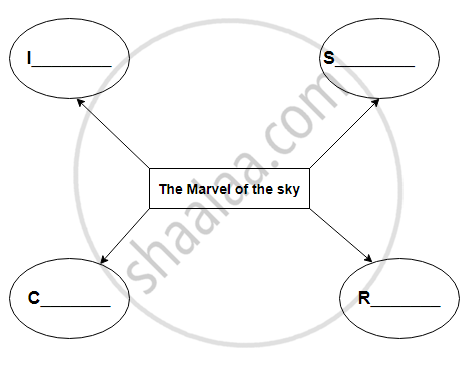
We saw small bits of grass peeping through the small cracks in concrete pavement. It left us thinking: however impossible things may look, there is always an opening…………
We saw a tree bare of all leaves in the cold winter months. We thought its chapter was over. But three months passed, spring set in and the tree was back to its green majesty once again, full of leaves, flowers, birds, and life. What if we too had the conviction that, however difficult things are right now, it will not remain so forever. Remember, this too shall pass.
We saw an army of ants lugging a fly which was at least ten times the ant’s size. The ants organized themselves around the fly, lifted it on frail feelers and carried it to quite a distance. Their teamwork and perseverance were impressive. What if we too are consistent, organized, focused ……… Spider webs are delicate, yet very strong. A rainbow colors the entire sky. Oysters take in a grain of sand they open up with a pearl. Innumerable stars shine across the infinite sky. Clouds take new shapes with every passing moment. The wind makes trees dance with unhindered passion. Water, without a hint of ego, changes its form according to the dictates of the sun and the wind. When we see a caterpillar turn into a butterfly, a flower turns into a fruit, we experience the alchemy of nature ………. We touch it and become gold ourselves.
A.2) Finding meanings :
Write what you mean by :
(i) _______ there is always an opening.
(ii) _______ its chapter was over.
(iii) _______ the tree was back to its green majesty.
(iv) _______ this too shall pass.
A.3) Matching :
Match the words in Column ‘A’ with their synonyms in Column ‘B’:
| Column 'A' | Column'B" | ||
| (i) | conviction | (a) | strong feeling |
| (ii) | alchemy | (b) | delicate |
| (iii) | frail | (c) | mysterious/magical power |
| (iv) | passion | (d) | strong belief |
A.4) Language study :
Rewrite the sentence using the correct question tag given in the brackets :
(i) Water changes its form. (does it?, do it?, do they?, doesn’t it)
(ii) However impossible things may look, there is always an opening. (Rewrite using ‘but’)
A.5) Personal Response :
Nature is the best teacher. Explain.
Is drama a good medium for conveying a social message? Discuss.
Rearrange the following in the proper order and insert them into a flow chart as per the poem.
- The plate turned to lead when it was gifted to false-hearted claimants.
- Many claimants donated their wealth to receive the plate of gold.
- For almost two years, no claimants received the plate of gold.
- A plate of gold fell in a temple from Heaven.
- The peasant offered comfort and courage to a blind miserable beggar, whom all had ignored.
- The priests announced that the one who loved God most of all would receive the gift from Heaven.
- When the priest gave the plate of gold to that peasant, it shone with thrice its luster.
- A simple peasant, who had nothing to offer, came to that temple.
In the following sentence, point out the Main Clause and Subordinate Clause. Encircle the Subordinator.
Old Behrman was a painter, who lived on the ground floor.
Who do you think benefits most from commercial advertisements?
Read the following sentence aloud. Write who said it and to whom.
“Look, here’s something for you.”
Find and read other poems of R. L. Stevenson using the internet. Find other rhythmic poems about trains, in English, or other languages.
How did Zigzag communicate with the Krishnans?
Imagine you are a marketing executive for a company in a specific industry (toothpaste, soup, hair care products, automobiles, etc) and are developing a product with a brand name that refers to a character from the story.
For example: You want to sell bandages that have little pictures of Don Quixote on them. Your company’s name is Kure-All and you decide to call them “Kure-All Quixote Bandages”.
The slogan might be: “Had a tough day with windmills? When you take a fall, use Kure-All.”
You can use exciting words, a catchy new slogan and a jingle among other things to promote sales of your item.
