Advertisements
Advertisements
Question
How does the poem emphasise the physical prowess of the Hawk?
Advertisements
Solution
Ted Hughes' poetry is known for its intense and obsessive fascination with the world of birds and animals. His poems shock us with unusual phrases and violent images. The poet, in the poem Hawk Roosting, presents the reader with a grotesque image of a Hawk whose physical prowess, from the perspective of the hawk itself, is emphasised. The Hawk sits on the topmost branch of a tree in the wood. The egocentric Hawk sees itself at the top of the world. It expresses its superiority through its physiology. The savage features of the Hawk make it appear ferocious and superior to the rest of the living beings. It talks of its “perfect kills and eats” even in its dreams. The fascist Hawk believes that it took the whole of Creation to make it. And now that the roles are reversed, it takes just one flight of it and it can revolve it all round slowly. The fashion in which it exercises its authority by calling the whole of the world its own, it gives itself the solemn right to kill where it pleases. There is no sophistication about the Hawk. He is arrogant and swaggers. His demeanour is not appreciable as he slanders the Sun, showing that even the Sun follows the Hawk. He talks of his eyes as the final authority and that they haven't “permitted no change” since it began. And the Hawk plans to keep it all like this.
APPEARS IN
RELATED QUESTIONS
Read the extract given below and answer the questions that follow:
That for themselves a cooling covert make
"Gainst the hot season; the mid forest brake,
Rich with the sprinkling of fair musk-rose blooms;
..................
(a) Identify the poem and the poet.
(b) What is the role of the clear rills?
(c) How has the mid forest brake become rich?
(d) Name the figure of speech in 'cooling covert'.
Read the extract and do the activities that follow:
The duke senior and his follower were sitting down to a meal one day when Orlando rushed out from among the trees, his sword in his hand. ‘Stop, and cat no more!’ he cried. The Duke and his friends asked him what he wanted.
‘Food,’ said Orlando. ‘I am almost dying of hunger’. They asked him to sit down and eat, but he would not do so. He told them that his old servant was in the woods, dying of hunger. ‘I will not eat a bite until he has been fed,’ Orlando said.
So the good Duke and his followers helped him to bring Adam to their hiding-place, and Orlando and the old man were fed and taken care of. When the Duke learned that Orlando was a son of his old friend sir Rowland de Boys, he welcomed him gladly to his forest court.
Orlando lived happily with the Duke and his friends, but he had not forgotten the lovely Rosalind. She was always in his thoughts andevery day he wrote poetry about her pinning it on the trees in the forest. ‘These trees shall be my books,’ he said, ‘so that everyone who looks in the forest will be able to read how sweet and good Rosalind is’.
Rosalind and Celia found some of these poems pinned on the trees. At first they were puzzled, wondering who could have written them; but one day Celia came in from a walk with the news that she had seen Orlando sleeping under a tree, and she and Rosalind guessed that he must be the poet. Rosalind was happy to think that Orlando had not forggoten her, because she loved him as much as he loved her.
A1. Complete - (2)
Complete the following sentences:
(i) Rosalind was happy to think _______
(ii) The Duke and his followers helped Orlando to bring _________
(iii) Orlando pinned the poems written about Rosalind on ______
(iv) When the Duke cam to know that Orlando was a son of his old friend, he _________
A2. Write a gist: (2)
Write a gist of the above given extract in about 50 words.
We know that chimps are intelligent because
Read the following passage carefully and complete the activities given below :
A.1) Complete the web :
Write the words from the passage on the web. 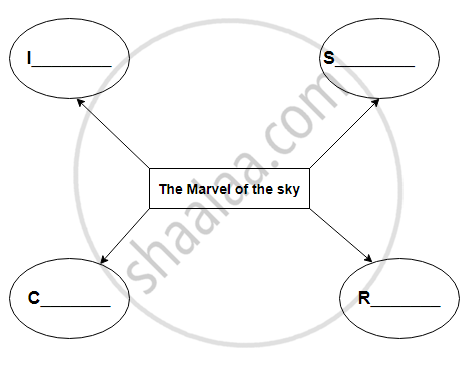
We saw small bits of grass peeping through the small cracks in concrete pavement. It left us thinking: however impossible things may look, there is always an opening…………
We saw a tree bare of all leaves in the cold winter months. We thought its chapter was over. But three months passed, spring set in and the tree was back to its green majesty once again, full of leaves, flowers, birds, and life. What if we too had the conviction that, however difficult things are right now, it will not remain so forever. Remember, this too shall pass.
We saw an army of ants lugging a fly which was at least ten times the ant’s size. The ants organized themselves around the fly, lifted it on frail feelers and carried it to quite a distance. Their teamwork and perseverance were impressive. What if we too are consistent, organized, focused ……… Spider webs are delicate, yet very strong. A rainbow colors the entire sky. Oysters take in a grain of sand they open up with a pearl. Innumerable stars shine across the infinite sky. Clouds take new shapes with every passing moment. The wind makes trees dance with unhindered passion. Water, without a hint of ego, changes its form according to the dictates of the sun and the wind. When we see a caterpillar turn into a butterfly, a flower turns into a fruit, we experience the alchemy of nature ………. We touch it and become gold ourselves.
A.2) Finding meanings :
Write what you mean by :
(i) _______ there is always an opening.
(ii) _______ its chapter was over.
(iii) _______ the tree was back to its green majesty.
(iv) _______ this too shall pass.
A.3) Matching :
Match the words in Column ‘A’ with their synonyms in Column ‘B’:
| Column 'A' | Column'B" | ||
| (i) | conviction | (a) | strong feeling |
| (ii) | alchemy | (b) | delicate |
| (iii) | frail | (c) | mysterious/magical power |
| (iv) | passion | (d) | strong belief |
A.4) Language study :
Rewrite the sentence using the correct question tag given in the brackets :
(i) Water changes its form. (does it?, do it?, do they?, doesn’t it)
(ii) However impossible things may look, there is always an opening. (Rewrite using ‘but’)
A.5) Personal Response :
Nature is the best teacher. Explain.
Briefly comment on:
Tsetan’s support to the author during the journey.
Comment on the influence of English – the language and the way of life – on Indian life as reflected in the story. What is the narrator's attitude to English?
Identify instances in the story that show the business acumen of Ramanand.
How does Shelley's attitude to science differ from that of Wordsworth and Keats?
Explain the contradiction in the similies, ‘Like a child from the womb, like a ghost from the tomb’.
What makes the urgency of the child's demand seem logical?
Identify the lines that reveal the critical tone of the poet towards the felling of the tree.
Make a list of archaic words from the poem and give their modern equivalents.
Discuss in groups and share with one another.
The daily routine of your mother and father on working days.
The term 'Anaesthesia' in the poem means - 'The planner gives beautiful pictures of the new modern city'. Now find out what is Amnesia and Hypnosis in the given context.
Guess the meaning of the following words and phrases:
untold wealth, closest to the Emperor’s heart, grave offence, banish.
Suggest what you would do in the following situation:
You realise that you no longer want to pursue your studies in the stream you have selected.
State the difference between poetry and drama.
Shakespeare is acknowledged as the greatest writer because he understood human nature better than anyone else. Explain the statement in the context of the play.
What is implied in the following phrases or lines?
- A silver house in the lovely sky
- It takes two weeks to build it up
- And two to pull it down.
Read the given extract (Act III)
Complete the following table.
| Sr. No. | Character | Supportive Character | Incident |
| 1. | Dr. Stockmann | (a) ................................. (b) ................................ |
(a) ................................. (b) ................................ |
| 2. | Peter Stockmann | (a) ................................. (b) ................................ (c) ................................. |
(a) ................................. (b) ................................ (c) ................................. |
| 3. | Aslaksen | (a) ................................. (b) ................................ |
(a) ................................. (b) ................................ |
Present any one of the speeches given above.
Who erected the first known veterinary hospitals in the world?
In the novel, the Lethargarians give a whole day’s time table of their activities. Can you guess what it would be like?
Use your own ideas and prepare their time table.
Explain the use of the following property in the development of the play.
An envelope containing the letter
What changes do we see in the life of human beings when the season changes? Write with reference to their clothes.
Find one example of the following given below from the poem: Metaphor
In the last stanza, there are three four-letter words that refer to a beautiful valley.
They are: • ______ • ______ • ______
From the poem, find three lines that use comparisons.
• ______ • ______ • ______
Complete the following phrases with the help of the poem.
- ______ music
- ______ rivers
- ______ breeze
- ______ lake
- ______ citron-trees
List the phrases which have the expression 'many a ______'.
Write in your own words.
How should that person sing?
Imagine the following and write about it in your own words:
What the world looks like to a baby.
Imagine the following and write about it in your own words:
What the world looks like to a fish.
What plans did the wife make?
Write the characteristics of a good listener.
Read the poem and answer the following.
What are the two different ways of eating strawberries?
Write other meaningful words that begin/end with gentle-hearted.
Write how the travellers crossed the second gulf.
What different names is ‘Rangoli’ known by in different regions?
Do you think that the young seagull’s parents were harsh to him? Why?
Describe the struggles underwent by the young seagull to overcome its fear of flying.
Selvi asked, 'Did they come in an aeroplane?' because she______.
Who first brought these vegetables to India?
The war between the two kingdoms ended in peace.
Work in groups. Discuss and have a debate on life in bustling cities and life in calm towns.
He got _________ the disease.
Connect and write the homophones in the box.
|
Sea |
 |
|
One |
 |
|
Flower |
 |


What is the main idea of the story?
Identify the character/speaker.
"Grow the fish at home, Anbu."
Look at the picture and tick Choose the correct word.

Answer using Yes or No and pick sentence from the story to support your answer.
Did Robinson’s ship sink?
The official was transferred.
What do you save? Why it is needed?
The merchants sold things made of______.
Name the things that good merchant offered for the plate
Draw me some hair, quickly, I look like a ______.
Write the correct word.
| rooster, king, hen, tiger, queen, tigress. |
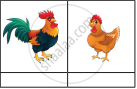
Match the animals with their sounds.
 |
bray |
 |
croak |
 |
bark |
 |
hum |
 |
neigh |
 |
mew |
Do you think Nasruddin was good at archery?
What sort of a boy is described in the poem?
