Advertisements
Advertisements
Question
What do you save? Why it is needed?
Advertisements
Solution
We have to save everything that nature gave. It is needed for our future generations.
APPEARS IN
RELATED QUESTIONS
You notice a sense of urgency in the poet's request – what is the reason for this?
Justify the verdict delivered in the poem.
I can support my answer with the help of the following suitable arguments:
- _______________________
- _______________________
- _______________________
Read the given extract (Act III)
Match column A with column B.
| Sr.No. | A | B |
| 1. | Dr. Thomas Stockmann | Opportunist |
| 2. | Katherine | Vulnerable |
| 3. | Peter Stockmann | Honest and upright |
| 4. | Petra | Coward |
| 5. | Hovstad | timid but supportive |
| 6. | Billing | Cuinng and corrupt |
| 7. | Aslaksen | Courageous |
Shylock was not at all generous.
Visit a library:
Read Lewis Carroll’s book ‘Alice in Wonderland.’
Make adjectives from the following.
- harm
- continue
- believe
- fear
- thought
- wish
- question
- courage
Read the data below and answer the following question.
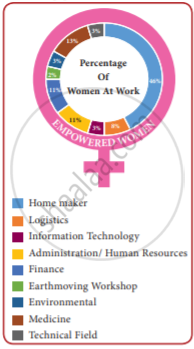
Choose the correct answer.
What is the difference between the percentage of women working in logistics and Medicine?
How will you treat your guest?
Write the correct form for the present perfect tense.
They ______ (start) playing.
Now, read the following passage on “Laughter Therapy” and answer the questions that follow.

- Laughing is an excellent way to reduce stress in our lives; it can help you to cope with and survive a stressful life. Laughter provides full-scale support for your muscles and unleashes a rush of stress-busting endorphins. Since our bodies cannot distinguish between real and fake laughter, anything that makes you giggle will have a positive impact.
- Laughter Therapy aims to get people laughing, in groups and individual sessions and can help reduce stress, make people and employees happier and more committed, as well as improve their interpersonal skills. This laughter comes from the body and not the mind.
- Laughter Yoga (Hasya yoga) is a practice involving prolonged voluntary laughter. It aims to get people laughing in groups. It is practiced in the early mornings in open-parks. It has been made popular as an exercise routine developed by Indian physician Madan Kataria, who writes about the practice in his 2002 book ‘Laugh for no reason'. Laughter Yoga is based on the belief that voluntary laughter provides the same physiological as well as psychological benefits as spontaneous laughter.
- Laughter yoga session may start with gentle warm-up techniques which include stretching, chanting, clapping, eye contact and body movements to help break down inhibitions and encourage a sense of playfulness. Moreover, laughter is the best medicine. Breathing exercises are used to prepare the lungs for laughter followed by a series of laughter exercises that combine a method of acting and visualization techniques. Twenty minutes of laughter is sufficient to augment physiological development.
- A handful of small-scale scientific studies have indicated that laughter yoga has some medically beneficial effects, including cardiovascular health and mood. This therapy has proved to be good for depressed patients. This laughter therapy also plays a crucial role in social bonding.
Answer the following.
a. How does laughter help one to cope with stress?
b. Which word in the text (para 2) means the same as ‘dedicated'?
c. Why do you think voluntary laughter provides the same physiological as well as psychological benefits as spontaneous laughter?
d. ‘Laughter is the best medicine’. Explain.
e. Given below is a set of activities. Which of these are followed in the ‘Laughter Yoga’ technique?
- sitting on the ground with legs crossed
- body movements
- clapping
- closed eyes
- breathing exercises
- chanting
- stretching of arms and legs
- bending backwards
- running/jogging
- eye contact
f. ‘Laughter therapy also plays a crucial role in social bonding’. How?
