Advertisements
Advertisements
Question
Explain the contradiction in the similies, ‘Like a child from the womb, like a ghost from the tomb’.
Advertisements
Solution
A child from the womb signifies the birth, a new beginning whereas the ghost from the tomb is in contrast, implying death or the end.
APPEARS IN
RELATED QUESTIONS
Read the following extract and then do all the activities that follow :
I rain into a stranger as he passed by
“Oh, excuse me please” was my reply.
He said, “please excuse me too; wasn't even watching for you.”
We were very polite, this stranger and I.
We went on out way and we said good-bye.
But at home a different story is told.
How we treat out loved ones, young and old.
Later that day, cooking the evening meal,
My daughter stood beside me very still.
When I turned, I nearly knoked her down.
“Move out of the way,” I said with a frown.
She walked away, her little heart broken.
I didn't realize how harshly I'd spoken.
While I lay awake in bed,
God's still small voice came to me and said,
“While Dealing with a stranger, common courtesy you use,
But children you love, you seem to abuse.”
A1. Order-
The incidents narrated in the extract are arranged in a jumbled manner here, Rearrange them in a proper order as they occur in the extract:
(i) The poet and the stranger went on their way saying good-bye.
(ii) Seeking excuse politely from the stranger, she went her way.
(iii) The poet ran into a stranger on the road.
(iv) The poet yelled at her daughter.
A2. Poetic device:
Make a list of rhyming pairs from the second stanza and note down the rhyme scheme of the same stanza.
A3. Personal Response:
Understanding and politeness are the essentials of out everyday life. Explain your views in brief.
A4. Creativity -
Frame two poetic lines on the following situation using a rhyming pattern with the help of clues given:
“While introducing great personalities, we praise them highly and talk about their qualities, but while speaking
about our friends we may not follow the same trend.”
While introducing great personalities, — a
------------------------------------ — a
But while speaking about our friends, — b
------------------------------------ — b
What caused a blow to man’s ego ?
(a) crushing/destructive (pars 1)
(b) used to (pare 2)
(c) searching (pare 4)
Mention the three phases of the author’s relationship with his grandmother before he left the country to study abroad.
Which language do you think the author and his grandmother used while talking to each other?
|
The energy stored in coal and petroleum originally came to the earth from the sun. The bulk of the present-day supplies was laid down some 200 to 600 million years ago, when tropical conditions were widespread. Lush, swampy forests produced huge trees; warm coastal seas swarmed with microscopic forms of life. When these organisms died, much of their tissue was recycled as it is today — through scavenging and decay. But a significant amount of dead plant and animal material was covered with mud, which prevented complete decomposition. With the passage of time, layer upon layer of the fine sediment was deposited over the once-living material; the sheer weight turned the sediments to rock. Sandwiched between the layers, both coal and petroleum were produced and preserved under pressure. Coal was formed mostly of giant fern-like plants that have only small counterparts today. Coal may still be forming here and there on earth, but conditions are not right for the production of significant quantities. |
Group related points.
Look for a story, a poem and a newspaper article on environment conservation and see how the style of each is different from the other.
Tick the item that is closest in meaning to the following phrase.
to take issue with
Examine the communication channels in the story between Paul and Bassett.
Personification is a figure of speech that attributes human qualities to inanimate things and abstract ideas. How has it been used in the poem?
The title, 'Refugee Blues' encapsulates the theme of the poem. Comment.
What is the poetic technique used by the poet to convey the plaintive theme of the poem?
Divide the class into 5 groups. Each group can prepare a decorative chart/poster using an epigrammatic line from the poem. You may use calligraphy/painting/or Paint program on a computer. (With permission, put up these charts in your school.)
The two best things the servants brought to God were gold and jewel stones.
Correct the following statement.
Sue and Johnsy were good neighbours.
Discuss in groups and share with one another.
How your family relaxes on weekends.
Answer the following question in short.
What did the bundle in silken cloth contain?
Choose the odd one out :
Bottom, Moth, Mustardseed, Cobweb.
Explain the following statement with reference to the context.
And then, once the ring's broken, we'll get to work and show the public every day just how incompetent the Mayor is!
Write the following in short:
The events at the court.
From the passage, find all the words and phrases used to describe the ‘monster’.
These two passages are examples of a short introduction to works of art - a short review. They cover the following points:
- The creator
- The theme or subject matter
- Type of art
- Individual style
- Presentation techniques
- Its effect on viewers
- Message or interpretation
Compare the points with those you used for a book review and the review of a play. Present the comparison in the form of a chart.
| Book Review | Review of a play | Review of a painting |
Rohan had finished ______ rounds of the tree before Mrs. Groover discovered him.
Read the following words aloud and copy them in your notebook.
- idle
- enough
- exclaimed
- commotion
- astounded
- antics
- wander
- wielding
Write other meaningful words that begin/end with snowwhite.
Enact the play.
Form groups of 5-8 and list the following.
Bad habits
What is the world wide web?
Choose a word that has at least four letters in it. Imagine that it is a short form. Write the name /phrase /words it stands for.
For example, STEP : Sunday and Thursday Evening Programmes.
Discuss, why it was considered as an adventurous and dangerous thing to travel in those days?
Write a paragraph on ‘The Grumble Family’ and their attitude towards other folks.
Read the data below and answer the following question.
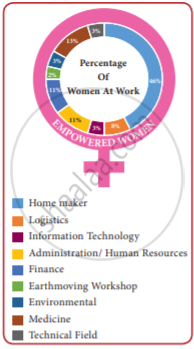
Choose the correct answer.
Identify the three jobs where the same percentage of women work.
What is inclusion? Why is it important?
Read the poem and fill in the blanks with the correct option.
It is better far to rule by ______, than ______.
- soft
- vain
- fear
- joy
- love
- heard
- toiled
- mild
- good
- sand
- life
- harsh
Olive Ridleys are the only sea turtles seen on Indian shores.
Read the lines and answer the questions given below.
Summer comes
in a blaze of heat with
sunny smiles
and dusty feet
- Does the poet welcome the summer? How do you know?
- Which line tells you that there is no rain in summer?
Read the lines and answer the questions given below.
Autumn is English
in red, yellow and brown
Autumn is Indian
Whenever leaves fell down
- How is autumn in India?
- Compare the English autumn with the Indian autumn.
How does Patna differ from Delhi?
Read scene I of the play carefully and answer the question below.
Whom does Mother Wolf talk about? How does she describe him?
Choose the picture for the passage.
| Our national emblem is taken from Ashoka’s pillar at Sarnath. It is found on all government documents, coins, currency notes, postcards, and envelopes. It consists of four lions standing back to back but, we can see only three lions at a time. There is a Dharma chakra in the centre of the base plate, with the figure of a bull in the right and that of a horse in the left. The entire structure is sitting on a lotus. The words ‘Sathyameva Jayate’ is written under it in Devanagari script. These words mean, ‘Truth alone Triumphs’. |
Vicky's father bought a______ robot
Choose the odd one out.
The hen-pigeon returned home when it started to _______.
Who is the guest?
Anbu got ______ fish this week.
Who is the hero of this story?
Uthaman was skilled in _____.
What were the people excited about?
Read the advertisement and answer the question given below.

What is the advertisement about?
What do you save? Why it is needed?
Why was the tree called 'The Mother Tree'?
Join the word with the correct prefix.
| paid | un |
| send | dis |
| able | re |
| continue | pre |
______will often say to be honest.
Write the word with same meaning.

pants- ______
Recite the poem The Painter with correct intonation.
Why did Nasruddin take someone else’s name each time he missed the target?
Do you think Nasruddin was good at archery?
Why did grandfather give the children money?
Being a bachelor, the stranger had no patience with children.
Activity: Live English: Packs, packets, pouches, wrappers

Given above is the picture of an imaginary food item’s packet. Let us see how to ‘read’ the matter on the packet as a vigilant consumer.
- Look at the wrapper and complete the sentences.
- The name of the food item is ______.
- It is made by ______.
- It is a ______ food item. (Veg/Non-veg)
- The ______ sign indicates whether it is a Veg or Non-veg food item.
- The ingredients are ______, ______, ______, ______.
- The date of packing is ______ and the expiry date is ______.
- It should be consumed before ______ from the date of manufacturing.
- Try and obtain more information about the various symbols printed on the packet.
- Discuss the following -
- Why the ‘recipe’ is given on the packet.
- Why the packet tells us to visit the website of the company.
- What ideas are used to make the packet attractive?
- How you will verify whether something is good for you to eat.
