Advertisements
Advertisements
Question
Would you agree that the author’s grandmother was a person strong in character? If yes, give instances that show this.
Advertisements
Solution
Yes, the author’s grandmother was a person strong in character. The instances to prove this are given below.
-
The author’s grandmother was a person strong in character. She was a picture of contentment.
-
She had her own thoughts about learning at school. She considered the teaching of scriptures to be more fruitful than science and music.
-
In her phase of loneliness and seclusion, she took to wheel-spinning and feeding sparrows.
-
She appeared composed and did not display any emotion when the author decided to go abroad for studies.
-
Ignoring everyone who tried to stop her, she sang for several hours celebrating the home-coming of her grandson.
-
During the last few hours of her life, ignoring the protests of her family members, she stopped talking to everyone and took to reciting prayers and telling her beads.
APPEARS IN
RELATED QUESTIONS
Attempt a character sketch of Otto Frank, Anne's father.
Can you think of a song or a poem in your language that talks of homecoming?
List the steps taken by the captain
(i) to protect the ship when rough weather began.
(ii) to check the flooding of the water in the ship.
Discuss in groups of four.
The sensitive behaviour of hill-folk.
Guess the meaning of the following word:
Kyang
In which language are these word found?
'The Address' is a story of human predicament that follows war. Comment
Look at the words given in the box below
|
snigger |
wriggle |
sneak |
squeak |
|
squawk |
titter |
pant |
chuckle |
|
giggle |
jeer |
chortle |
guffaw |
|
sigh |
sidle |
boo |
shriek |
|
scramble |
croak |
straggle |
plod |
|
gasp |
|
|
|
Now classify them according to their closeness in meaning to the words given below
|
A |
B |
C |
D |
E |
|
snigger |
wriggle |
squeak |
jeer |
sigh |
Notice these words in the poem and guess their meaning from the context
| turquoise | darts |
How does Kumudini Lakhia describe her guru Ramgopal's influence on her?
Write words from the poem that describe the following.
- sky ____________
- heart ____________
- hand ____________
- beginning ____________
- surprises ____________
Name the world-famous personality who reached great heights despite of humble circumstances.
Find from the story one word for the following.
the highest-ranking official who commands a ship ______
Read the story and complete the following.
When Revathi played her favourite raga, the plants began to move because, ____________.
State the facts about the story.
- Main characters:
- Problem:
- Attempts made to solve it:
- Climax/Turning point:
- Problem solved:
- End:
Discuss in groups and share with one another.
The daily routine of your mother and father on working days.
Write any five illnesses of the animals in the poem that you find most amusing / laughable.
Given below are various professions in column A and in column B, the nature of work in respective professions. Match the columns.
| A | B |
| (i) Anaesthetist | (a) Specialist in the treatment of problems concerning the position of teeth and jaws. |
| (ii) Pharmacist | (b) A person who designs buildings and supervises the process of constructing them. |
| (iii) Orthodentist | (c) A person who is in charge of a newspaper or of a part of a newspaper. |
| (iv) Dermitologist | (d) The medical study of the skin and its diseases. |
| (v) Architect | (e) A person who has been trained to prepare medicines and sell them to the public. |
| (vi) Chartered Accountant | (f) A person whose job is to give drugs which makes the person not feel pain especially in preparation for a medical operation. |
| (vii) Editor | (g) A person who is engaged in the profession of accounting and examining the statements and records of accounts. |
Expand the idea inherent in the following proverb :
One should eat to live, not live to eat - Franklin.
What could have happened to the one who flew away? Who was she?
Read aloud the speech in which Thiruvalluvar explains how the fabric was made. Present the process in the form of a chart. Draw pictures for the chart and label them.
State whether the following statement is True or False:
Oberon transforms Bottom's head into that of an ass.
Read the passage and find the verbs used with the following nouns and phrases:
- volcano
- molten rock
- volcanic mountain
- dust
- 165 village and towns
- the wind and the sea
- seeds
- bird
Form pairs. Discuss and prepare a list of things that can be and will be done in future. (5 things) Spot the modal verbs in your answer.
Discuss what makes the following sentences funny.
- Your wasted time will be refunded.
- There was no highway attached to the booth.
Complete the following sentence with reference to the passage.
Nobody knows for certain who ___________________.
Pick out from the poem, two lines each that reflect an optimistic (positive) attitude and pessimistic (negative) attitude.
Optimism :
- ______
- ______
Pessimism :
- ______
- ______
Pick out three examples of interrogation (rhetorical questions) from the poem.
Explain in your own words the point that each one makes.
| Interrogation | Explanation |
| (1) | |
| (2) | |
| (3) |
Write in your own words.
What does the poet hope for?
Say whether you agree or disagree.
The prince had rare, uncommon likes and dislikes.
Correct the following sentence and rewrite it.
Papa Panov gave hot soup to the sweeper, milk to the young mother, and coffee to the beggars.
Describe the following in one or two lines.
The first little house of the bird.
Guess the meaning of the following word.
pounced
Name the following.
Third-time winners of the Olympic gold medal for hockey.
Discuss the following in group.
Do’s and Don’ts for young children.
Where was the well situated?
Do you long to be something else? Write about your longing.
Who is a ‘netizen’?
____________ had provided Prospero formerly with books and provisions.
He woke up very late in the morning.
Neerja passed on the warning in a code to the pilots because she______.
Complete the sentence given below with word/phrase.
The whole earth smelled ______ and ______.
Choose the picture for the passage.
| Our national emblem is taken from Ashoka’s pillar at Sarnath. It is found on all government documents, coins, currency notes, postcards, and envelopes. It consists of four lions standing back to back but, we can see only three lions at a time. There is a Dharma chakra in the centre of the base plate, with the figure of a bull in the right and that of a horse in the left. The entire structure is sitting on a lotus. The words ‘Sathyameva Jayate’ is written under it in Devanagari script. These words mean, ‘Truth alone Triumphs’. |
______is a Do It Yourself kid.
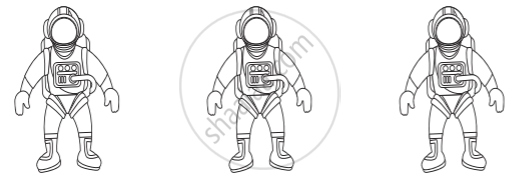
Read the passage three times and colour a spacesuit for each time.
A spacesuit is like a spaceship built for one. A spacesuit lets us work and live in space. It protects us from the heat and the cold. It gives us air to breathe. The suit is made of many parts and has water to drink. It even has a built-in toilet, if you need to use it.
The message was to gather on ______.
Do you love to seek answers to the questions?
Anbu was a ________ old boy.
Amir switched off the fan wheFalsen he walked out.
Amir realised his mistakes.
Speak and win.
Join in any group. Support or oppose using 4 to 5 sentences to win.
| I support Divya. | I oppose Divya. |
Moles dig ______ to catch earth worms.
What did Ani's parents teach her?
What did Bala want to learn?
Replace the bold word/words with a word from the quiver and re-write the sentence –
In no time she hit the object she aimed at.
Who was Hiawatha?
Read the passage given below and answer the questions that follow
Humans have long been fascinated by fiction. We experience excitement in assigning supernatural power to imaginary characters in fictional stories – and so we have Spider man, Batman, He–man, Titans and many more. The ‘Cyborg’ was an offshoot of such wild imagination of humans to invest our species with superhuman powers. Today, the Cyborg is no more an imaginary organism. We are living in a world where a sizeable population of humans have merged their bodies with technological implants. The term ‘Cyborg’, short for ‘cybernetic organism’, was coined to describe a man, whose body is implanted with technological devices to supplement and substitute body functions.
Cyborgs include people with cardiac pacemakers, contact lenses, bionic ears and eyes, prosthetics and so on. In other words, a cyborg is partly human and partly machine. The technological innovations in the field of medicine and healthcare augment humans with machines, producing a beta version of the human body. The advent of brain machine interfaces is certain to blur the boundary between humans and machines. Scientists are working hard to find a technique for age reversal too. People do not want to die, so mankind is striving to get to the final frontier, which is development of machines and devices that would accord man immortality.
The needs of humans are not limited. As time passes, food habits change, thinking patterns change, and even appearances change. We are about to travel by driverless, fully automated vehicles. Computers and smart phones have become our masters. The more we depend and merge with technological advancements, the more the humanness in us slowly erodes. Intelligence is sought to be infused into machines and robotics are designed in such a way to give man a virtual human companion. The field of artificial intelligence is overtaking the human brain and many fear that it could even harm the human race. Despite certain limitations and potential threats, many believe that cyborgs will be the next step in the evolution of mankind. The amalgamation of man and machine is sure to add a new dimension to the life of mankind and this will prove to be the ‘biggest evolution in Biology’ since the emergence of life, four billion years ago.
Questions:
a) Account for the popularity of characters with supernatural powers.
b) Who is referred to as a ‘Cyborg’?
c) What is expected to happen with the advent of the brain machine interface?
d) The needs of humans are not limited. How is this statement elaborated in the passage?
e) How can a machine turn into a virtual companion for humans?
f) Explain the flipside of the rapid technological advancement.
g) Identify the word in para 1 which means ‘everlasting life’.
h) Which of the following words is synonymous with ‘amalgamation’?
- recreation
- integration
- exploration
- proposition
i) Which of the following options is the antonym of the word ‘advent’?
- drawback
- dispute
- departure
- danger
j) Find out the word which is the antonym of ‘natural’ in para 3.
Read the extract and complete the activities given below:
|
“I don’t believe in taking the right decisions. I take decisions, I take decisions and then make them right:” One of them make them right. One of Ratan Tata’s inspiring words which made me dream beyond shadows. I feel fortunate that I discovered him in the early stage of my life, and now I am using his teachings to mould my future the way I want. Even though Ratan Tata was born into a very posh family in India, he never took money and power for granted. He graduated from Riverdale country from New York, Ratan Tata began his career in the Tata Group working on the shop floor of Tata Steel. After working for almost 10 years, he was appointed as the director-in-charge of the National Radio and Electronics Company Limited (NELCO) in order to help its struggling finances. He worked hard to build a better consumer electronics division, but the economic recession and union strikes prevented him from achieving success, and this success helped Tata to be appointed as the chairman of the Tata Group of companies. He started with a very basic job in his father’s company, and today he owns a billion-dollar company. The tag of greatness does not come without making any sacrifices, and this tag on Ratan Tata suits to its best. Tata Group launched its passenger car Tata Indica in the year 1998 but Tata Indica was a failure in its first year, and the experiment seemed to be failing. Many people started advising Ratan Tata that he should sell the passenger car business. Ratan Tata also agreed to this, and a proposal was given to Ford; they showed interest too. The three-hour meeting at Ford headquarters in Detroit, chairman of Ford (Bill Ford) said to Ratan Tata, “Why did you enter in the passenger car business when you were not knowing of it. It will be a favour if we buy this business from you.” Ratan Tata decided to move back home. While travelling, he was very tense as the feeling of being insulted was on his mind. After earlier failures, Tata Motors did well with its business of passenger cars but in the same period, Ford did very bad. In 2008 when Ford was on it way of bankruptcy, Tata Group offered Ford to buy its luxury car brand, Jaguar Land Rover. Ford arrived in Mumbai for the meeting. In the meeting, Bill Ford said to Ratan Tata, you are doing a big favour for us by buying-Jaguar-Land Rover is now owned by Tata Group and is currently making profits. |
A1. Rewrite the following sentences as per their occurrence in the extract: (2)
- He was appointed as the Director-in-charge of the National Radio and Electronics Company Limited.
- Tata Group launched its passenger car “Tata Indica” in the year 1998.
- Billi Ford said to Ratan Tata, "You are doing a big favour for us by buying Jaguar-Land Rover."
- He graduated from Riverdale country from New York.
A2. Explain: (2)
The writer says, "I don't believe in taking right decisions. I take decisions and then make them right."
A3. Give reasons: (2)
Ratan Tata decided to sell his passenger car business.
A4. Personal Response: (2)
Right decision at the right time is important success. Express your opinion.
A5. Grammar: (2)
Do as directed:
- He worked hard building a better consumer electronics division.
(Rewrite the sentence using the infinitive form of the underlined word) - Tata Group launched the passenger car Tata Indica.
(Rewrite it beginning with 'The passenger car Tata Indica......')
A6. Vocabulary:
Give antonyms.
- Profit × ______
- Prevent × ______
Being a bachelor, the stranger had no patience with children.
Being a bachelor, the stranger had no patience with children.
