Advertisements
Advertisements
Question
Which language do you think the author and his grandmother used while talking to each other?
Advertisements
Solution
The author and his grandmother might have used their mother-tongue to converse with each other. As the author, Khushwant Singh belongs to Punjab, the language used by them might be Punjabi.
APPEARS IN
RELATED QUESTIONS
Read the passage carefully.
1. I remember my childhood as being generally happy and can recall experiencing some of the most carefree times of my life. But I can also remember, even more vividly, moments of being deeply frightened. As a child, I was truly terrified of the dark and getting lost. These fears were very real and caused me some extremely uncomfortable moments.
2. Maybe it was the strange way things looked and sounded in my familiar room at night that scared me so much. There was never total darkness, but a street light or passing car lights made clothes hung over a chair take on the shape of an unknown beast. Out of the corner of my eye, I saw curtains move when there was no breeze. A tiny creak in the floor would sound a hundred times louder than in the daylight and my imagination would take over, creating burglars and monsters. Darkness always made me feel helpless. My heart would pound and I would lie very still so that 'the enemy' wouldn't discover me.
3. Another childhood fear of mine was that I would get lost, especially on the way home from school. Every morning, I got on the school bus right near my home ‒ that was no problem. After school, though, when all the buses were lined up along the curve, I was terrified that I would get on the wrong one and be taken to some unfamiliar neighbourhood. I would scan the bus for the faces of my friends, make sure that the bus driver was the same one that had been there in the morning, and even then ask the others over and over again to be sure I was in the right bus. On school or family trips to an amusement park or a museum, I wouldn't let the leaders out of my sight. And of course, I was never very adventurous when it came to taking walks or hikes because I would go only where I was sure I would never get lost.
4. Perhaps, one of the worst fears I had as a child was that of not being liked or accepted by others. First of all, I was quite shy. Secondly, I worried constantly about my looks, thinking people wouldn't like me because I was too fat or wore braces. I tried to wear 'the right clothes' and had intense arguments with my mother over the importance of wearing flats instead of saddled shoes to school. Being popular was very important to me then and the fear of not being liked was a powerful one.
5. One of the processes of evolving from a child to an adult is being able to recognise and overcome our fears. I have learnt that darkness does not have to take on a life of its own, that others can help me when I am lost and that friendliness and sincerity will encourage people to like me. Understanding the things that scared us as children helps to cope with our lives as adults.
(a) On the basis of your reading of the above passage, make notes using headings and subheadings. Use recognizable abbreviations wherever necessary.
(b) Make a summary of the passage in not more than 80 words using the notes made and also suggest a suitable title.
Read the following extract and do the given activities:
B.1) Fill in the Balloons with suitable ideas from the poem:
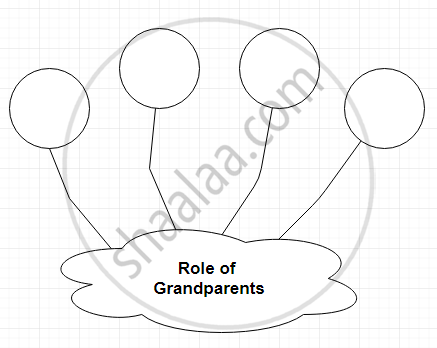 “Oh, the value of the elderly! How could anyone not know?
They hold so many keys, so many things they can show.
We all will read the other side this I firmly believe
And the elderly are closest oh what clues we could retrieve.
For their characters are closest to how we’ll be on high.
They are the ones most developed, you can see it if you try.
They’ve let go of the frivolous and kept things that are dear
The memories of so sweet, of loved ones that were near.
As a nation, we are missing our greatest true resource,
To get to know our elders and let them guide our course.”
B.2) Find Evidence:
Pick out the line from the extract which supports the given ideas:
(i) The elders have many things to share.
(ii) Everybody knows the value of elderly people.
(iii) The elderly people have vast experience.
(iv) The elderly people are a boon to the nation.
B.3) Write a pair from the extract that rhymes with the given word:
| Fear | ........................... | .......................... |
We 'draw up a deed'. Complete the following phrase with an appropriate word.
________one's word
Examine the communication channels in the story between Paul and his mother.
Discuss in pairs
Ruskin's insistence on looking intensely at words, and assuring oneself of meaning, syllable by syllable – nay, letter by letter.
The quill is the central element of the poem – what does it symbolise?
The significance of reading an autobiography lies in drawing lessons from another life. What is the significance of Kumudini's account for us as readers?
How do stories/biographies of such famous people help youngsters?
Read the story and complete the following.
At first, Revathi’s plants did not look normal and healthy because, ____________.
Add the appropriate Prefix to make the following word opposite in meaning.
continue
The writer of the story is William Blake.
In the following sentence, point out the Main Clause and Subordinate Clause. Encircle the Subordinator.
Old Behrman was a painter, who lived on the ground floor.
Discuss in groups and share with one another.
When you go for a picnic, what and how do you enjoy?
Read the lesson and name the following.
The First surgeon to perform operations ______
Read aloud/Enact the play.
Guess the meaning of the following from the context.
The garden still is alight with lilies.
Write a short note on the following:
The message in the vision.
Form groups. Discuss the first two paragraphs. Try to present their content in the form of a series of conversations among the volunteers.
Complete the following sentence with reference to the passage.
They may be composed and sung or recited for many years before __________________.
Complete the following diagram.

What did Gopal Bhand want to tell the husband and wife?
List and say whether the following statement agrees with the passage or not.
You should try to talk most of the time whenever there is a discussion.
If you were to grow very tiny like a Lilliputian, what are the things you would like to do? Write about any three of these things.
What are the complaints of the animals?
Write in short how the travellers crossed the first ditch.
Read the following.
- Skipper: captain of a ship or boat.
- Dipper: This word has two meanings. Dipper means a container for taking out water. Also, there are two constellations called Little Dipper (Little Bear) and Big Dipper (Big Bear) in the sky.
- Milky Way: The band of light consisting of stars that spreads across the sky at night.
Do you long to be something else? Write about your longing.
Guess the meaning of the following word.
beautify
What did the Bodwells think when they heard the mother shout.
Write down the word that alliterate in the poetic line below
That spreads treasures on a tree.
Read the lines and answer the questions.
They are of all forms and shapes
They all have an excellent ending
What do have an excellent ending?
Identify the character/speaker.
You may stay if you answer my riddle.
Can courage be developed suddenly? Why?
The boy was so inspired by Mithali that he was happy for his sister to play cricket.
Complete the sentence given below with word/phrase.
The hole in the ground was filled______.
Which planet has red storm?
It is used in the fisher’s _____.
The second daughter ________ the milet to a flock of birds.
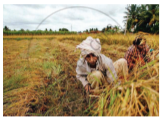
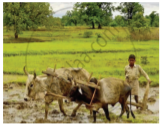
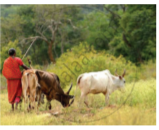
| Mr. Murugan is a farmer. He has a small piece of land and two bulls. He takes good care of his bulls as they help him in farming. Every morning, he takes the bulls for grazing. When it rains he ploughs the land with the bulls. As he has no one to help he starts sowing the seed before sunrise. He irrigates the crop till it grows. He reaps and binds the crop then takes it to thrash the paddy. Finally, with the help of the bulls, he takes the paddy to his house. |
Name the actions of Murugan.
 |
|
 |
|
 |
How can we make our nation proud?
Vicky pleaded his father to buy a robot.
Recite the poem 'My Robot' with correct intonation.
Why did the old man disguise himself as a beggar?
The bird-catcher decided to sit under the ________.
Recite the poem ‘Mother Nature’.
What was his master’s advice?
Circle the animals which are in the voyage.

Do you love to seek answers to the questions?
Name the animal and sound it makes.
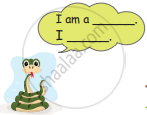
Write the word with same meaning.

post- ______
Is there something that you will struggle for? why?
Match with the opposite gender.
| 1. | prince | bridegroom |
| 2. | hero | princess |
| 3. | bride | heroine |
What did Nasruddin boast about?
While listening to the story, what did Alice see?
What does the poet want us to do at night?
Are these sentence TRUE or FALSE
The poet tells the child to be afraid when it is dark.
How did the tree help the boy earn money?
What did he make out of it?
Being a bachelor, the stranger had no patience with children.
