Advertisements
Advertisements
Question
Read the story ‘Lord Emsworth and the Girl Friend’ by P. G. Wodehouse.
Advertisements
Solution
|
Summary of "Lord Emsworth and the Girl Friend" The story follows the mild-mannered and slightly scatterbrained Lord Emsworth, the ninth Earl of Emsworth, who has two primary passions in life: his prize-winning pig, the Empress of Blandings, and his garden at Blandings Castle. Despite his noble title, Lord Emsworth is happiest when he's away from social obligations and can tend to his peaceful pursuits. One day, while strolling through the gardens, Lord Emsworth encounters a young girl named Gladys, who has run away from an unpleasant job and an even less pleasant boss. She is trying to find refuge on the castle grounds, and, much to Lord Emsworth’s surprise, she wins his heart with her cheerful personality and shared love for animals. Lord Emsworth finds himself sympathizing with her plight, and, in a moment of uncharacteristic boldness, he decides to help her. The story humorously unfolds as Lord Emsworth navigates his interactions with Gladys and attempts to protect her from those who would send her back to her harsh former life. His unexpected friendship with Gladys helps him realize the value of compassion and even inspires him to stand up for something—rare for the timid earl. |
APPEARS IN
RELATED QUESTIONS
The black kite may start a fire because
Attempt the following question in 100-150 words:
What do you think about Anne’s talent for writing essays, which she wrote convincingly when punished by the teacher?
Tick the statement that is true.
The story hinges on a particular historical event.
‘My tongs are like a tiger among toys.’ It means ______
Teach it in accents______ and______.
- soft
- vain
- fear
- joy
- love
- heard
- toiled
- mild
- good
- sand
- life
- harsh
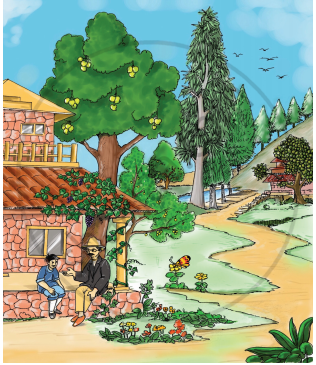
Listen to your teacher read the first part of the story. Many things described in the story can be seen in the picture. Find and name them.
Divide the following word.
hotel
_____ fights with everyone in school.
Read the passage and colour one bag each time you read.
There lived a poor but an honest farmer in a village. He supported himself, his wife and seven children using his small piece of land.
One day while he was walking in his field, he found a bag of gold.
He took it home and showed it to his wife. His wife told him to keep some of the gold. He told his wife that honesty is the best policy. He tried to find the person who lost it. At last, he found that the owner of the bag and gave it back. The rich man took the bag and thanked him.

Read the passage and write a summary of it. Suggest a suitable title for the summary.
|
A sparrow is a small bird which is found throughout the world. There are many different species of sparrows. Sparrows are only about four to six inches in length. Many people appreciate their beautiful songs. Sparrows prefer to build their nests in low places-usually on the ground clumps of grass low trees and low bushes. In cities, they build their nests in building nooks or holes. They rarely build their nests in high places. They build their nests out of twigs grasses and plant fibers. Their nests are usually small and well-built structures. Female sparrows lay four to six eggs at a time. The eggs are white with reddish-brown spots. They hatch within eleven to fourteen days. Both the male and female parents care for the young. Insects are fed to the young after hatching. The large feet of the sparrows are used for scratching seeds. Adult sparrows mainly eat seeds. Sparrows can be found almost everywhere where there are humans. Many people throughout the world enjoy these delightful birds. The sparrows are some of the few birds that engage in dust bathing. Sparrows will first scratch a hole in the ground with their feet then lie in it and fling dirt or sand over their bodies with flicks of their wings. They will also bathe in water or in dry or melting snow. Water bathing is similar to dust bathing with the sparrow standing in shallow water and flicking water over its back with its wings also ducking its head under the water. Both activities are social with up to a hundred birds participating at once and are followed by preening and sometimes group singing. |
