Advertisements
Advertisements
Question
Comment on the symbols used in ‘A Munda Song’. What aspect of the tribal worldview do they reflect?
Advertisements
Solution
In ‘A Munda Song’, symbols such as the sun, moon and cowshed connect human life with the rhythms of nature. The rising sun is associated with the birth of a son, while the moon is associated with the birth of a daughter. The cowshed being depleted after a son’s birth and filled after a daughter’s birth shows that daughters are considered precious and valuable.
These symbols reflect the tribal worldview of living in close harmony with nature. The Munda community’s life is linked to natural cycles such as the rising and setting of the sun and the changing seasons, rather than clock time.
APPEARS IN
RELATED QUESTIONS
Read the passage carefully.
1. I remember my childhood as being generally happy and can recall experiencing some of the most carefree times of my life. But I can also remember, even more vividly, moments of being deeply frightened. As a child, I was truly terrified of the dark and getting lost. These fears were very real and caused me some extremely uncomfortable moments.
2. Maybe it was the strange way things looked and sounded in my familiar room at night that scared me so much. There was never total darkness, but a street light or passing car lights made clothes hung over a chair take on the shape of an unknown beast. Out of the corner of my eye, I saw curtains move when there was no breeze. A tiny creak in the floor would sound a hundred times louder than in the daylight and my imagination would take over, creating burglars and monsters. Darkness always made me feel helpless. My heart would pound and I would lie very still so that 'the enemy' wouldn't discover me.
3. Another childhood fear of mine was that I would get lost, especially on the way home from school. Every morning, I got on the school bus right near my home ‒ that was no problem. After school, though, when all the buses were lined up along the curve, I was terrified that I would get on the wrong one and be taken to some unfamiliar neighbourhood. I would scan the bus for the faces of my friends, make sure that the bus driver was the same one that had been there in the morning, and even then ask the others over and over again to be sure I was in the right bus. On school or family trips to an amusement park or a museum, I wouldn't let the leaders out of my sight. And of course, I was never very adventurous when it came to taking walks or hikes because I would go only where I was sure I would never get lost.
4. Perhaps, one of the worst fears I had as a child was that of not being liked or accepted by others. First of all, I was quite shy. Secondly, I worried constantly about my looks, thinking people wouldn't like me because I was too fat or wore braces. I tried to wear 'the right clothes' and had intense arguments with my mother over the importance of wearing flats instead of saddled shoes to school. Being popular was very important to me then and the fear of not being liked was a powerful one.
5. One of the processes of evolving from a child to an adult is being able to recognise and overcome our fears. I have learnt that darkness does not have to take on a life of its own, that others can help me when I am lost and that friendliness and sincerity will encourage people to like me. Understanding the things that scared us as children helps to cope with our lives as adults.
(a) On the basis of your reading of the above passage, make notes using headings and subheadings. Use recognizable abbreviations wherever necessary.
(b) Make a summary of the passage in not more than 80 words using the notes made and also suggest a suitable title.
Answer the following question in 30-40 words:
“The sight of the food maddened him.” What does this suggest? (His First Fight)
|
The energy stored in coal and petroleum originally came to the earth from the sun. The bulk of the present-day supplies was laid down some 200 to 600 million years ago, when tropical conditions were widespread. Lush, swampy forests produced huge trees; warm coastal seas swarmed with microscopic forms of life. When these organisms died, much of their tissue was recycled as it is today — through scavenging and decay. But a significant amount of dead plant and animal material was covered with mud, which prevented complete decomposition. With the passage of time, layer upon layer of the fine sediment was deposited over the once-living material; the sheer weight turned the sediments to rock. Sandwiched between the layers, both coal and petroleum were produced and preserved under pressure. Coal was formed mostly of giant fern-like plants that have only small counterparts today. Coal may still be forming here and there on earth, but conditions are not right for the production of significant quantities. |
Number the points.
Do you think that the ruled always adopts the language of the ruler?
This short story revolves around a single important event. Discuss how the narrative is woven around this central fact.
What do you think are the reasons for the references made to the English people and the British monarchy?
How does the insertion of dialogue in the story contribute to its interest?
Discuss in small groups.
‘On reading Shelley’s A Defence of Poetry, the question insistently occurs why there is no similar A Defence of Science written by a scientist of equal endowment.’
Notice these expressions in the poem and guess their meaning from the context:
| rancid breath | squelching tar |
| spectroscopic flight of fancy | |
| rearing on the thunderclap | brunette |
| peroxide blonde | clinical assent |
| raven black |
Why have the words, 'pretended' and 'seemed' been used in the lines:
...Pretended to believe every single word
of what the tiger king said.
And seemed to be taken in by all the lies.
How does the sense of these lines connect with the line 'Ajamil wasn't a fool'?
Make groups and discuss the following:
What inspired them to spend the best part of their lives to research and share their findings?
Read the poem and fill in the table.
| Time of the day | Location | Poet’s Activity | Hawker’s Activities | Gardener’s Activities | Watchman’s Activities |
| Morning | __________ | __________ | __________ | __________ | __________ |
| Afternoon | __________ | __________ | __________ | __________ | __________ |
| Night | __________ | __________ | __________ | __________ | __________ |
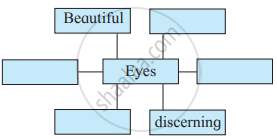
Complete the web with the help of adjectives used to describe eyes and nose in all respects. Two are done for you.

Expand the idea inherent in the following proverb :
Fools rush in where angels fear to tread - Alexander Pope.
Fill in the gap, choosing a word from the bracket to make an appropriate comparison.
(tall / quiet / humble / merry / busy / slippery / fast / sly / slow / big)
as ______ as a fox
Discuss and write 1-2 lines about the following,
The lesson that Bushi learned.
Answer the following question in one sentence.
What examples of man’s progress have been given in the poem?
Who was Sushruta?
Complete the following sentence with reference to the passage:
He realised that making the body suffer was not ____________.
Read the following sentence aloud. Write who said it and to whom.
“What! ... how ! ... That’s impossible! ”
Read: ‘Last Chance to See’ by Douglas Adams and Mark Carwardine.
Gather more information about the following from your Science textbook, the internet, and other sources.
Gravitational force
Write the symbol that is used in the poem to represent the following idea.
It was tempting and needed to be tried.
Describe the following in one or two lines.
The nest.
Discuss how you will measure the worth of a journey.
In what way can we help to reduce or minimize waste generation?
Discuss the issue in groups of 4 or 5 and note down all good suggestions.
Resolve to follow them yourself. Some have been given below for your reference.
- Don’t waste food.
- Take as much as you want but finish everything that’s on your plate.
- Don’t throw away broken or half-used things. Repair them and use them.
- Avoid things which can be used only once.
For example: thermocol (polysterene) cups, plastic glasses, etc. - Reuse!
- Recycle!
Guess the meaning of on the wing.
Read the following line from the poem and answer the question that follow.
My heart will keep the courage of the quest And hope the road's last turn will be the best.
|
My heart will keep the courage of the quest, And hope the road's last turn will be the best. |
- What kind of quest does the poet seek here?
- What is the poet’s hope?
What did the narrator think the unusual sound was?
Is the bird a crow?
Few articles are missing in the given passage. Edit the passage given below by adding suitable articles where ever necessary.
My neighbourhood is very interesting place. My house is located in apartment building downtown near many stores and offices. There is small supermarket across street, where my family likes to go shopping. There is also post office and bank near our home. In our neighbourhood there is small, Green Park where my friends and I like to play on weekends and holidays. There is small pond near park and there are many ducks in park. We always have great time. In addition there is elementary school close to our home where my little brother studies in third grade. There are so many things to see and do in my neighbourhood that’s why I like it. It’s really great place.
Identify the speaker/character.
‘ It’s Somu’s thoughtless ways that reduce me to tears’
Hamid’s heart sank because the price of the tongs was______for him.
Write the names of the characters in this story.
1. ______ 2. ______ 3. ______
Which mode of transport did Fogg choose?
Read the line and answer the question.
I must go down to the sea again, to the lonely sea and the sky
Where does the poet want to go?
Mother did not ask for______.
What is the difference between this toy train and a normal train?
Gulliver was hailed as a hero because he ______.
Complete the sentence given below with word/phrase.
The hole became ______ and ______.
Why did the farmer have to travel far?
How did the aliens know the boys' language?
What does it give to the farmer?
Put the given time expressions in the correct columns.
| winter | morning | 2’ o clock | evening | 1947 |
| March | Sunday | 15th August | 4.30 PM | wedding day |
| in | at | on |
Jaswant was captured alive.
Did Tabaqui receive a warm welcome from the pack of wolves? How do you know?
The hen-pigeon returned home when it started to _______.
Did she give up the fight?
Why was the fish floating on top?
Match the rhyming words.
| 1. | flow | know |
| 2. | grow | week |
| 3. | seek | blow |
Kani and Teddy were in the garden at _____.
Try your own.
What happened to Jayan?
Name the things that good merchant offered for the plate
What will you do if you have a gold plate?
Work or play, let us______.
Do you think Nasruddin was good at archery?
Choose the right word.
The tamarind tree grows over Tansen’s ______.
Who according to Gandhi, can fight against evil and how?
Activity: Live English: Packs, packets, pouches, wrappers

Given above is the picture of an imaginary food item’s packet. Let us see how to ‘read’ the matter on the packet as a vigilant consumer.
- Look at the wrapper and complete the sentences.
- The name of the food item is ______.
- It is made by ______.
- It is a ______ food item. (Veg/Non-veg)
- The ______ sign indicates whether it is a Veg or Non-veg food item.
- The ingredients are ______, ______, ______, ______.
- The date of packing is ______ and the expiry date is ______.
- It should be consumed before ______ from the date of manufacturing.
- Try and obtain more information about the various symbols printed on the packet.
- Discuss the following -
- Why the ‘recipe’ is given on the packet.
- Why the packet tells us to visit the website of the company.
- What ideas are used to make the packet attractive?
- How you will verify whether something is good for you to eat.
