Advertisements
Advertisements
Question
Explain the significance of the lines ‘I tie this Ridin creeper To fasten your soul to your body.’
Advertisements
Solution
Ridin is a creeper that is supposed to have special medicinal qualities. It is said that the Ridin creeper will tie the spirit of good health to the body to ensure its continued presence.
APPEARS IN
RELATED QUESTIONS
How does Anne criticize the attitude of the grown-ups in her diary?
It was her determination that helped Helen Keller get admission to Radcliffe College. Comment.
How did a story book, 'Little Lord Fauntleroy' open a window of knowledge to Helen and help to shape her career?
Read the passage carefully and complete the activities given below :
A1 True or False
A2 Mention the two things that were found when the tall grass was hacked.
A3 The narrator prayed that Rex should not make any sudden movements meets. Explain giving reasons.
We 'draw up a deed'. Complete the following phrase with an appropriate word.
________ends meet
Suggest a few instances in the poem which highlight humour and irony.
How do the patterns of creativity displayed by scientists differ from those displayed by poets?
Notice this word in the poem and guess its meaning from the context.
turquoise
The text is an excerpt from Sesame and Lilies which consists of two essays, primarily, written for delivery as public lectures in 1864. Identify the features that fit the speech mode. Notice the sentence patterns.
Comment on the physical features of the hawk highlighted in the poem and their significance.
Say why the speaker of the poem wishes to be a-
hawker
The kite - Bazar in Ahmedabad, is open day and night for a week.
The poem is a Petrarchan Sonnet. The poem is divided into two parts -
- An Octave
The first part comprising eight lines. - A sestet
The second part comprising six lines.
Read the first four lines of the poem. The rhyme scheme is a b b a. Read the rhyme scheme for the next four lines. It is a b b a. Now read the first three lines of the sestet and note the rhyme scheme. It is c d c. The rhyme scheme of the last three lines is d c d. This is the common design of a Petrarchan Sonnet.
This is a Petrarchan Sonnet. Complete the given table by giving examples from the poem.
| Features | Examples / Lines |
| Objects used | |
| Praise/blames | |
| Metaphor | |
| Simile | |
| Personification | |
| Number of lines | |
| Rhyme scheme |
Write 3 to 4 lines about the following in your own words.
First Cardiac Surgery
Write 3 to 4 lines about the following in your own words.
First Neurosurgeon
Proverbs associated with the word season: for eg: Make hay while the sun shines.
- _________________________
- _________________________
Say WHY. . . . . .
Mother agreed to send Ramanujan to England.
Find at least five other Akbar and Birbal stories and share them with your friends. Make a list of the stories collected by the entire class. Put your list in alphabetical order.
'It all builds on the charm of the 1967 film, which by itself is a must-watch for any child.'
Explain this sentence in the context of the movie, focusing on the two given phrases- 'Charm of the 1967 film' and 'must-watch'.
Find more information about other Param Vir Chakra awardees. Prepare a collage using photographs, pictures, and text matter written in beautiful handwriting.
Match the columns :
| A | B |
| (1) Theseus | (1) Robin Goodfellow |
| (2) Titania | (2) Queen of the Amazons |
| (3) Puck | (3) Duke of Athens |
| (4) Hippolyta | (4) Faeries |
| (5) Cobweb, Moth | (5) Queen of the Faeries |
Read the story and write about the following in short.
Kojo
Complete the following sentence with reference to the passage:
For six years did Gautama practise ____________.
Write about one occasion when you have behaved like -
Mr. Nobody
Read the passage and name the following.
She was the wife of King Menelaus.
Often the brook speaks of itself as if it is human.
For example, 'I bicker down a valley.'
Find two other examples of the human activities of the brook.
Write other meaningful words that begin/end with anywhere.
How was Gulliver taken to the city?
Discuss what you can do to help other animals in your surroundings. Write down any three ideas you like from the discussion.
List the insects, birds, trees and plants mentioned in the poem.
What examples of plentiful things does the poet give?
Show the major events in the story of Pheidippides on a ‘time-line’.
What is used to make Rangoli designs?
What different names is ‘Rangoli’ known by in different regions?
How was the young seagull’s first attempt to fly?
The second human being that Miranda saw on the island was __________________.
Identify the character or speaker.
It seems to me like the recollection of a dream.
Answer the following question in about 100-150 word.
Describe the funny incident that caused the confusion in the house.
What are the three rules given by the bird?
We should develop the ability to learn from______
- self
- others
- books
What kind of a life do you want to lead in this world?
Teach it in accents______ and______.
- soft
- vain
- fear
- joy
- love
- heard
- toiled
- mild
- good
- sand
- life
- harsh
Pick out the words which rhyme with the given words and write similar rhyming words on your own.
| 1. | far | ||
| 2. | fear | ||
| 3. | low | ||
| 4. | kind | ||
| 5. | remain | ||
| 6. | they |
Write the story in your own words
Work in pair, find answer for the question and share in the class.
Name the seasons mentioned in the poem?
Work in pair, find answer for the question and share in the class.
Which word refers to ‘rain’?.
We don’t use _________ in the soil.
A country should have inner boundaries. Justify.
It never takes ______ and ______.
Pick out the rhyming words from the poem and write.
| Mars | |
| time | |
| be |
Choose the correct picture for the passage.
There is a table under a tree. A man with a big hat and a hare with long ears are sitting. A young girl is sitting between them. There are many cups on the table. The girl has a cup in her hand, and the man has a pot in his hand. It seems like they are having tea. Yes, they are having tea at the tea party in Wonderland. The girl is Alice, and she is in Wonderland.
Who showed love and care to the children?
Which quality makes 'world is one and human is one'?
What should we vow for?
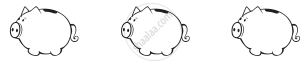
Read the passage three times on your own. Colour a Piggy bank each time you read.
Piggy bank is a coin box used by children. The real use of a piggy bank is to store coins. Piggy banks look like pigs. They come in many shapes and sizes. In Tamil, they are known as Hundial. It is a red, mud pot. We can drop the coins into the pot. Once the pot is full, we must break the pot and use the coins. Start saving with your hundial today!
Do you tell the truth always? Why?
Why did Bala go to Chennai with his father?
How did Mugund’s mother die?
Why did the headmaster give Megala a special prize?
Choose the right word.
Chintha Chettu is a tamarind ______.
