Advertisements
Advertisements
Question
What does the reference to raw mythology imply?
Advertisements
Solution
The Banyan tree is a mythological one, and when his grandmother calls it along with the other trees to be sacred. Religious sentiment is brought out in not just the poet but the reader as well. When the tree is slaughtered on the orders of the poet's father, a mystery is revealed. First, the scraggy aerial roots were brought down unleashing age-old trunk that had a circumference of fifty feet. It was a tree that had witnessed ages and held all the knowledge knotted inside. When it was brought down it felt as if all the mythology was revealed to the poet. The darkness and the concealed, the enlightenment it has secreted away for so long. The reasons and the answers to all the logics all were beheld by the tree and now was slaughtered.
APPEARS IN
RELATED QUESTIONS
Answer any three of the following in 30-40 words each:
(a) Why has the poet’s mother been compared to the ‘late winter’s moon’?
(b) The poet says, ‘And yet, for these Children, these windows, not this map, their world.’ Which world do these children belong to? Which world is inaccessible to them?
(c) What was the plea of the folk who had put up the roadside stand?
(d) What will happen to Aunt Jennifer’s tigers when she is dead?
How did Helen Keller enjoy her visit to the World fair? (120‒150 words)
Why are animals considered as intelligent as humans ?
Read the following passage and do the given activities :
B1 Select :
Complete the following sentences by selecting the correct alternatives:
(i) It is more important to have _______ before rushing to work. (lunch, breakfast, dinner)
(ii) Skipping breakfast brings a higher risk of _______ (cancer, heart attack, brain attack)
(iii) An adequate _______ is provided by your meal. (energy, weight, height)
(iv) More than half of the people risk heart attack due to _______ eating. (early morning, afternoon, late night)
MEN WHO SKIP BREAKFAST FACE
27% HIGHER RISK OF HEART ATTACK
Late-Night Eaters at 55% risk. TNN.
London-Breakfast is widely acknowledged as the most important meal of the day. But now, there’s more reason to have that piece of toast before rushing to work: Skipping breakfast has for the first time been associated with an increase in heart attacks.
A study published in the American Heart Association journal circulation showed that men who skipped breakfast had a 27% higher risk of heart attack or death from coronary heart disease than those who didn’t.
“Skipping breakfast may lead to one or more risk factors, including obesity, high blood pressure, high cholesterol, and diabetes, which may, in turn, lead to a heart attack over time,” said Leah E. Cahill, lead author from the Harvard School of Public Health.
“Our study group has spent decades studying the health effects of diet quality and composition, and now this new data also suggests overall dietary habits can be important to lower risk of coronary heart disease,” said co-author Eric Rimm.
“Don’t skip breakfast,” Cahill said. “Eating breakfast is associated with a decreased risk of heart attacks. Incorporating many types of healthy foods into your breakfast is an essay way to ensure your meal provides adequate energy and a healthy balance of nutrients.
B2 Find:
Find the pieces of ‘advice’ from the passage and write.
B3 Antonyms :
Find out the antonyms for the following words from the passage and write:
(i) higher (ii) decrease
(iii) excluding (iv) low
B4 Reported Speech :
Complete the reported speech of the following sentences given indirect form:
(i) “Our study group has spent decades studying the health effects of diet quality and composition,” said co-author Eric Rimm.
Co-author Eric Rimm _________
(ii) “Dont’s skip breakfast,” Cahill said.
Cahill _______
B5 Personal Response :
How will you practice the message implied in the passage in your life?
Notice the kind of English Tsetan uses while talking to the author. How do you think he picked it up?
Give reasons for the following statement.
The author thought that his positive thinking strategy worked well after all.
We 'draw up a deed'. Complete the following phrase with an appropriate word.
________ends meet
'Constancy' is the theme of the poem. Indicate the words, phrases, and images that suggest the theme.
Explain the undertones in the statement:
'Wife and husband in unusual rapport
State one unspoken thought':
How does the banyan tree stand out as different from other trees? What details of the tree does the poet highlight in the poem?
Discuss the following in pairs or in small groups.
“Before you begin experimenting you need to perfect the technique with which you experiment.”
Read the extract 'Being Neighborly' and complete the following statement:
In order to tidy the room, Jo __________________.
Write down in your own words the way Laurie confirmed the names of the March sisters.
Find from the poem, positive qualities to fill up the web.
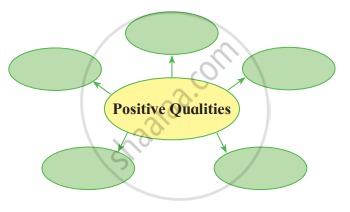
Find proof from the poem for the following.
The poet’s minute observations of the steady growth of the cherry tree.
In Gujarat, the kite - festival is celebrated to welcome the Spring.
Discuss in groups and share with one another.
Do you spend time admiring and thinking over the beauties of nature? Elaborate on your response.
Given below are some words from legal terminology used in court affairs. Discuss and complete the table accordingly.
| Sr. No | Legal Terminology | Description |
| 1. | Affidavit | A written statement confirmed by oath or affirmation for use as evidence in court. |
| 2. | Argument | |
| 3. | Consent | |
| 4. | Counsel | |
| 5. | Judgement | |
| 6. | Trial | |
| 7. | Verdict | |
| 8. | Contempt of Court | |
| 9. | Notice | |
| 10. | Stay order |
Use the following word/phrase to make a sentence of your own.
enthusiasm
What characteristics are needed to be a good player of Kabaddi? What should you do to develop each? Discuss this in groups of 5 and write a composition on it.
Select the correct options :
A Midsummer-Night’s Dream is a ___________________.
- poetic drama
- comedy of errors
- a comedy based on fantasy
- a character play
- a revenge tragedy
- belongs to realm of dreams
Explain the following statement with reference to the context.
Because your father can't do without my help.
Discuss and write 1-2 lines about the following,
The lesson that Bushi learned.
Answer the following question in one sentence.
Who misses all the fun?
Think carefully for a minute.
Jog your memory and recall all the things/objects on which you have seen wheels. Write them down
To whom is the poem addressed?
Read the passage. Underline the new words. Guess their meaning from the context. Verify it from a good dictionary.
You want to start human settlement somewhere else other than the earth, in the universe. Will you select a star or a planet? Why? What features supporting life will you look for? Try to find answers to such questions and make a presentation using scientific information and your imagination.
What changes do we see in the life of human beings when the season changes? Write with reference to their clothes.
Fill in the blank choosing the appropriate word/idiom from the lesson.
He was dizzy and he ______ the room.
Make a list of your favourite fruits and vegetables and note down the time of the year when they are available in plenty.
Form groups of four or five.
Try to find the answers to the following questions through observation and by talking to your teachers, parents and others. Discuss your answers in the group.
- How is waste generated?
- How is it removed or cleared?
- How can we help in the task of clearing or removing garbage?
What did the Judge tell Ahmad?
Write what the lark does.
What part did Anne Sullivan play in Helen’s life?
What is meant by 'Honour the white cane'?
What different names is ‘Rangoli’ known by in different regions?
Marco Polo, Christopher Columbus, Ibn Battuta, Amerigo Vespucci, Xuanzang, Ferdinand Magellan, Bartolomeu Dias, Herodotus, Captain James Cook, Vasco De Gama.
What is common among these individuals? Browse Internet or refer books and share some information about them.
Who was Caliban? What was he employed for?
Why did Prospero set Ferdinand a severe task to perform?
Mention at least two expressions which shows that Mrs. Krishnan was not willing to have Zigzag at home?
Hamid’s friends are ______
The______ of ______ are nearly run.
- soft
- vain
- fear
- joy
- love
- heard
- toiled
- mild
- good
- sand
- life
- harsh
Look at the number pattern. Fill the blank in the middle of the series or end of the series.
SCD, TEF, UGH, ______, WKL
Fill in the table
| Problems Faced By Mr. Fogg And His Team | Solution |
| The train stopped in the middle of the forest. | |
| They couldn’t hire the elephant. | |
| They were in need of an elephant driver. |
How does the coconut tree grow?
Who is Muthu?
Read the lines and answer the question given below.
Each a glimpse and gone forever;
a. What is ‘each’ over here? Why is it gone forever?
Try your own.
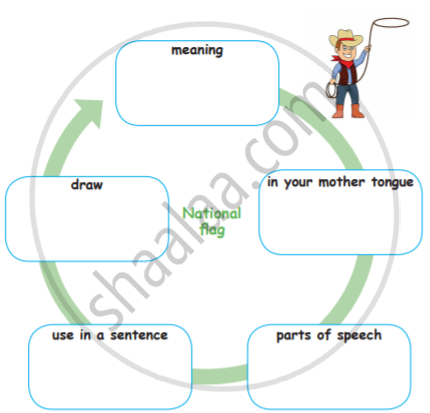
Choose the correct option from the given homophones.
The wind ______off the leaves.
Master trained Akilan on a ______.
Anbu was talented in catching______.
Choose and write the adverbs to complete the sentence.

She won the game _____
Where do ants pile their food?
Name the animal and sound it makes.
If the fisher draws his net soon, he won’t get ______ in the net.
What are the details not to be revealed in public domain?
Read the following passage and do the activities:
A1. Fill in the blanks: (2)
- ______ percent of our daily communication is non-verbal.
- Eye contact is another type of ______ communication.
- Frequent blinking is a sign of the person feeling ______.
- One can readily detect _______.
|
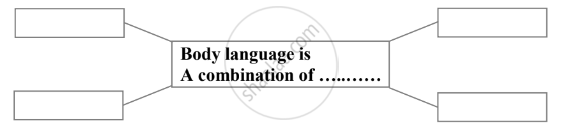
According to some experts, a staggering 93 percent of our daily communication is non-verbal. Facial expressions are easy to decipher. One can readily detect happiness, sadness, anger. Physicians can tell a patient is doing well (or not) by looking at his/her face. Eye contact is another type of non-verbal communication, which can tell a lot about the other person. The eyes convey a range of emotions-happiness, sadness, boredom, surprise, confidence .......... even emotional interest. Staring at someone's forehead may intimidate the recipient, staring at the mouth is sometimes interpretated as a sign of emotional interest. In fact, staring into someone's eyes is a sign of lying, and so is looking away. In certain cultures, lack of eye contact is taken as a sign of respect. If body language is to be defined, it is a combination of facial expression, gestures, eye contact, body movements and posture and voice. Frequent blinking is a sign of the person feeling distressed or uncomfortable. If the pupils are dilated, it ofter indicates interest, even emotional interest. The lips also reflect our body language, and lip biting indicates worry and/or anxiety; tightening of the lips may be an indication of disapproval. Slightly turned-up lips indicate happiness and slightly turned-down lips indicate sadness. |
A2.
A3. Find the antonyms of: (2)
- verbal × ______
- entertaining × ______
- sender × ______
- comfortable × ______
A4. Do as Directed: (2)
- The eyes convey a range of emotions. (Frame a 'Wh' question in order to get the underlined part as answer).
- Physicians can tell about a patient's wellness. (Rewrite using 'able to')
A5. Personal Response: (2)
Non-verbal communication plays an important role in our daily life. Comment.
Read the extract and complete the activities given below:
|
The call of the seas has always found an echo in me. Not being rich enough to roam in a private yacht, I have taken the poor man's way out. I swim across them. I have always been fascinated by the Indian ocean, whether at Mumbai, at Puri or at Gopalpur. I have swam in all these places and have felt the thrill. But the idea of swimming the Palk Strait did not occur to me until after I swam in the English channel. Steeped in the history and tradition of this nation, practically unconquered. teaming with hair-raising hazards, the sea between India and Sri Lanka had all the elements of challenge, danger and difficulty that tempted me. By the way, for preparation, I continued a strict and rigorous course of training which began in 1960. I also had to collect a comprehensive range of facts and information about this sea. Neither of these was easy. Despite all the information I had gathered, I soon found that very little was known about the Palk Strait, especially about the tides and currents. Everything about the English channel is known-there is the Channel Swimming Association, there are trained pilots there are wants to be hired, accurate weather forecasts, dependable tide tables and every other form of assistance was readily available. All that one needed was money. Here in the Palk Strait one has to find out firstly from where information could be obtained and then decide how much of it could be incorrect or misleading! |
A1. Rewrite the following as per their sequence in the extract: (2)
- I also had to collect a comprehensive range of facts and information about this sea.
- I have swam in all these places and have felt the thrill.
- All that one needed was money.
- Despite all the information I had gathered, I soon found that very little was known about the Palk Strait.
A2. Explain: (2)
What does the writer man by saving, "Steeped in the history and tradition of this nation, practically unconquered, teeming with hair-raising hazards, the sea between India and Sri Lanka had all the elements of challenge, danger and difficulty that tempted me"?
A3. Give reason: (2)
The narrator had an intense desire to swim in the Palk Strait. Explain the reasons for it.
A4. Personal Response: (2)
Do you like to have an adventurous life? Express your opinion.
A5. Grammar:
Do as directed: (2)
- Very little was known about the Palk Strait. (Rewrite as a negative sentence)
- I had to collect a comprehensive range of facts. (Rewrite the sentence beginning with 'A comprehensive ........)
A6. Vocabulary: (2)
Give the synonyms of the following words:
- rigorous - ______
- thrill - ______
