Advertisements
Advertisements
प्रश्न
What does the reference to raw mythology imply?
Advertisements
उत्तर
The Banyan tree is a mythological one, and when his grandmother calls it along with the other trees to be sacred. Religious sentiment is brought out in not just the poet but the reader as well. When the tree is slaughtered on the orders of the poet's father, a mystery is revealed. First, the scraggy aerial roots were brought down unleashing age-old trunk that had a circumference of fifty feet. It was a tree that had witnessed ages and held all the knowledge knotted inside. When it was brought down it felt as if all the mythology was revealed to the poet. The darkness and the concealed, the enlightenment it has secreted away for so long. The reasons and the answers to all the logics all were beheld by the tree and now was slaughtered.
APPEARS IN
संबंधित प्रश्न
How did a story book, 'Little Lord Fauntleroy' open a window of knowledge to Helen and help to shape her career?
The black kite may start a fire because
Read the following passage and complete the activities given below:
Answer the following question in 200-250 words:
Helen had a great love for animals and birds. Write about this aspect of her character.
This short story revolves around a single important event. Discuss how the narrative is woven around this central fact.
How does the poet juxtapose the human condition with the behaviour of the political class?
Read the following statement and mark those that apply to you.
I have cordial relationships with all but I cannot connect with anyone.
Using a dictionary/internet note down the main difference between a developing nation and a developed nation.
Pick out some sentences from the lesson that convey a general truth.
‘But the peasant bowed and prayed to God ...........’ What could he have prayed for?
Correct the following statement.
Behrman was a very heartless person.
Choose the proper alternatives from the statements given below which would explain why town planning is essential - _______________.
- To develop the city according to the guidelines.
- To get the ‘Best City Award’.
- To attract tourists.
- To use and develop the land available in the city for the interest of the citizens.
Match the terms in ‘A’ with their explanation in ‘B’.
| 'A' | 'B' | ||
| (1) | tooth- extraction | (a) | a cut made for surgery |
| (2) | cardiac | (b) | having length, breadth, and depth |
| (3) | sedative | (c) | plastic surgery |
| (4) | tumor | (d) | related to the heart |
| (5) | incision | (e) | a control unit for a robotic surgery |
| (6) | a console | (f) | removing a decayed tooth |
| (7) | 3-D | (g) | a substance that makes a person sleep |
| (8) | Cushing clip | (h) | an extra growth in the body |
| (i) | a device to stop blood loss in neurosurgery |
Join the sentence using appropriate Co-ordinators. (but, or, so, and)
He places his fingers into the master controls. He operates all four arms of the Da Vinci.
Find at least two things from the poem that show the following:
It is the early morning.
Make a list of functions/events/programs/activities organized in your junior college. Choose three events and plan a program schedule of your own. Prepare a script as well to show the associating role of the compere for a particular event. Make your own sequence and design a template for the same.
Draw a diagram to show how life returned to the island. Label the diagram.
(Use the technique of drawing diagrams when you study science, geography, etc.)
Show the three categories of volcanoes using the following tree diagram structure.
Write a short speech for the State of Maharashtra.
Antonio had gone on a long voyage.
Read the following sentence aloud. Write who said it and to whom.
“Look, here’s something for you.”
Write the meaning of doth.
A parody is a playful, comic imitation of a writer’s style. A parody is like a verbal cartoon. Compare the original poem and its parody given on page 35 using the following points:
|
How doth the little busy bee |
How doth the little crocodile (parody) |
| Choice of a subject (an animal) | __________________ |
| __________________ | __________________ |
| Number of lines and stanzas | __________________ |
| __________________ | __________________ |
| Same or similar constructions | __________________ |
| __________________ | __________________ |
| Tone of the poem | __________________ |
| __________________ | __________________ |
Answer in your own words.
What did the ancestor from 1910 wish to do instead of making his bed?
Find the words that mean the following from the first stanza.
- Gold hammered into a flat, thin shape: ______
- show off proudly: ______
- tilt, move at an angle: ______
- across, especially in a slanting direction: ______
The items in the programme below have got mixed up. Rearrange them in the proper order. Just add the number in the left-hand column.
| Balanand Vidyalaya Art Festival Programme | |
| ( ) | → Koli Dance |
| ( ) | → igniting the Lamp |
| ( ) | → Chief Guest Speaks |
| ( ) | → Appraisal of the Art Festival |
| ( ) | → Dignitaries Arrive |
| ( ) | → Recital of ‘Taal kacheri’ |
| ( ) | → Welcome and Introduction of Guests |
| ( ) | → Prize Distribution |
| ( ) | → The Boy Comes Home - A skit by Std IX |
| ( ) | → Vote of Thanks |
Write your own impressions about the news items given in (a), (b), (c), and (d) in the table below.
| News item | Good news Bad news | Reliable Unreliable | Interesting Uninteresting Boring | Others |
| (a) | ||||
| (b) | ||||
| (c) | ||||
| (d) |
Read: ‘The Psalm of Life’- a poem by H. W. Longfellow.
Write other meaningful words that begin/end with gentle-hearted.
Show the major events in the story of Pheidippides on a ‘time-line’.
Where is Rangoli usually drawn?
How was the young seagull’s first attempt to fly?
Do you think that the young seagull’s parents were harsh to him? Why?
Answer the following question in about 80-120 word.
If you were to live in the Complaining Street, how would you deal with the people who grumble?
What do you think are the two most important lessons that the speaker mentions?
The______ of ______ are nearly run.
- soft
- vain
- fear
- joy
- love
- heard
- toiled
- mild
- good
- sand
- life
- harsh
Where did Raj’s mother send him?
Identify and write the sport's name respectively.
- ______
- ______
- ______
- ______
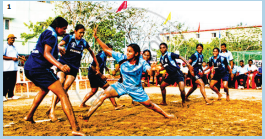
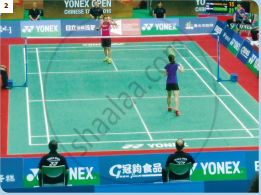
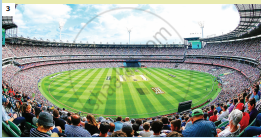
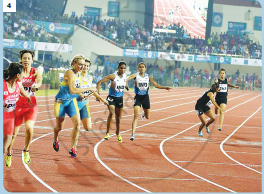
Women/Men can achieve anything, provided they put their heart and soul into it. Discuss in the class. Do you think being a man or a woman makes a difference?
Gulliver took the small creatures in his hand and crushed them.
How is water produced in Mars?
It ploughs soil before _________.
A ________ dies for the nation.
What did Anitha eat in the expo?
Connect the rhyming words.
| strong | tall |
| call | sack |
| back | along |
Choose the odd one out.
Write the rhyming word.
Tree - ______.
Fruits and shadows are free under the _______.
Look at the picture and tick choose the correct word.

The message was to gather on ______.
Answer the following yes or no question.
Did Appu share guava?
Write the word under the correct group and divide it.
bullet
candle
bat
title
ball
tiffin
 |
 |
 |
Why relationships are more important than wealth?
Why was the teacher annoyed?
Savings is done after fulfilling the______.
Who wins the world at the end?
Do you think Nasruddin was good at archery?
Read the following passage carefully and answer the following questions.
Pollution is the introduction of contaminants into the environment that cause harm to the ecosystem. The different kinds of pollution are air pollution, water pollution and land pollution. The release of various gases, finely divided solid particles, or liquid droplets that escape into the atmosphere to disperse and dilute in the environment is called air pollution. Modern society is also concerned about specific types of pollutants, such as noise pollution, light pollution, and plastic pollution.
Particulate Matter (PM), also known as particle pollution, is a complex mixture of extremely small particles and liquid droplets that get into the air. These particles if inhaled can affect health. The impact of PM 2.5 is particularly high in South Asia. Outdoor pollution is caused by a variety of pollutants like public and private vehicles, waste burning in the open, power production industries and construction and even cigarette smoking in public places.
Presently, air pollution is a major and growing risk factor for ill health in India. Delhi is one of the most air polluted cities in India. The air in the city as well as areas surrounding it has worsened to extremely hazardous levels in the recent years. This year’s pollution level is the worst in four years. Several studies have shown that poor air quality is a cause for many health issues among people with lower respiratory disorders with symptoms like dry cough, breathlessness, wheezing, chest discomfort, serious lung infections and cardio vascular diseases. Some studies throw light on the fact that about 16 per cent of the deaths worldwide in 2015 were due to pollution.
Air Masks are an option to protect oneself outdoor. Air masks can be used while commuting or while one is exposed to a polluted area. Some of these masks also include a layer of Activated carbon to filter the air. They protect us from suspended air particles and particulate matter up to the size of 2.5 microns and above. Their usage is limited to some days and should be disposed off after their prescribed duration of usage. The price for air masks starts from Rs 100 and can go up to Rs 500 and more.
We have to take active measures to control pollution and protect ourselves to lead a healthy and pollution free life.
- What is meant by pollution? Mention the different kinds of pollution.
- How does Particulate Matter cause air pollution?
- Identify three major causes of pollution in air
- Name the types of pollution we encounter now.
- What sort of health issues do people face due to air pollution?
- How can we protect ourselves outdoor from air pollution?
- Suggest a suitable title to the passage.
- Identify the meaning of the word similar to the one used in the fourth para:
- emerging
- filtering
- floating
- falling
Being a bachelor, the stranger had no patience with children.
Activity: Live English: Packs, packets, pouches, wrappers

Given above is the picture of an imaginary food item’s packet. Let us see how to ‘read’ the matter on the packet as a vigilant consumer.
- Look at the wrapper and complete the sentences.
- The name of the food item is ______.
- It is made by ______.
- It is a ______ food item. (Veg/Non-veg)
- The ______ sign indicates whether it is a Veg or Non-veg food item.
- The ingredients are ______, ______, ______, ______.
- The date of packing is ______ and the expiry date is ______.
- It should be consumed before ______ from the date of manufacturing.
- Try and obtain more information about the various symbols printed on the packet.
- Discuss the following -
- Why the ‘recipe’ is given on the packet.
- Why the packet tells us to visit the website of the company.
- What ideas are used to make the packet attractive?
- How you will verify whether something is good for you to eat.
