Advertisements
Advertisements
प्रश्न
Notice the kind of English Tsetan uses while talking to the author. How do you think he picked it up?
Advertisements
उत्तर
Tsetan spoke short sentences, direct and simple. His English is simple; vocabulary not rhetorical. Besides he called the author “sir” everywhere. He seems to pay much respect to the author. He apparently was a tourist guide, whaich means daily interactions with foreign tourists. That is where he must have picked up the language from. It is quiet possible that he had broken knowledge of other languages as well.
APPEARS IN
संबंधित प्रश्न
How did the air raids disrupt the Dutch public life?
Answer any four of the following in 30 − 40 words each :
(a) What does Saheb look for in the garbage dumps?
(b) How was Gandhi treated at Rajendra Prasad's house?
(c) Why does one feel 'a sudden strangeness' on counting to twelve and keeping quiet?
(d) Mention any two things which cause pain and suffering. (A Thing of Beauty)
(e) When was the Tiger King in danger of losing his throne?
(f) What role did the American professor play in bringing Hana and Sadao together?
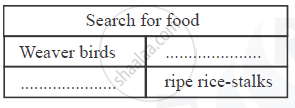
Complete the following table :
What inference can you draw from the action of the female gorilla described in para 2 ?
Read the following passage and do the activities:
B1 Match:
Match the areas given in Column ‘A’ with the description of Mehendi design given in Column ‘B’:
| 'A' | 'B" | ||
| (i) | North African | (a) | A mix of Indo-Pakistani and Arabic design |
| (ii) | Indian | (b) | Delicate loops and curves, paisleys, teardrops |
| (iii) | Arabic | (c) | Geometrical images |
| (iv) | South Asian | (d) | Local textiles, paintings, and architecture |
Henna comes from the leaves of the plant Lawsonia inertias. The plant grows in hot and dry climes and is native to North Africa, the Indian subcontinent and the Middle East. The leaves of the plant are dried and crushed to powder. Various additives such as coffee decoction, tea, lime juice, Mehendi and eucalyptus oil are mixed with the henna powder to increase the potency of the dry, this also helps to bind the powder to a paste-like consistency. The mixture is applied through cones in intricate patterns depending on the region of use.
Album of Patterns
Four major styles can be found in the vast dictionary of Mehendi designs. Earlier the application was restricted to hand and feet, but the adoption of Mehendi by different cultures throughout the world has seen experimentation on different body parts including the neck naval and back.
North African patterns rely on geometrical images to trace the shape of hands and feet, Arabic designs borrow heavily from local textiles, paintings, and architecture. These are more spaced out, to allow the design to stand out boldly from the skin parts left untouched by henna. The Indian style comprises of delicate loops and curves, paisleys, teardrops and flowers that give a dainty filigreed glow-like effect. Though intricate patterning is the name of the game today, this trend took off in India only during the 20th century. The patterns preferred by the South Asian countries are mixed with Indo-Pakistani and Arabic design schemes. Chinese and Celtic symbols now find a place in the vast repertoire of Mehendi designs as well.
B2 Complete:
Complete the following and write:
(i) The procedure before applying henna _______
(ii) The reasons for using additives _______
(iii) The suitable climatic conditions for the henna plant _______
(iv) Mehendi is used on _______
B3 Find words:
Look at the following description and find out proper words from the passage and write:
(i) Existing naturally in the place : - n _______
(ii) Consist of something: - c _______
(iii) Delicate decoration made from gold, silver and copper wire: - f _______
(iv) Substance that is added in small quantity : - a _______
B4 Language study:
Fill in the blanks with suitable subordinators given in the box:
| as well as, so that, however, which |
(i) The mixture is applied through cones in intricate patterns _______ depend on the region of use.
(ii) The intricate pattern is the name of the game of today _______, this trend took off in India, recently.
(iii) North African pattern relies on geometrical images ______ they can trace the shape of hands and feet.
(iv) The patterns preferred by the South Asian countries are mixed with Indo-Pakistani _______ Arabic design schemes.
B5 Personal Response:
Which Mehendi design do you like? Why?
A1 Web :
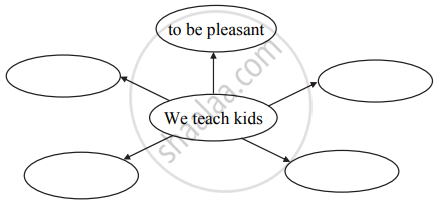
Complete the following web with the help of the passage :
My dictionary tells me that personality is the “Personal or individual quality that makes one person be different and act differently from another.” Personality is, “the total physical, intellectual and emotional structure of an individual, including abilities, interests, and attitudes.”
There are many benefits to having a pleasant personality. There is only one opportunity to make a first impression, and all of us instinctively make decisions or judgments about an individual within the first few seconds of crossing paths. With that in mind, I believe when we teach our kids to smile, to be pleasant and cheerful, to be courteous and respectful of others, to pleasantly respond to requests or questions, we are helping them develop a personality that will open many doors for them. Once the doors are opened, the character will keep them open; but personality, not character, is on display in the first few seconds. Therefore, it’s important to develop a pleasant personality and use it for life.
A2 Personality :
Personality of an individual is recognized by :
(i) _______ (ii) _______
(iii) _______ (iv) _______
A3 Vocabulary :
Find out words for the following from the passage and write:
(i) polite =
(ii) relating to feelings =
(iii) to do anything naturally without thinking =
(iv) a chance to do something =
A4 Complete the following table :
| Noun | Adjective | Adverb |
| – | different | differently |
| Instinct | – | instinctively |
Select any word from the table and use it meaningfully in a sentence of your own.
A5 Personal Response :
Why do you thing, personality development is necessary?
There is mention of three communities in the story: the Marathas, the Mughals, the Anglo-Indians. Which language do you think they used within their communities and while speaking to the other groups?
The peacock is the national bird of India. Why do you think the peacock has been chosen?
'Constancy' is the theme of the poem. Indicate the words, phrases, and images that suggest the theme.
Why is the speaker’s childhood described as ‘a forgotten boredom’?
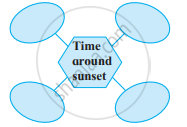
Pick out words from the poem to fill in the web diagram. They should be related to the theme in the web.
Think and answer in your own words.
What could be the age group of the speaker in the poem?
Say why the speaker of the poem wishes to be a-
hawker
Using points from the lesson, give the details of the following in a short paragraph.
The kite Bazar of Ahmedabad.
Correct the following statement.
The last leaf was a real leaf that survived.
Write four reasons why animals in a zoo suffer more than those who live free in the wild.
Say WHY. . . . . .
Hardy and Ramanujan could not talk freely with each other.
Read the passage and answer the following question:
What is 'Param Vir Chakra'?
Make a list of functions/events/programs/activities organized in your junior college. Choose three events and plan a program schedule of your own. Prepare a script as well to show the associating role of the compere for a particular event. Make your own sequence and design a template for the same.
Find a suitable object for each comparison.
Choose any one of the objects we use daily and find out how it is made. Present the information in the form of a chart.
What changes in the stage setting would you suggest.
State whether the following statement is True or False:
Oberon transforms Bottom's head into that of an ass.
The man in the moon is mentioned in many nursery rhymes and stories. When people see the spots on the surface of the moon, they imagine that it’s a human face or the figure of a man who lives on the moon. Sometimes, other characters like rabbits are also imagined to live with the man. Here are two nursery rhymes about the man on the moon.
Answer the following question in one sentence.
What would he do if he had the power to do it?
Form a pair. Write at least one short dialogue for the following expression.
I agree.
Discuss what a friendly and good-natured peacock would say to a crane. Write his speech. (5-8 lines.)
Imagine that there is a Mr Somebody who has to correct all the wrongs that are done by Mr Nobody. Write in the following table, what Mr Somebody will have to do.
| Mr Nobody’s Actions | Tasks for Mr Somebody |
| 1. The plate is broken / cracked | Mend the plate. / Throw it away carefully. |
| 2. The book is torn | ____________ |
| 3. The door is ajar. | ____________ |
| 4. The buttons are pulled from the shirt | ____________ |
| 5. The pins are scattered. | ____________ |
| 6. The door is still squeaking. | ____________ |
| 7. There are finger marks upon the door. | ____________ |
| 8. The ink has spilled over. | ____________ |
| 9. Boots are lying around. | ____________ |
| 10. ____________ | ____________ |
| 11. ____________ | ____________ |
Add a few more things to the list in the above table, using your own ideas and experience.
Think and answer:
Are the boys and girls happy that it is raining?
Rewrite in your own words.
One event from the story.
Find from the Internet and write down.
From which play is this song extracted?
Fill in the blank choosing the appropriate word/idiom from the lesson.
The ______ solved the mysterious crime.
Listen carefully and write all the words correctly.
You are right. Write it down in the right-hand corner.
Read the word. Write the words that combine to make it.
footprint
How do we come to know that Kasim was a generous man?
Guess the meaning of the following word.
magnificent
How did the bird try to reach its parents without having to fly?
Look at the following expressions from the text. With the help of your teacher rewrite them in standard English. One has been done for you.
| 1. ‘Musta got away – whatt’d he like? | Must got away - what was he like?’ |
| 2. ‘Looky here, Joe | |
| 3. ‘No sign o’ nothing’ | |
| 4. ‘Back t’ the lines ye goodaam | |
| 5. ‘What was the idea of all them cops tarryhootin’ round the house last night. |
How did Hamid’s friends show that they enjoyed eating the sweets?
Find a sentence/word from the text which express the following.
One of the qualities of the teacher.
What did Mr. Fogg mean by, ‘it was foreseen’?
Identify the speaker/character.
Don't worry, Madam, it's only a warning.
Why does the child clamber and scramble?
Discuss in groups. Retell the story in your own words. Each one should say one sentence.
You can begin like this:
Gulliver was travelling in a ship. One stormy night, the ship was wrecked...
The pit was comfortable for the wild boar to sleep in.
The ________ are trying to terraform Mars.
We don’t use _________ in the soil.
What happened to Dr. Karmugilan in the story?
The scene is set inside a thick forest and it is nearing dusk. Relate this time frame with the behaviour of the animals in the forest.
Vicky’s father decided to change his son’s character.
Fruits and shadows are free under the _______.
Answer using Yes or No and pick sentence from the story to support your answer.
Do cannibals eat people?
Circle and write the adverbs.
We will leave today. ______
Teddy took his pillow as a sign of ______ them.
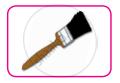
Name the pictures and match it with the rhyming words.
 |
dancer | |
 |
floor | |
 |
will | |
 |
rush |
Write about the places where the poet wants us to run.
What happens when the day is over?
Why did he go there?
According to Tagore, when will India get the opportunity to win the gift of freedom?
Read the following sentence.
‘A very wise man once remarked that of the unspoken word, you are a master; of the spoken word, you are a slave.’
The sentence has two pairs of opposites - spoken and unspoken, and master and slave. The contrasting ideas make the sentence more effective. Putting together opposite or contrasting ideas in one sentence is a literary device. It is called antithesis.
Read the following examples of antithesis.
- Give every man thy ear, but few thy voice.
- Man proposes and God disposes.
- Speech is silver, but silence is gold.
- Patience is bitter, but it has a sweet fruit.
