Advertisements
Advertisements
प्रश्न
Notice the kind of English Tsetan uses while talking to the author. How do you think he picked it up?
Advertisements
उत्तर
Tsetan spoke short sentences, direct and simple. His English is simple; vocabulary not rhetorical. Besides he called the author “sir” everywhere. He seems to pay much respect to the author. He apparently was a tourist guide, whaich means daily interactions with foreign tourists. That is where he must have picked up the language from. It is quiet possible that he had broken knowledge of other languages as well.
APPEARS IN
संबंधित प्रश्न
Discuss the following statement in groups of two pairs, each pair in a group taking opposite points of view.
Reality is what is directly experienced through the senses.
Nouveau riche and bourgeoise are French words. Collect from newspapers, magazines, and other sources some more French words or expressions that are commonly used in English.
Locate expressions in the text reflect the Indian idiom, for example, the pride of the generations of his ancestors.
An acrostic is a poem or a write· up in which the first letter of each line forms a word. when it is read vertically.
For example,
Faithful
Reliable
Inspiring
Encouraging
Noble
Dedicated
With your benchmate / group, complete the acrostic of BELIEVE and FAITH.
(Please note that the words / phrases should be more or less related to the topic. You can use a thesaurus.)
Be certain of
E ......................
L ......................
I ......................
E ......................
V ......................
E ......................
F ......................
A ......................
I ......................
T ......................
H ......................
Think and answer in your own words.
What is the difference between a hawker and a shopkeeper?
Write down any two Slogans on 'Gender Equality'.
For preparing questions based on the poem, an overall understanding of the poem is a must. Discuss with your partner and prepare a set of five questions.
For example:
- What is the name of the bridge?
- ________________________________
- ________________________________
- ________________________________
- ________________________________
- ________________________________
Behrman did not know anything about the last leaf on the ivy.
Find out from a vet or from a website, what precaution a vet has to take when he/she is called to treat wild, dangerous animals?
Make point-wise notes of the same.
Find at least five other Akbar and Birbal stories and share them with your friends. Make a list of the stories collected by the entire class. Put your list in alphabetical order.
Fill in the gap, choosing a word from the bracket to make an appropriate comparison.
as ______ as a worm
Suggest what you would do in the following situation:
You are going through a crisis that is making you short-tempered and impatient, due to which you end up causing harm to your family and friends. They have started complaining about it quite often.
Find 2/4 expressions of humour from the extract.
Can you imagine life without wheels? Try and think of what life would be like if there were no wheels around.
Write a conversation between a donkey and a horse.
Apart from class/school, where else are you likely to find a time table useful?
Read the following sentence aloud. Write who said it and to whom.
“You have nothing else?”
Write the following:
The sights seen through a railway carriage mentioned in the first stanza.
Gather more information about the following from your Science textbook, the internet, and other sources.
Gravitational force
Write the meaning of doth.
These two passages are examples of a short introduction to works of art - a short review. They cover the following points:
- The creator
- The theme or subject matter
- Type of art
- Individual style
- Presentation techniques
- Its effect on viewers
- Message or interpretation
Compare the points with those you used for a book review and the review of a play. Present the comparison in the form of a chart.
| Book Review | Review of a play | Review of a painting |
Put the following events in proper order.
- Holmes and others go to the bank.
- Clay digs a tunnel.
- Ross closes the office of the 'Red-headed League'.
- Holmes catches the criminal Clay.
- Clay and Ross enter the cellar to steal the gold.
- The bank received a lot of gold from the Bank of France.
- Holmes visits the area around Mr. Wilson’s shop.
Does Marouckla get any of the things she brings?
List and say whether the following statement agrees with the passage or not.
If you don’t understand something, don’t let the others know about it.
Read the highlighted words. They are adverbs.
- I was pulling hard.
- They ran away.
- Later, I was taken to the city.
- I went very carefully.
- They were greatly pleased.
Write how the travellers crossed the second gulf.
Find a word that has a similar meaning.
unfair
What will happen to the bird in imprisonment?
Pick out the words which rhyme with the given words and write similar rhyming words on your own.
| 1. | far | ||
| 2. | fear | ||
| 3. | low | ||
| 4. | kind | ||
| 5. | remain | ||
| 6. | they |
How can we make our life worth living?
The terrorists asked Neerja to collect the passports of the passengers because ______.
Read the following article about the amazing similarities between the assassination of John F. Kennedy and Abraham Lincoln; then underline the passive forms.
Abraham Lincoln was elected to Congress in 1846. Voters elected John F. Kennedy to Congress in 1946.
Lincoln was elected president in 1860. Voters elected Kennedy president in 1960.
Both men were particularly concerned with civil rights.
Both wives lost their children while living in the White House.
Lincoln was shot on a Friday. Someone shot Kennedy on a Friday.
Lincoln was shot in the head. The gunman shot Kennedy in the head.
Lincoln’s secretary was called Kennedy. Kennedy’s secretary was called Lincoln.
Lincoln was assassinated by a Southerner. A Southerner assassinated Kennedy.
Lincoln was succeeded by a Southerner named Johnson. A Southerner named Johnson succeeded Kennedy.
Andrew Johnson, who succeeded Lincoln, was born in 1808.
Lyndon Johnson, who succeeded Kennedy, was born in 1908.
John Wilkes Booth, who assassinated Lincoln, was born in 1839. Lee Harvey Oswald, who assassinated Kennedy, was born in 1939.
Both assassins were known by their three names and both names are composed of fifteen letters.
Lincoln was shot at a theatre named “Ford”. The gunman shot Kennedy in a car called a “Lincoln” that the company Ford made.
Booth ran from the theatre and was caught in a warehouse. Oswald ran from a warehouse and the police caught him in a theatre.
Booth was assassinated before his trial. Someone assassinated Oswald before his trial.
Why did Muthu say that he could walk along its side?
Read the lines and answer the question given below.
Each a glimpse and gone forever;
a. What is ‘each’ over here? Why is it gone forever?
What does ‘charges along like troops in a battle’ mean?
Gulliver took the small creatures in his hand and crushed them.
The blue lights seen through the window were aliens.
How did the aliens know the boys' language?
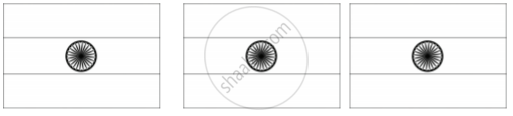
Read the passage and colour one flag each time you read.
Our national emblem is taken from Ashoka’s pillar at Sarnath. It is found on all government documents, coins, currency notes, postcards, and envelopes. It consists of four lions standing back to back but, we can see only three lions at a time. There is a Dharma chakra in the centre of the base plate, with the figure of a bull in the right and that of a horse in the left. The entire structure is sitting on a lotus. The words ‘Sathyameva Jayate’ is written under it in Devanagari script. These words mean, ‘Truth alone Triumphs’.
Vicky decided to______ the robot at the end.
Robot asked Vicky to sell him to an ______ master.
How did Vicky change at the end?
How did the old man disguise himself?
Where did we visit a mermaid?
_______ is our culture.
Name the character or speaker.
“Learn well, live well!”
What did they use as net?
Name the character or speaker.
"Did someone scold you?"
Who were the friends referred in the story?
Leaf cutter ants drink ______.
The king looked for a______.
What is the main idea of the story?
The pretty little fir tree was happy with gold leaves but______.
What does the poet want us to do at night?
How did the animals know that the king was just a jackal?
The passage given below is on Kabbadi. Read the passage and complete the activities that follow.
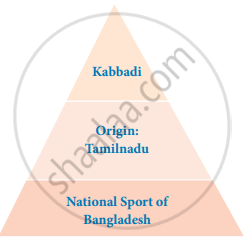
Kabbadi (கபடி - in Tamil) is a contact team sport that originated in Tamil Nadu, India. It is the national sport of Bangladesh. It is also popular in South Asia and is the state game of the Indian states of Tamil Nadu, Kerala, Andhra Pradesh, Bihar, Haryana, Karnataka, Maharashtra, Punjab, and Telangana.

Kabbadi is played between two teams of seven players: the objective of the game is for a single player on offence referred to as a 'raider', to run in to the opposing teams half of a court, tag out as many of their defenders as possible, and return to their own half of the court–all without being tackled by the defenders. Points are scored for each player tagged by the raider, while the opposing team earns a point for stopping the raider. Players are taken out of the game if they are tagged or tackled, but can be 'revived' for each point scored by their team from a tag or tackle. The raider should hold his breath and utter the words like 'kabbadi kabbadi, hututu hututu, chadu kudu' etc. while the opponents try to catch him. If he stops uttering these words, he is considered out.
The game is known by its regional names in different parts of the subcontinent, such as Kabbadi or Chedugudu in Andhra Pradesh, Kabbadi in Kerala and Telangana, Hadudu in Bangladesh, Bhavatik in Maldives, Kauddi or Kabbadi in the Punjab Region, Hu-Tu-Tu in Western India and Hu-Do-Do in Eastern India and Chadakudu in South India. The highest governing body of Kabbadi is the International Kabbadi Federation.
Given below is the visual presentation of the first paragraph.
i) Represent the other paragraphs in a visual form of your choice(flow chart, mind-map, pie-chart, etc.).
ii) Choose the correct option.
1. A contact sport usually involves a ______contact between players.
- violent
- gentle
- physical
2. Kabbadi is a game played between ______.
- seven teams of two players
- two teams of seven players
- four teams of seven players
3. A single ______.
- player on offence is referred to as a raider
- offence is referred to as a raider
- raider is an offence by the player
iii) Answer the following.
- How does a raider score points for his team?
- When does a raider concede a point to the opponent team?
- Can a player be revived when he/she is out of the game? Explain your answer.
- Kabbadi is called by different names in different parts of India. Do you know how Pallankuzhi is called in Karnataka, Andhra Pradesh and Kerala?
Which of the following should one avoid while using social media? Tick against the correct options.
Being a bachelor, the stranger had no patience with children.
Look up the following entries in the Language Study pages given at the end.
- stress
- intonation
- sound
- consonant
- vowel
