Advertisements
Advertisements
प्रश्न
Notice these expressions in the text. Infer their meaning from the context.
-
blow-by-blow account
-
morale booster
-
relegated to
-
political acumen
-
de facto
-
astute
-
doctored accounts
-
gave vent to
Advertisements
उत्तर
-
blow-by-blow account: detailed account. In the text “The Adventure” this expression occurs in the context of Gangadharpant trying to understand the outcome of the Battle of Panipat by reading a book on the topic.
-
morale booster: anything that serves to increase morale or confidence. The expression occurs in the text 'Adventure' where it is told that the Marathas emerged victorious in the Battle of Panipat which increased their morale or confidence in establishing their supremacy all over the country.
-
Relegated to: assigned to a lower rank or position. In the text, it is said how Dadasaheb, a Maratha Chieftain was assigned to a lower rank after the Battle of Panipat.
-
political acumen: political shrewdness with keen insight. In the text 'The Adventure' the expression is used to convey how Madhavrao and Vishwasrao because of their shrewdness could expand their influence all over India.
-
de facto: existing in fact whether with lawful authority or not. In the text 'Adventure' the Peshwas is regarded as de facto rulers as they kept the Mughal regime alive in Delhi.
-
astute: marked by practical hardheaded intelligence. In the text “The Adventure” this word is used to convey that the Peshwas were very intelligent to recognise the importance of technological age dawning in Europe.
-
doctored accounts: manipulation of accounts. This expression conveys that the Bakhars were not providing historical facts but manipulated accounts of history.
-
give vent to: to express one's feelings and ideas. Professor Gaitonde expressed his ideas in the public lecture on the Battle of Panipat.
APPEARS IN
संबंधित प्रश्न
B1. Select
Fill in the blanks choosing the correct alternatives from those given in the bracket:
(i) The author was inspired and motivated to read ............................................ by the time she was eleven.
[Shakespeare, Chaucer, G.B. Shaw]
(ii) Every lesson .......................... ......... took was spiced with half a dozen or more anecdotes.
[Mrs. Rowlands, Sister Monica, Mr. A.N. Patil]
(iii) The teachers helped the narrator to become ..................................... . .
[confident, happy, independent]
(iv) Mrs. Cynthia Nesamani and Sister Monica gave .......................................... to the narrator.
[freedom to do what he wanted, advice to do something, instructions to produce better results]
In a way, one of the greatest gifts any teacher can give a student, I think, is to inculcate a curiosity to learn.
I've been incredibly lucky to have at least one such teacher at every stage in my life. The first was Mrs. Rowlands who taught me in primary school. She taught me to read without ever pushing me. She made me want to read more by giving 'me some of the most interesting children's books available. And although I still love to go back to those books from time to time, it was only because of her that I was able to read Shakespeare by the time I was ten, and Chaucer a year later.
In later years, it was Mr. A.N. Patil, my Marathi and Hindi Teacher who made a huge impression on me. Every lesson he took, was spiced with half a dozen or more anecdotes from a wide variety of subjects: among them history, politics, religion and sociology. I was, and still am in awe of his knowledge, which despite rather desperate attempts, I doubt I'll ever be able to match.
There have also been other teachers who helped me to try to become independent: to think and act for myself using my own judgement, which to my mind has been just as, if not more important, than actually learning anything.
After all, it's much too easy to become a completely useless repository of facts and little else.
Two teachers whom I remember in particular are Mrs. Cynthia Nesamani and Sister Monica, both taught me in school. The former, by and large, gave me a free rein to do what I wanted to do. I, being one of those people who dislike instructions, she helped me to produce much better results than I'd have otherwise done.
B2.Complete
Read the extract and complete the following:
The teacher can
(i) .............
(ii) ..............
(iii )..............
(iv).................
B3. Similar word
Look at the following sentences arid pick the word having similar meaning to the given word and rewrite:
(i) Spiced His conversation is always with a lot of humour. (made interesting, garnished, flavoured)
(ii) Repository
The library should not merely be a ................ of books. (store-house, reservoir, tank)
(iii) Inculcate
It is the responsibility of the parents and teachers to .......values in the child's formative years. (imbibe, give, show)
(iv) Incredibly
I have been .. lucky to have at least one such teacher at every stage in my life. (importantly, unbelievably, beautifully)
B4. Language study
(i) There have also been other teachers. They have helped me to try to become
independent. (Combine using 'who')
(ii) It was only because of her that I was able-to read Shakespeare.
(Rewrite beginning with: If it was not for her, ).
B.5 Out motivators
Look at the following table and complete it by presenting your own views
| Personalities | Influence on your life |
| (i) Teachers | |
| (ii) Parents | |
| (iii) Relatives | |
| (iv) Friends |
A1 Web :
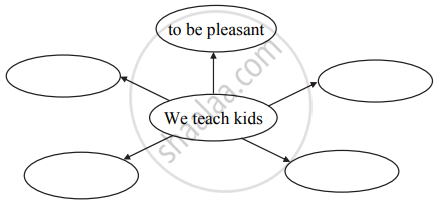
Complete the following web with the help of the passage :
My dictionary tells me that personality is the “Personal or individual quality that makes one person be different and act differently from another.” Personality is, “the total physical, intellectual and emotional structure of an individual, including abilities, interests, and attitudes.”
There are many benefits to having a pleasant personality. There is only one opportunity to make a first impression, and all of us instinctively make decisions or judgments about an individual within the first few seconds of crossing paths. With that in mind, I believe when we teach our kids to smile, to be pleasant and cheerful, to be courteous and respectful of others, to pleasantly respond to requests or questions, we are helping them develop a personality that will open many doors for them. Once the doors are opened, the character will keep them open; but personality, not character, is on display in the first few seconds. Therefore, it’s important to develop a pleasant personality and use it for life.
A2 Personality :
Personality of an individual is recognized by :
(i) _______ (ii) _______
(iii) _______ (iv) _______
A3 Vocabulary :
Find out words for the following from the passage and write:
(i) polite =
(ii) relating to feelings =
(iii) to do anything naturally without thinking =
(iv) a chance to do something =
A4 Complete the following table :
| Noun | Adjective | Adverb |
| – | different | differently |
| Instinct | – | instinctively |
Select any word from the table and use it meaningfully in a sentence of your own.
A5 Personal Response :
Why do you thing, personality development is necessary?
Briefly comment on:
Tsetan’s support to the author during the journey.
The story begins with a description of the setting. How does this serve as a fitting prelude to the events described in the story?
We 'draw up a deed'. Complete the following phrase with an appropriate word.
________a deaf ear to
How is humour employed to comment on the pains that the author took to get his watch set right.
People with foibles are often not conscious of them.
Explain the phrase.
his bending sickle's compass
Identify the lines that reveal the critical tone of the poet towards the felling of the tree.
Why have the words, 'pretended' and 'seemed' been used in the lines:
...Pretended to believe every single word
of what the tiger king said.
And seemed to be taken in by all the lies.
How does the sense of these lines connect with the line 'Ajamil wasn't a fool'?
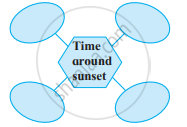
Pick out words from the poem to fill in the web diagram. They should be related to the theme in the web.
Answer in your own words.
What message does the poem convey to all of us?
Find out from the internet the poem ‘Song of Youth’ by Dr APJ Abdul Kalam.
- Copy it down in your notebook and write its theme in your own words.
- Using information from your school library or the Internet, prepare a Profile of any great Indian Scientist.
In the following sentence, point out the Main Clause and Subordinate Clause. Encircle the Subordinator.
Old Behrman was a painter, who lived on the ground floor.
You have heard the proverb ‘Plan your work, work your plan’. It means - ________________.
Answer the following question in short.
Why was Tenali Raman taken to the court in a palanquin?
Write a short note on Emperor Akbar.
Fill in the gap, choosing a word from the bracket to make an appropriate comparison.
(tall / quiet / humble / merry / busy / slippery / fast / sly / slow / big)
as ______ as a snail
Comment on the given statement after reading the given dialogue -
It’s a pity some honest man not to be better of that ________________________________________________.
Comment on the versatility and the aptness of the stage settings, as per the requirement of the play “A Midsummer-Night’s Dream!”
Expand the following ideas in a paragraph or two:-
Where there is a will, there is a way.
What two basic rules were followed in the Science Fair?
List the various people and places mentioned in the passage. The places Milo visits and the people he meets have unusual names. Write the meanings of those names.
How do you behave with your classmates? Write about your attitude and behaviour in the appropriate column.
Some actions:
- Ask others for help
- Refuse help
- Judge others by their appearance
- Judge others by their accent
| Always | Sometimes | Never |
| ____________ | ____________ | ____________ |
| ____________ | ____________ | ____________ |
| ____________ | ____________ | ____________ |
Using your imagination, write more sentences in the same pattern:
- But the more the lion had, the more he wanted.
- Whenever he took a walk, they followed him.
- To be king is good. But to be kind is better.
Write the symbol that is used in the poem to represent the following idea.
I made a rare choice.
Present Mr. Wilson’s story as it would be shown in a comic strip. Write what picture you will show in each frame along with the dialogues. Write the dialogue with the help of the story. Examples:
 |
 |
 |
Find the meaning of the following word.
adorning
Name the following.
Pounced on Dhyan Chand and hurt him.
What are the complaints of the animals?
Write a short note/story based on the ill effects of pollution.
What is meant by 'Honour the white cane'?
What does 'Rangaawali' mean?
Read the following passage and answer the questions that follow.
BUNGEE-JUMPING
Bungee jumping is an activity that involves jumping from a tall structure while connected to a long elastic cord. The tall structure is usually a fixed object, such as a building, bridge or crane; but it is also possible to jump from a movable object, such as a hot-air-balloon or helicopter, that has the ability to hover above the ground. The thrill comes from the freefalling and the rebound. When the person jumps, the cord stretches, and the jumper flies upwards again as the cord recoils and continues to oscillate up and down until all the kinetic energy is dissipated.
Jumping Heights, located in Mohan Chatti village, in Rishikesh has been rated as one of the most preferred bungee jumping destinations in India at a height of 83 meters. It is the only place in India where bungee jumping can be done from a fixed platform. This is also India’s only fixed platform Bungee- performed from a professional cantilever, to separate it from entertainment parks, and create instead, an extreme adventure zone. The Bungee has been designed by David Allardice of New Zealand.
The Cantilever platform is built over a rocky cliff over-looking the river Hall, a tributary of River Ganges. Bungee-ing amidst the vastness of nature lends the experience an absolutely breathtaking quality. Jumping heights is well known for its safety measures and experienced staff. It costs around Rs 2500 per jump, a bit expensive, but totally worth the experience. The Bungee jumping experience has been set amidst the astoundingly stunning landscape of Rishikesh. To Bungee jump, one must be at least 12 years and should weigh between 40-110 kg.
Questions
- What is Bungee Jumping?
- Can Bungee be performed from a movable object? How?
- When do you think Bungee becomes thrilling?
- What is the experience when one falls off the platform?
- Where is the Bungee jumping point located in India?
- What is the minimum age to Bungee jump?
Answer the question in a paragraph of about 100 – 150 word.
Write a detailed character sketch of Prospero.
What was the grandfather wearing?
What did Aravind confess?
The parents noticed some changes in the child. What were they?
Look at the number pattern. Fill the blank in the middle of the series or end of the series.
ELFA, GLHA, ILJA, ______, MLNA
Why did the author leave town?
The horses were four and a half inches tall.
Did Tabaqui receive a warm welcome from the pack of wolves? How do you know?
Who sews the cloth?
The hut was very ______.
Where did we visit a mermaid?
______is next to parents in care.
Read the advertisement and answer the question given below.

When does the offer end?
Why do the leafcutter ants grow the fungus?
Write a paragraph on the topic ‘Park’.
The goose is swimming with its ______.
Fill in the blank
Pick out the rhyming words and write.
| green | |
| human | |
| will | |
| welfare |
Why did Manju’s parents leave the village?
In real the plate was made of ______.
How did Bala help Amma and sisters?
If the fisher draws his net soon, he won’t get ______ in the net.
Match with the opposite gender.
| 1. | prince | bridegroom |
| 2. | hero | princess |
| 3. | bride | heroine |
Write about the places where the poet wants us to run.
What does the poet want us to do at night?
Who came to Akbar’s court?
