Advertisements
Advertisements
प्रश्न
Discuss in groups of four.
The accounts of exotic places in legends and the reality.
Advertisements
उत्तर
All the exotic places on earth have been much written and talked about already either in legends or articles. There are several ancient myths attached to such places. It has been seen in many cases, especially the river sources and mountain caves are associated with religion and declared holy. However, in reality these places are nothing but nature's beautiful treasures. Places like Kailash and Manasarovar occupy a prominent place in Hinduism as well as Buddhism.
APPEARS IN
संबंधित प्रश्न
It was her determination that helped Helen Keller get admission to Radcliffe College. Comment.
Attempt the following in 150-200 words.
What was the incident of the Frost King? How did it affect Helen?
Read the extract given below and answer the questions that follow:
Far far from gusty waves these children's faces.
Like rootless weeds, the hair torn round their pallor;
The tall girl with her weighed-down head.
(a) Who are these children?
(b) Which figure of speech has been used in the first two lines?
(c) Why is the tall girl's head weighed down?
(d) What does the word, 'pallor' mean?
Complete the following table :
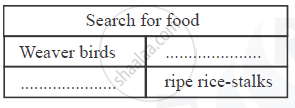
Read the following extract and then do all the activities that follow :
I rain into a stranger as he passed by
“Oh, excuse me please” was my reply.
He said, “please excuse me too; wasn't even watching for you.”
We were very polite, this stranger and I.
We went on out way and we said good-bye.
But at home a different story is told.
How we treat out loved ones, young and old.
Later that day, cooking the evening meal,
My daughter stood beside me very still.
When I turned, I nearly knoked her down.
“Move out of the way,” I said with a frown.
She walked away, her little heart broken.
I didn't realize how harshly I'd spoken.
While I lay awake in bed,
God's still small voice came to me and said,
“While Dealing with a stranger, common courtesy you use,
But children you love, you seem to abuse.”
A1. Order-
The incidents narrated in the extract are arranged in a jumbled manner here, Rearrange them in a proper order as they occur in the extract:
(i) The poet and the stranger went on their way saying good-bye.
(ii) Seeking excuse politely from the stranger, she went her way.
(iii) The poet ran into a stranger on the road.
(iv) The poet yelled at her daughter.
A2. Poetic device:
Make a list of rhyming pairs from the second stanza and note down the rhyme scheme of the same stanza.
A3. Personal Response:
Understanding and politeness are the essentials of out everyday life. Explain your views in brief.
A4. Creativity -
Frame two poetic lines on the following situation using a rhyming pattern with the help of clues given:
“While introducing great personalities, we praise them highly and talk about their qualities, but while speaking
about our friends we may not follow the same trend.”
While introducing great personalities, — a
------------------------------------ — a
But while speaking about our friends, — b
------------------------------------ — b
Answer the following question in 150-200 words:
Why did Anne like her father more than she liked her mother?
|
The energy stored in coal and petroleum originally came to the earth from the sun. The bulk of the present-day supplies was laid down some 200 to 600 million years ago, when tropical conditions were widespread. Lush, swampy forests produced huge trees; warm coastal seas swarmed with microscopic forms of life. When these organisms died, much of their tissue was recycled as it is today — through scavenging and decay. But a significant amount of dead plant and animal material was covered with mud, which prevented complete decomposition. With the passage of time, layer upon layer of the fine sediment was deposited over the once-living material; the sheer weight turned the sediments to rock. Sandwiched between the layers, both coal and petroleum were produced and preserved under pressure. Coal was formed mostly of giant fern-like plants that have only small counterparts today. Coal may still be forming here and there on earth, but conditions are not right for the production of significant quantities. |
Combine related points.
How has the author linked the symbol of the rocking-horse to Paul's triumphs at the races?
How does 'A Kondh Song' substantiate the tribal urge to gain domination over time by conversing with their dead ancestors?
Why does the poet prefer to be a primitive Pagan rather than a member of civilised society?
Explain the undertones in the statement:
'Wife and husband in unusual rapport
State one unspoken thought':
What decision taken by Dick changed his fortune?
Think and answer in your own words in your notebook.
Why does the poet appeal to us, to respect the life of a worm?
Pick out a word from the poem to complete the sentence meaningfully.
Stephen Hawking was a ______ (famous) Astrophysicist.
Read the poem and complete the web about the activities the planners do.

Write 3 to 4 lines about the following in your own words.
The Robotic Surgery
Say WHY. . . . . .
Ramanujan found the number 1729 very interesting.
Answer the following question in short.
What do you learn about Pundits of Vijaynagar?
Give reasons :
Oberon and Titania fight for the custody of the Indian boy because - Oberon wants __________________.
Explain the following statement with reference to the context.
And it's by no means the small sacrifice the town will have to make.
Discuss and write 1-2 lines about the following,
Yonamine’s ideas about marriage.
Make a time table of your daily routine
- On a school day
- On a holiday, and
- During examinations.
Start at the time you normally get up and list your activities
hourly: 7 am to 8 am, and so on.
Read the poem : ‘Where lies the land...’ by A. C. Clough.
Form groups of 4. Find all the references to the time given in the passage. Then make a chart to show the events described in the passage along with the time when they occur. Example:
| All night long: | The crew stayed on their feet. |
| Near midnight: | ________________________ |
| At 12.53: | ________________________ |
(Use as many lines as you need.)
How long does the whole event described in this passage take? Work it out by reading the passage.
Read the story ‘Lord Emsworth and the Girl Friend’ by P. G. Wodehouse.
Who said the following, to whom, and when?
“Mighty thy Teacher must be and divine.”
Listen carefully and guess how the sentence would end.
When the teacher read the answer papers, she was ______.
Choose a suitable heading for each announcement from those given below.
(Change in School Hours, Cleanliness, Story-telling Competition, Lost and Found, Warning, Football Match)
1.
|
6 July 2015 It has been observed by the Head Boy and Head Girl that certain classes do not clean up their classrooms before leaving. If any class is found untidy and littered after school, that class will be detained the next day after school hours up to 4 pm. Please take note of this. |
2.
| Tomorrow, that is, on the 10th of July, the school will close an hour earlier, as the teachers have to attend an important P. T. A. meeting. So please inform your parents to arrange to pick you up at 2 pm instead of 3 pm. |
3.
| On Sunday, 12th July 2015 there is a football match between classes VIII and IX, on the school ground. The match will begin at 9 am. All students are invited to come and cheer their favorite team. Please come on time, so that the players are not distracted. |
4.
|
The school has organized a Story-telling Competition for Classes V, VI, and VII from 21st to 25th of July. The competition will be held in the school hall at 10 in the morning. Children may select -
Three prizes will be given for each category. The time limit is 3-5 minutes. Those who wish to participate may contact Mrs. Sanjana Mohite for other details. They must register their names with her before the 16th of July. |
5.
|
Construction work to extend the school building will start next week. All students are cautioned not to cross over the fence at the construction site. It is dangerous and may cause you injury. Please stay away from that fence. |
6.
| A cycle key with a blue key chain has been found on the ground. Whoever has lost it can contact the clerk Mrs. Neena Pinto and see if it belongs to him/her. |
List the characters in the play.
Birds and animals
The poem has rhyming words at the end of the lines. Find and write the pairs of rhyming words in each stanza.
Guess the meaning of on the wing.
Share a memorable trip from your life
What did the coach teach the child?
Why did the author help his Grandfather plant trees?
What did Raj buy?
Mother did not ask for______.
What did she sell to support her family?
Write a paragraph about 50 words describing the scenes that the poet passed by.
Find example of alliteration and write them in the blank.
to muddy roads
monsoons and mangoes
Name some of the activities that the village children were doing on their vacation.
It is used in the fisher’s _____.
How did the second daughter use the grain?
Where did Anitha go?
Where did the bird catcher sit?
Akilan’s passion is to learn ______.
Match the following.
| 1. | Pablo | Inspector |
| 2. | Velayudham | old man |
| 3. | Sreejith | dog |
Bala and Janani acted like the______.
Circle and write the adverbs.
He laughed merrily ______.
Muthu collected ______ from every house.
Speak and win.
Join in one of the two groups. Choose two characters. Support or oppose any one of the characters. Say some sentences for the one you support and say some sentences against the other one, to win.
| I support | I oppose |
Where were they going?
What kind of water did Divya use to brush her teeth?
Recite the poem with correct intonation.
Do you think Ani will be a good leader? Why?
Read the passage carefully and answer the following question.
What is the main idea of the story?
______ was helpful for his father to drive out the wild animals.
Before going to bed that night, Chris gave his new teacher a ______.
Which creatures wake up in the morning before the child does?
