Advertisements
Advertisements
प्रश्न
Discuss the following in group.
Do’s and Don’ts for young children.
Advertisements
उत्तर
| Sr. No. | Do’s | Don’ts |
| (1) | Wash hands before eating. | Talk while eating. |
| (2) | Take small portions of food. | Fill your plate when you can't finish it. |
| (3) | Eat everything served on the plate. | Waste food. |
| (4) | Respect elders. | Disrespect elders. |
| (5) | Be kind and gentle to all. | Be rude and impolite. |
| (6) | Be neat and presentable. | Be untidy and unclean. |
| (7) | Speak politely. | Speak loudly. |
| (8) | Help others in need. | Ignore those in need. |
| (9) | Help parents at home. | Avoid work. |
| (10) | Make friends/be friendly. | Make enemies. |
संबंधित प्रश्न
Read the text below and summarise it.
The Great Desert Where Hippos Once Wallowed
The Sahara sets a standard for dry land. It’s the world’s largest desert. Relative humidity can drop into the low single digits. There are places where it rains only about once a century. There are people who reach the end of their lives without ever seeing water come from the sky.
Yet beneath the Sahara are vast aquifers of fresh water, enough liquid to fill a small sea. It is fossil water, a treasure laid down in prehistoric times, some of it possibly a million years old. Just 6,000 years ago, the Sahara was a much different place.
It was green. Prehistoric rock art in the Sahara shows something surprising: hippopotamuses, which need year-round water.
“We don’t have much evidence of a tropical paradise out there, but we had something perfectly liveable,” says Jennifer Smith, a geologist at Washington University in St Louis.
The green Sahara was the product of the migration of the paleo-monsoon. In the same way that ice ages come and go, so too do monsoons migrate north and south. The dynamics of earth’s motion are responsible. The tilt of the earth’s axis varies in a regular cycle — sometimes the planet is more tilted towards the sun, sometimes less so. The axis also wobbles like a spinning top. The date of the earth’s perihelion — its closest approach to the sun — varies in cycle as well.
At times when the Northern Hemisphere tilts sharply towards the sun and the planet makes its closest approach, the increased blast of sunlight during the north’s summer months can cause the African monsoon (which currently occurs between the Equator and roughly 17°N latitude) to shift to the north as it did 10,000 years ago, inundating North Africa.
Around 5,000 years ago the monsoon shifted dramatically southward again. The prehistoric inhabitants of the Sahara discovered that their relatively green surroundings were undergoing something worse than a drought (and perhaps they migrated towards the Nile Valley, where Egyptian culture began to flourish at around the same time).
“We’re learning, and only in recent years, that some climate changes in the past have been as rapid as anything underway today,” says Robert Giegengack, a University of Pennsylvania geologist.
As the land dried out and vegetation decreased, the soil lost its ability to hold water when it did rain. Fewer clouds formed from evaporation. When it rained, the water washed away and evaporated quickly. There was a kind of runaway drying effect. By 4,000 years ago the Sahara had become what it is today.
No one knows how human-driven climate change may alter the Sahara in the future. It’s something scientists can ponder while sipping bottled fossil water pumped from underground.
“It’s the best water in Egypt,” Giegengack said — clean, refreshing mineral water. If you want to drink something good, try the ancient buried treasure of the Sahara.
Staff Writer, Washington Post
No trees except the one which grows and seethes in one's dreams'– why is the phrase 'grows and seethes' used?
The kite - Bazar in Ahmedabad, is open day and night for a week.
Pick out dialogue of Tenali Raman that proves that he had the following quality.
Wit and wisdom
Visit a library:
Find more information/stories about scholars of the ancient world - Aryabhatta, Bhaskaracharya, Varahamihira, Charaka, Nagarjuna, Jeevaka.
List and say whether the following statement agrees with the passage or not.
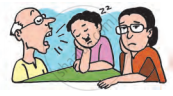
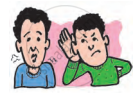
You should look at the person you are talking to.
Look at the speaker in each picture. Say whether each one is a good speaker. Give reasons for your answer.
 |
 |
 |
 |
 |
Role play
Put students in pairs to role-play a conversation between:
- Alice and her sister.
- Alice and White Rabbit.
The eggs hatched and the babies flew away.
Why do we ask questions?
