Advertisements
Advertisements
Question
How does the banyan tree stand out as different from other trees? What details of the tree does the poet highlight in the poem?
Advertisements
Solution
In Bhagavad Geeta, Krishna said, “Of all the trees I am Banyan Tree”. Banyan is considered to be the most pious tree in Hindu mythology. It is believed that Buddha renounced under the banyan tree in Bodh Gaya. There are many more such stories that this tree encompasses in its age-old aerial roots that fall to the ground mysteriously. The poet is impressed by its huge figure as he says, “the great tree revealed its rings of two hundred years”. The physical description of the banyan carves an image of an enigma. The tree's aerial roots dangling from above to reach out to the ground. They are the proof of all the years and decades the tree has lived. It is a tough tree and it takes more than usual effort to bring it down. And when it happens, all watched it fall in terror and fascination, the slaughter of the age-old banyan tree. It feels as if raw mythology was revealed its age to the poet and his folk.
APPEARS IN
RELATED QUESTIONS
What was Mr. Otto Frank's major contribution to the world?
How did Helen display her passion for Radcliffe College?
Answer any four of the following question in 30 – 40 words each:
(a) ''What a thunderclap these words were to me!'' (Franz). What were those words and what was their effect of Franz?
(b) Why did Douglas fail to come to the surface of the pool as he hoped to?
(c) What was Kamala Das's childhood fear?
(d) How is the Earth a source of life when all seems dead on it? Keeping Quiet)
(e) How does Mr. Lamb react when Derry enters his garden?
(f) Which problem did the Maharaja face when he had killed seventy tigers? How did he solve it?
Answer any four of the following in 30 − 40 words each :
(a) What does Saheb look for in the garbage dumps?
(b) How was Gandhi treated at Rajendra Prasad's house?
(c) Why does one feel 'a sudden strangeness' on counting to twelve and keeping quiet?
(d) Mention any two things which cause pain and suffering. (A Thing of Beauty)
(e) When was the Tiger King in danger of losing his throne?
(f) What role did the American professor play in bringing Hana and Sadao together?
With reference to ‘The Story of My Life’, describe how a teacher can positively impact a child’s life ?
Attempt a character sketch of Squire Cass.
Read the extract and do the following activities :
B1 Likes and dislikes :
(i) The child likes eating _______
(ii) The child dislikes eating _______
They won’t eat peas, don’t like your bread -
For something in it crunches;
They gag on fat, the gravy’s gross,
They won’t eat grapes in bunches.
Tomatoes, onions, peppers, fish
Garlic nor cottage cheese;
Oh, it’s a dish uncommon rare
That truly seems to please.
No red sauce may the ice cream have,
“It’s bleeding,” they will say;
And gravely hand it to their mum
To take it to clean away
But let us speak of chocolate cake,
It must be frosted o’er;
They’ll devour three full slabs,
And calmly ask for more.
Oh, I do so always love to eat
With picky little pests,
Whose parents joy to make them
The most undesirable guests!
B2 What message does the poem convey for children?
B3 Pick out two pairs of rhyming words from the poem.
Divide the article into four sections based on the shifts in the sub-topics and give a suitable sub-heading for each section. One has been done for you in the article as an example.
Discuss the following statement in groups of two pairs, each pair in a group taking opposite points of view.
Reality is what is directly experienced through the senses.
'The Address' is a story of human predicament that follows war. Comment
We 'draw up a deed'. Complete the following phrase with an appropriate word.
________one's word
Discuss the following in pairs or in small groups.
What were the voices that Paul heard? Did they lead him to success in the real sense?
What, according to Russell, is the importance of love in life?
How do the words in bold, in the lines below, illustrate the poet’s ability to convey criticism cryptically?
Our meddling intellect
Misshapes the beauteous forms of things:
We murder to dissect.
Why do you think the poet has used so many 'negatives' to make his statement?
What would you say are 'the finer growths' that the story supports in a novel?
Explain the undertones in the statement:
'Wife and husband in unusual rapport
State one unspoken thought':
How did the author feel about her mother's passion to make her a dancer?
Read the following statement and mark those that apply to you.
I have cordial relationships with all but I cannot connect with anyone.
complete the following sentence.
Ajoy reported about ________________.
Find proof from the poem for the following.
The colour imagery in the poem.
Answer the given question in your own words.
Why was the Prince sad?
Stories can be told even in the form of poetry. Such poems are called Narrative poems. Narrative poems do not always follow rhythmic patterns of a fixed rhyme scheme. Such poems are written in a style called ‘Free Verse.’
Recall and name some narrative poems you have done/read earlier.
Read the story and choose the appropriate meaning.
Masterpiece ____________.
Go through the poem and state whether the following statement is true or false.
Planners deliberately find drawbacks in the old city planning.
Say WHY. . . . . .
Ramanujan found the number 1729 very interesting.
Complete the following statements with the help of the text.
To learn about meditation, you have to see ____________________________________________________________ Watch your thinking. Do not ________________________ Do not ____________________________________ Begin to learn ______________________________ Just watch thought. Do not ____________________________________________________.
Discuss in groups and think about it.
List a few occasions on which you had become angry. What do you do when you are angry?
Can you name different types of fabrics? Which is the most expensive fabric you know? Talk to your parents or to a textile shop assistant. Collect samples of as many types as you can and paste them into your scrapbook. Name each type.
Discuss the question after you have seen a presentation of the ‘ad’.
What does the ad tell you?
Answer the following question in one sentence.
Why does he ‘miss all the fun’?
Complete the following sentence using your idea:
I can ______.
Present any one of the speeches given above.
Does the traveller really have a magic stone?
Find four words ending with ‘-ous’ from the story.
Can you add three more words ending with ‘-ous’ to this list?
Hold a mock trial for the following offence. There should be a complainant, a defendant, and lawyers to argue the case on behalf of them. The whole class can vote to pass the judgment. On what occasions will you plead for justice? What punishment will you suggest? When will you plead for mercy?
A young man was injured in a road accident due to another man’s careless driving.
What characteristics of Mr. Nobody do we learn about from this poem?
Make a list of your favourite fruits and vegetables and note down the time of the year when they are available in plenty.
What does 'Rangaawali' mean?
The taxi driver took away the narrator’s suitcase.
Read the following lines from the poem and answer the question given below.
There's a family nobody likes to meet;
They live, it is said, on Complaining Street
- Where does the family live?
- Why do you think the street is named as ‘Complaining Street’?
Read the story again and write how these character reacted in these situation:
Zigzag hardly never sleeps.
Somu………………………
Dr.Krishnan……………………….
Hamid’s friends enjoyed the ride in the merry-go-round. But Hamid didn’t go on it. Why?
What were the children doing beside the stone wall?
Write the names of the characters in this story.
1. ______ 2. ______ 3. ______
Read the lines and answer the questions.
Deep inside the mountain
the adventures hide themselves.
Where do adventures hide?
Identify the character/speaker.
Go to my cottage and fetch my gloves and fan.
How does Alice feel after all these changes?
stained by - mark made on clothes or materials
The white washed walls were stained by many monsoons. ______
Fill in the table
| Problems Faced By Mr. Fogg And His Team | Solution |
| The train stopped in the middle of the forest. | |
| They couldn’t hire the elephant. | |
| They were in need of an elephant driver. |
Complete the sentence given below with word/phrase.
The hole became ______ and ______.
How did Santhosh record his diary?
Who helped Jaswant in the battle against Chinese?
Welcome guests to win everyone’s _____ in life’s race.
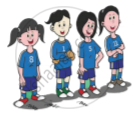
Write the events won by these players.
 |
______ |
 |
______ |
 |
______ |
Fill in the blank
He is rich ______ he looks simple.
Why did the king want a leader who knows to grow a plant?
Name the pictures and match it with the rhyming words.
 |
dancer | |
 |
floor | |
 |
will | |
 |
rush |
Replace the bold word/words with a word from the quiver and re-write the sentence –
The teacher said something about his good handwriting. He felt very happy.
Choose the right word.
“Eat the leaves of the tamarind tree, and you’ll also sing like ______.
