English

Tick the statement that is true. The story is an account of real events.

Advertisements
Advertisements

Question

Tick the statement that is true.

The story is an account of real events.

Options

  • True

  • False

MCQ
True or False
Advertisements

Solution

The story is an account of real events. (True)

shaalaa.com
Reading Skills
  Is there an error in this question or solution?
Chapter 5: The Adventure - Understanding the text [Page 69]

APPEARS IN

NCERT English Hornbill (Core) Class 11
Chapter 5 The Adventure
Understanding the text | Q 1 | Page 69

RELATED QUESTIONS

Read the passage given below : 

1. Maharana Pratap ruled over Mewar only for 25 years. However, he accomplished so much grandeur during his reign that his glory surpassed the boundaries of countries and time turning him into an immortal personality. He along with his kingdom became a synonym for valour, sacrifice and patriotism. Mewar had been a leading Rajput kingdom even before Maharana Pratap occupied the throne. Kings of Mewar, with the cooperation of their nobles and subjects, had established such traditions in the kingdom, as augmented their magnificence despite the hurdles of having a smaller area under their command and less population. There did come a few thorny occasions when the flag of the kingdom seemed sliding down. Their flag once again heaved high in the sky thanks to the gallantry and brilliance of the people of Mewar.
 
2. The destiny of Mewar was good in the sense that barring a few kings, most of the rulers were competent and patriotic. This glorious tradition of the kingdom almost continued for 1500 years since its establishment, right from the reign of Bappa Rawal. In fact, only 60 years before Maharana Pratap, Rana Sanga drove the kingdom to the pinnacle of fame. His reputation went beyond Rajasthan and reached Delhi. Two generations before him. Rana Kumbha had given a new stature to the kingdom through victories and developmental work. During his reign, literature and art also progressed extraordinarily. Rana himself was inclined towards writing and his works are read with reverence even today The ambience of his kingdom was conducive to the creation of high-quality work of art and literature. These accomplishments were the outcome of a longstanding tradition sustained by several generations.
 
3. The life of the people of Mewar must have been peaceful and prosperous during the long span of time; otherwise, such extraordinary accomplishment in these fields would not have been possible. This is reflected in their art and literature as well as their loving nature. They compensate for the lack of admirable physique by their firm but pleasant nature. The ambience of Mewar remains lovely thanks to the cheerful and liberal character of its people.
 
4. One may observe astonishing pieces of workmanship not only in the forts and palaces of Mewar but also in public utility buildings. Ruins of many structures which are still standing tall in their grandeur are testimony to the fact that Mewar was not only the land of the brave but also a seat of art and culture. Amidst aggression and bloodshed, literature and art flourished and creative pursuits of literature and artists did not suffer. Imagine, how glorious the period must have been when the Vijaya Stambha which is the sample of our great ancient architecture even today, was constructed. In the same fort, Kirti Stambha is standing high, reflecting how liberal the then administration was which allowed people from other communities and kingdoms to come and carry out construction work. It is useless to indulge in the debate whether the Vijaya Stambha was constructed first or the Kirti Stambha. The fact is that both the capitals are standing side by side and reveal the proximity between the king and the subjects of Mewar.
 
5. The cycle of time does not remain the same Whereas the reign of Rana Sanga was crucial in raising the kingdom to the acme of glory, it also proved to be his nemesis. History took a turn. The fortune of Mewar – the land of the brave, started waning. Rana tried to save the day with his acumen which was running against the stream and the glorious traditions for some time.
 
On the basis of your understanding of the above passage answer each of the questions given below with the help of options that follow :
 
(a) Maharana Pratap became immortal because :
(i) he ruled Mewar for 25 years.
(ii) he added a lot of grandeur to Mewar.
(iii) of his valour, sacrifice and patriotism.
(iv) both (ii) and (iii)

(b) Difficulties in the way of Mewar were :
(i) lack of cooperation of the nobility.
(ii) ancient traditions of the kingdom.
(iii) its small area and small population.
(iv) the poverty of the subjects.
 
(c) During thorny occasions :
(i) the flag of Mewar seemed to be lowered.
(ii) the flag of Mewar was hoisted high.
(iii) the people of Mewar showed gallantry.
(iv) most of the rulers heaved a sigh of relief.

(d) Mewar was lucky because :
(i) all of its rulers were competent.
(ii) most of its people were competent.
(iii) most of its rulers were competent.
(iv) only a few of its people were incompetent.
 
Answer the following questions briefly:
(e) Who is the earliest king of Mewar mentioned in the passage?
(f) What was Rana Kumbha's contribution to the glory of Mewar?
(g) What does the writer find worth admiration in the people of Mewar?
(h) How could art and literature flourish in Mewar?
(i) How did the rulers show that they cared for their subjects?
(j) What does the erection of Vijaya Stambha and Kirti Stambha in the same fort signify?
(k) Find words from the passage which mean the same as each of the following:
(i) surprising (para 4)
(ii) evidence (para 4)

Read the following passage carefully and complete the activities given below: 
B.1)  Order :
Rearrange the following sentences in proper order:
(i)
Hanmant joined engineering.
(ii) Hanmant got his Diploma and secured a job in Philips.
(iii) Hanmant migrated to Pune when he was in class VI.
(iv) Hanmant took up a painting job to earn. 

            Hanmant Gaikwad was born in Koregaon in Satara district.
            “My native place is Rahimatpur, around 10 km from Koregaon. My father was a clerk in the court and we lived in a small, rented house.”
            Hanmant was a brilliant student especially good in mathematics. When he was in class six, the family shifted to Pune. They lived in Phugewadi near Dapodi in a tiny one-room house-10 by 10 feet. At this point, Hanmant realized the difference between himself and those who had money.
            Hanmant was then studying at Modern High School. He needed one rupee to buy a bus ticket to and from the everyday. Even that was hard to come by.
           Despite the hardships, Hanmant secured 88% in class 10. Hanmant completed his diploma and joined Philips as a trainee. But he wasn’t happy with the work he got there.
           The natural choice for a diploma engineer is to go for a B.Tech. But engineering colleges charge hefty fees. At the time, the family’s only source of income was a teacher’s salary of Rs. 2,300 a month……….
           And then I decided to also do some earning. “Khud Ka Kamana Chalu Kiya”.
          Hanmant took up painting jobs and quickly discovered it was excellent business.
          The young engineering student paid his own fees from the third year onwards. But his lifestyle remained frugal.
         Life was getting better, but Hanmant had his sights set higher. In the final year of engineering, he was attracted to the writings of Swami Vivekananda.
         “I felt Ki Kuch Alag Karna hai. What should I do, I did not know but in 1993 I formed an organization-Bharat Vikas Pratisthan.”

B.2) Complete : 

Hardships faced by Hanmant Gaikwad 


B.3)  Rewrite the following sentence choosing the appropriate word/s for the underlined word/s : 
(i)
His lifestyle remained frugal:
(a) simple
(b) meager
(c) extravagant

(ii) Despite hardships, Hanmant secured 88% in class X:
(a) In spite of
(b) Regarding
(c) Affected

(iii) Hanmant took up painting jobs:
(a) assumed
(b) to continue
(c) accepted

(iv) Hanmant had his sights set higher:
(a) looked ahead
(b) lofty ambitions
(c) looked above 

B.4)  Do as Directed
(i) Hanmant secured 88% in class X.                                   ( Begin the sentence as-88%....................)
(ii) In the final year of engineering, he was attracted towards the writings of Swami Vivekananda.       (Frame a ‘Wh-question’ to get the underlined part as the answer.) 

B.5) “Today’s hardships lead to tomorrow’s success”-Justify.


The three stanzas depict three different phases. What are they?


Notice these expression in the text. Infer their meaning from the context.
cairn of rocks


Notice these expression in the text. Infer their meaning from the context.
careered down


Discuss the following statement in groups of two pairs, each pair in a group taking opposite points of view.

The story is called ‘The Adventure’. Compare it with the adventure described in ‘We’re Not Afraid to Die...’


Identify some of the improbable images the author has used to effect greater humour.


What, according to Russell, is the importance of love in life?


How does Shelley's attitude to science differ from that of Wordsworth and Keats?


The Cloud ‘fuses together a creative myth, a scientific monograph, and a gay picaresque tale of cloud adventure':  explain.


Comment on the physical features of the hawk highlighted in the poem and their significance.


How does the banyan tree stand out as different from other trees? What details of the tree does the poet highlight in the poem?


Read the story and complete the following.

Revathi’s grief knew no bounds because, ____________.


Say why the speaker of the poem wishes to be a -

watchman


Everyone admired the statue of the Happy Prince.


In Gujarat, the kite - festival is celebrated to welcome the Spring.


The last leaf fell off during the rain.


Proverbs associated with the word season: for eg: Make hay while the sun shines.

  1. _________________________
  2. _________________________

Give reasons :

Oberon and Titania fight for the custody of the Indian boy because - Oberon wants __________________.


Answer the following question in one sentence.

What should human beings do in order to make progress?


Make a chart to show the important points to remember while making a graphic presentation.


An activity:
Speak fast, think faster! Form groups of 4-6. Discuss each of the following topics. Then each person in the group should choose a topic and speak about it for one minute. Try to say as many sentences as you can in that time.

Imagine you are watching a scene. For example, someone learning to ride a bicycle; or a cricket match. Give a running commentary on what you see.

‘Monu is sitting on the bicycle. It has side wheels. Monu tries to push the pedal down - No - he stops. His uncle holds the seat in one hand and the handle in the other hand. He says, ‘Come on, Monu’... etc.


Write a short note on the following:

The ‘four signs’ that Prince Siddharth beheld.


Draw word webs for the following. Begin with the given word and go on writing as many other words associated with it, as you can. Use these words to write other related words to form a word web.


Write about one occasion when you have behaved like -

Mr. Nobody


Read the following:

  • Charging along like troops in a battle. 
  • Fly as thick as driving rain.

Using your imagination, write one or two comparisons each with -

  • like ______
  • as ______ as 

Write about the sights you may see from a bus or an airplane. You may write it in the form of a short poem. 


How does the following character in the story live up to their name? Provide points from the story.

Teshumai Tewindrow


Pick out the line that means:

Sing in such a manner: 


Rohan and Muk entered the garden at midnight ______.


List 5 of the sounds that you like.


Find out how the following game is played.

Kho-Kho


Write other meaningful words that begin/end with springtime.


Read the following lines from the poem and answer the question that follow.

Let me but live my life from year to year,
With forward face and unreluctant soul;

  1. Whom does the word ‘me’ refer to?
  2. What kind of life does the poet want to lead?

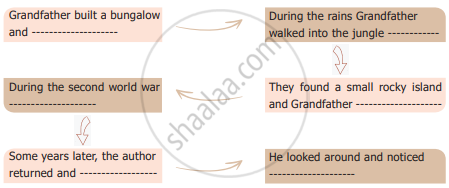
Mention the things that the grandfather imagined.


In New York, Mr. Scotti left the plane because he thought he.


Write about Hamid in one or two sentences.


Take a stanza from the poem. Write it in the blanks and find the rhyme scheme.

Lines from the poem Rhyme scheme (a/b/c/d)


Find out the rhyme scheme employed in the fourth stanza.


Identify the speaker/character.

Stop ship. Drop anchor. Quick!


According to the author the tendril was moving towards grandfather because it______.


Mithali is one of the women players to score seven consecutive 50s.


Describe the beauty of the blue mountain.


What is the difference between this toy train and a normal train?


Flag day is observed on the _________.


Who helped Jaswant in the battle against Chinese?


Who asked the Robot to charge the phone?


The hut was very ______.


Look at the picture and Choose the correct word.


The bird-catcher had a pigeon in his _______.


What will you do if someone ensnares birds?


Every ______ they would go fishing.


Circle and write the adverbs.

He laughed merrily ______.


Meena’s father was a fisher man.


Why relationships are more important than wealth?


Amir realised his mistakes.


What did Bala teach Nithin?


What did Nasruddin boast about?


Now, read the following passage on “Laughter Therapy” and answer the questions that follow.

  1. Laughing is an excellent way to reduce stress in our lives; it can help you to cope with and survive a stressful life. Laughter provides full-scale support for your muscles and unleashes a rush of stress-busting endorphins. Since our bodies cannot distinguish between real and fake laughter, anything that makes you giggle will have a positive impact.
  2. Laughter Therapy aims to get people laughing, in groups and individual sessions and can help reduce stress, make people and employees happier and more committed, as well as improve their interpersonal skills. This laughter comes from the body and not the mind.
  3. Laughter Yoga (Hasya yoga) is a practice involving prolonged voluntary laughter. It aims to get people laughing in groups. It is practiced in the early mornings in open-parks. It has been made popular as an exercise routine developed by Indian physician Madan Kataria, who writes about the practice in his 2002 book ‘Laugh for no reason'. Laughter Yoga is based on the belief that voluntary laughter provides the same physiological as well as psychological benefits as spontaneous laughter.
  4. Laughter yoga session may start with gentle warm-up techniques which include stretching, chanting, clapping, eye contact and body movements to help break down inhibitions and encourage a sense of playfulness. Moreover, laughter is the best medicine. Breathing exercises are used to prepare the lungs for laughter followed by a series of laughter exercises that combine a method of acting and visualization techniques. Twenty minutes of laughter is sufficient to augment physiological development.
  5. A handful of small-scale scientific studies have indicated that laughter yoga has some medically beneficial effects, including cardiovascular health and mood. This therapy has proved to be good for depressed patients. This laughter therapy also plays a crucial role in social bonding.

Answer the following.

a. How does laughter help one to cope with stress?

b. Which word in the text (para 2) means the same as ‘dedicated'?

c. Why do you think voluntary laughter provides the same physiological as well as psychological benefits as spontaneous laughter?

d. ‘Laughter is the best medicine’. Explain.

e. Given below is a set of activities. Which of these are followed in the ‘Laughter Yoga’ technique?

  • sitting on the ground with legs crossed 
  • body movements
  • clapping
  • closed eyes 
  • breathing exercises 
  • chanting
  • stretching of arms and legs
  • bending backwards 
  • running/jogging
  • eye contact

f. ‘Laughter therapy also plays a crucial role in social bonding’. How?


Read the following passage and answer the questions that follow:

The Stationmaster’s Supreme Sacrifice by Sanchari Pal (Adapted)

  1. Thirty-three years ago, on the night of December 2, 1984, Bhopal was hit by a catastrophe that had no parallel in the world’s industrial history. An accident at the Union Carbide pesticide plant in Bhopal had released almost 30 tons of a highly toxic gas called methyl isocyanate, turning the city into a vast gas chamber. The result was a nightmare; more than 600,000 people were exposed to the deadly gas cloud that left thousands dead and many more breathless, blind and in agonizing pain. Few people know that during the Bhopal gas tragedy a heroic stationmaster risked his own life to save others.
  2. On the evening of December 3, 1984, Ghulam Dastagir was settling down in his office to complete some pending paperwork. This work kept him in his office till 1am in the night, when he emerged to check the arrival of the Gorakhpur Mumbai Express. As he stepped on to the platform, the deputy stationmaster felt his eyes burn and a queer itching sensation in his throat. He did not know that poisonous fumes leaking from Union Carbide’s pesticide factory were stealthily enveloping the railway station.
  3. Beginning to choke, Dastagir did not know then that twenty-three of his railway colleagues, including his boss, station superintendent Harish Dhurve, had already died. It was later reported that Dhurve had heard about the deadly gas and had immediately tried stopping the movement of trains passing through Bhopal before collapsing in his office chamber. His suddenly worsening health and years of experience told Dastagir that something was very wrong. Though he did not fully comprehend what was happening, he decided to act immediately when he did not get any response from the station master. He alerted the senior staff at nearby stations, like Vidisha and Itarsi, to suspend all train traffic to Bhopal.
  4. However, the jam-packed GorakhpurKanpur Express was already standing at the platform and its departure time was 20 minutes away. Listening to his gut instinct, Dastagir summoned his staff and told them to immediately clear the train for departure. When they asked if they should wait until the order to do so came from the head office, Dastagir replied that he would take complete responsibility for the train’s early departure. He wanted to ensure that the train left immediately, without any delay. His colleagues later recalled that Dastagir could barely stand and breathe as he spoke to them. Breaking all rules and without taking permission from anyone, he and his brave staff personally flagged off the train.
  5. But Dastagir’s work was not done. The railway station was filling up with people, desperate to flee the fumes. Some were gasping, others were vomiting, and most were weeping. Dastagir chose to remain on duty, running from one platform to another, attending, helping and consoling victims. He also sent an SOS to all the nearby railway offices, asking for immediate medical help. As a result, four ambulances with paramedics and railway doctors arrived at the station. It was winter and the gas was staying low to the ground, a thick haze poisoning everything in its path. Besieged by hordes of suffering people, the station soon resembled the emergency room of a large hospital. Dastagir stayed at the station, steadfastly doing his duty, knowing that his family was out there in the ill-fated city. That day all he had for his protection was a wet handkerchief on his mouth.
  6. Ghulam Dastagir’s devotion to duty saved the lives of hundreds of people. However, the catastrophe didn’t leave him unscathed. One of his sons died on the night of the tragedy and another developed a lifelong skin infection. Dastagir himself spent his last 19 years shuttling in and out of hospitals; he developed a painful growth in the throat due to prolonged exposure to toxic fumes. When he passed away in 2003, his death certificate mentioned that he was suffering from diseases caused as a direct result of exposure to MIC (Methyl Isocyanate) gas. A memorial has been built at platform No.1 to pay tribute to those who sacrificed their lives in the line of duty on the fateful night of December 3, 1984. However, Ghulam Dastagir, who died later, is not one of them. A forgotten hero whose sense of duty and commitment saved countless lives, Dastagir’s story deserves to be recognized and remembered by our fellow countrymen.
  1. Why was the accident at Union Carbide unparalleled in the world’s industrial history?
  2. How was Dastagir affected by the poisonous gas?
  3. What was the action taken by the station superintendent?
  4. How did Dastagir and his staff break rules?
  5. What was the cause of Dastagir’s death?
  6. Find words from the passage which mean the opposite of the following.
  1. safeguard (para 1)
  2. common or familiar (para 2)
  3. prompt (para 4)
  4. cause (para 6)

Share
Notifications

Englishहिंदीमराठी


      Forgot password?
Use app×