Advertisements
Advertisements
Question
Guess the meaning of the following word:
Kora
In which language are these word found?
Advertisements
Solution
Below word is from the Tibetan language.
Kora: It is the circumambulationof a stupa or a temple. It is also a pilgrimage that the Buddhists do to Namtso Lake and Mount Kailash, both holy sites in Tibet. It is also a type of meditation.
APPEARS IN
RELATED QUESTIONS
He asked. Boy, did he ask! First he asked me for a chance, then he asked nearly all the people he came across if they wanted to buy a telephone system from him. And his asking paid off. As he likes to put it, “Even a blind hog finds an acorn every once in a while.” That simply means that if you ask enough, eventually someone will say ‘yes’.
He cared. He cared about me and his customers. He discovered that when he cared more about taking care of his customers than he cared about taking care of himself, it wasn’t long before he didn’t have to worry about taking care of himself.
Most of all, Cowboy started every day as a winner! He hit the front door expecting something good to happen. He believed that things were going to go his way regardless of what happened. He had no expectation of failure, only an expectation of success. And I’ve found that when you expect success and take action on that expectation, you almost always get success.
Cowboy has made millions of dollars. He has also lost it all, only to get it all back again. In his life as in mine, it has been that once you know and practice the principles of success, they will work for you again and again.
He can also be an inspiration to you. He is proof that it’s not environment or education or technical skills and ability that make you success. He proves that it takes more: it takes the principles we so often overlook or take for granted. These are the principles of that Ya Gotta’s for success.
Question:
(1) What was the cowboy’s motto?
(2) What did the cowboy learn after he lost millions of dollars?
(3) Why did the cowboy firmly believe that asking would pay off?
(4) When you expect success and take action on that expectation you almost always succeed. [Name the part of speech of the underlined words]
(5)
(a) He cared about me and his customers. [Rewrite using ‘not only ……………….but also’’]
(b) Cowboy has made millions of dollars [Add a question tag]
(6) In what way is the cowboy a source of inspiration for you?
Answer any six of the following questions in 30‒40 words:
(a) Why did Gandhiji feel that taking the Champaran case to the court was useless?
(b) Why did the peddler derive pleasure from his idea of the world as a rattrap?
(c) How is Mukesh different from the other bangle makers of Firozabad?
(d) What tempted Franz to stay away from school?
(e) Why did the maharaja ban tiger hunting in the state?
(f) How was the skunk's story different from the other stories narrated by Jack?
(g) Which words of her brother made a deep impression on Bama?
Why do dolphins cover their long noses with sponges or shells ?
A1 Web :
Complete the following web with the help of the passage :
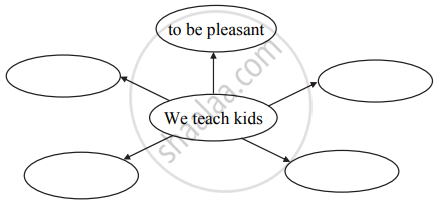
My dictionary tells me that personality is the “Personal or individual quality that makes one person be different and act differently from another.” Personality is, “the total physical, intellectual and emotional structure of an individual, including abilities, interests, and attitudes.”
There are many benefits to having a pleasant personality. There is only one opportunity to make a first impression, and all of us instinctively make decisions or judgments about an individual within the first few seconds of crossing paths. With that in mind, I believe when we teach our kids to smile, to be pleasant and cheerful, to be courteous and respectful of others, to pleasantly respond to requests or questions, we are helping them develop a personality that will open many doors for them. Once the doors are opened, the character will keep them open; but personality, not character, is on display in the first few seconds. Therefore, it’s important to develop a pleasant personality and use it for life.
A2 Personality :
Personality of an individual is recognized by :
(i) _______ (ii) _______
(iii) _______ (iv) _______
A3 Vocabulary :
Find out words for the following from the passage and write:
(i) polite =
(ii) relating to feelings =
(iii) to do anything naturally without thinking =
(iv) a chance to do something =
A4 Complete the following table :
| Noun | Adjective | Adverb |
| – | different | differently |
| Instinct | – | instinctively |
Select any word from the table and use it meaningfully in a sentence of your own.
A5 Personal Response :
Why do you thing, personality development is necessary?
Read the following passage and do the given activities:
B.1) Comparison
Write the comparison between the parts of the modular phone and the human body:
| Modular Phone | Parts of Human Body |
Every phone you buy, no matter how costly and latest it is, will go out of date in a year or so. That’s how quickly the smartphone world is moving right now. To keep yourself up to date with the current specification you will have to keep switching phones every once a while. What’s the solution to this problem?
MODULAR PHONES!
A modular device is a phone, tablet or another device where individual components such as the screen, camera, CPU, battery, memory can be removed by the user and replaced by others with a different specification. Imagine your body to be your phone and your clothes as the components, you can wear anything according to your needs and moods. Similarly, modular phones let you choose between components of different properties and specifications.
This would mean we’ll have the liberty to customize our phones, just like Lego building blocks! The main components of the phone will be Brain (processor), Spine (frame, screen) and Heart (battery). The other components may include a camera, storage memory, GPS, audio jack, speakers, USB module, etc. and the phone will have a motherboard, i.e. a base that will hold all components together
B.2) Give examples:
Write two examples that give the liberty to customize our phone.
• ____________________
• ____________________
B.3) Framing sentence:
Use the given phrases in sentences of your own:
(i) up to date
(ii) once a while
B.4) Write as instructed:
Rewrite the sentence as interrogative:
(i) We’ll have the liberty to customize our phones.
(ii) We will have the liberty to customize our phones. (Rewrite using the present participle form of the underlined word)
B.5) Personal Response
If given a chance to design a modular phone, what new features would you add?
Answer the following in 200-250 words :
What are Helen's opinions about examinations?
Attempt the following question in 100-150 words:
What do you think about Anne’s talent for writing essays, which she wrote convincingly when punished by the teacher?
Notice these expression in the text. Infer their meaning from the context.
careered down
Briefly explain the following statement from the text.
“You neither travelled to the past nor the future. You were in the present experiencing a different world.”
'The Address' is a story of human predicament that follows war. Comment
What impressions of Shahid do you gather from the piece?
What impression would you form of a state where the King was 'just and placid'?
Discuss in pairs
Ruskin's insistence on looking intensely at words, and assuring oneself of meaning, syllable by syllable – nay, letter by letter.
How does the poet tossed back from ecstasy into despair?
What facet of political life does the behaviour of Ajamil illustrate?
Using a good dictionary, find the shade of difference in the following:
‘Profession’ refers to ____________
Underline the verb in the following sentence and state whether the sentence is in the Active or Passive voice.
England gave Ramanujan great honours.
Fill in the gap, choosing a word from the bracket to make an appropriate comparison.
(tall / quiet / humble / merry / busy / slippery / fast / sly / slow / big)
as ______ as an elephant
Read the description of the Kabaddi match and do the following:
Choose any one event and draw a diagram to show what happened.
Find one more example which shows that a beautiful appearance is not enough.
Discuss the following question after you have seen a presentation of the ‘ad’.
What would happen if you ate proper meals like rice and dal or dal-roti?
Read the passage and answer the following:
Who is the main character in the story?
From the play, find all the words that are related to the following:
knowledge and learning
Add other related words you know to the list.
Read the following pieces from the story and suggest a title for each as shown in the 1st one.
| From | Up to | Title | |
| 1. | It was a hot afternoon ______ | ______ said the aunt weakly. | ‘Children Pester their Aunt’ |
| 2. | The smaller girl created a diversion ______ | ______ likely to lose his bet. | ______ |
| 3. | In a low confidential voice ______ | ______ it was so stupid,” said Cyril. | ______ |
| 4. | She (Bertha) did all that she was told ______ | ______ must be an extra good child. | ______ |
| 5. | The storyteller paused to let ______ | ______ popular tunes of the day. | ______ |
| 6. | Bertha was trembling very much ______ | ______ the three medals for goodness ______ | ______ |
Say whether you agree or disagree.
The wolf could not trace Bertha because she was behind a myrtle bush.
Do you know of similar stories in your mother tongue or in other languages? Narrate it in short.
Who said the following, to whom, and when?
“Mighty thy Teacher must be and divine.”
What did the husband want to buy?
Guess the meaning of the following word.
postponed
Write what the poet is doing.
Does the poet like the experience?
Write the line which tells us about it.
What did Anshuman’s father compare bad habits to?
Discuss the following in group.
What can we do to get rid of bad habits?
Guess the meaning of on the wing.
How did the cops manage to enter the locked house?
Read the following line from the poem and answer the question given below.
They growl at that and they growl at this;
Whatever comes, there is something amiss;
- What does the word ‘growl’ mean here?
- Why do they find everything amiss?
Write the name of the toys against each picture.

What did Usha see while walking to the bazaar?
How can we make our life worth living?
Write down the word that alliterate in the poetic line below
That spreads treasures on a tree.
Read Section – III (para 1 and 4) and answer the following questions.
Paragraph 1
1. Who listened to the chipping sound of the chisel? ______
2. Who was working with the hammer and chisel? ______
Paragraph 4
1. Who was staring? ______
2. Who was the young stone carver? ______
3. What was he working on? ______
Why was Sir Francis angry?
Who inhabited the jungles that the train passed through?
What are the two reasons the author gives for the plants moving towards grandfather?
What did she sell to support her family?
Discuss in groups. Retell the story in your own words. Each one should say one sentence.
You can begin like this:
Gulliver was travelling in a ship. One stormy night, the ship was wrecked...
Work in pair, find answer for the question and share in the class.
When is it autumn in India? Why does the poet say this? Is there an autumn season in India?
Who is the wisest of all? Why?
_______ broke out in the near by villages.
Read the passage three times and colour a bull for each time.
Mr. Murugan is a farmer. He has a small piece of land and two bulls. He takes good care of his bulls as they help him in farming. Every morning, he takes the bulls for grazing. When it rains he ploughs the land with the bulls. As he has no one to help he starts sowing the seed before sunrise. He irrigates the crop till it grows. He reaps and binds the crop then takes it to thrash the paddy. Finally, with the help of the bulls, he takes the paddy to his house.

Who asked the Robot to charge the phone?
Why did the old man need someone?
______is good at cooking.
Appu felt hungry and ate a______.
Sparrow tied the elephant and the crocodile with a ______.
Parents never let us get ______.
Why should we close the tap after using it?
Read the passage carefully and answer the following question.
What did the farmer find in the field?
Write the word with same meaning.

chips- ______
The fir tree was not happy with the gold leaves ______.
