Advertisements
Advertisements
Question
What facet of political life does the behaviour of Ajamil illustrate?
Advertisements
Solution
The poem Ajamil and the Tigers is a political satire by Arun Kolatkar; Ajamil and the Tigers represent the corrupt politicians and the oppressed subjects. The sheep represent the mass, the mob; the sheepdogs are the incarnation of the army. It is to be seen how the commoners, sheep, and sheepdog, are annihilated by the rulers, Ajamil. How their sentiments are overlooked. The poet has beautifully retold the fantastic story of Ajamil, the believed to be a good shepherd, which he possibly heard in Jejuri. When the tigers are captured by the brave sheepdog, Ajamil lets them lose, despite being warned by the dog. To show his prominence, he did not listen to the sheepdog and did not even make any eye contact with him. Rather he offered a gala feast to the tigers and gave them gifts like sheep meat, skin, and wool. The audacious warriors are paid no heed to and the subjects are sacrificed for Ajamil wanted to maintain his supremacy.
APPEARS IN
RELATED QUESTIONS
Notice these expression in the text. Infer their meaning from the context.
billowed
Guess the meaning of the following word:
Kyang
In which language are these word found?
Comment on the way in which the theme of the story has been introduced.
What two things are compared in the poem?
An acrostic is a poem or a write· up in which the first letter of each line forms a word. when it is read vertically.
For example,
Faithful
Reliable
Inspiring
Encouraging
Noble
Dedicated
With your benchmate / group, complete the acrostic of BELIEVE and FAITH.
(Please note that the words / phrases should be more or less related to the topic. You can use a thesaurus.)
Be certain of
E ......................
L ......................
I ......................
E ......................
V ......................
E ......................
F ......................
A ......................
I ......................
T ......................
H ......................
Name the world-famous personality who reached great heights despite of humble circumstances.

Pick out words from the poem to fill in the web diagram. They should be related to the theme in the web.
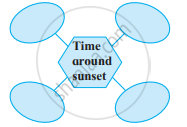
Read the story and complete the following.
Revathi won the prize for the ‘Best plant’ because, ____________.
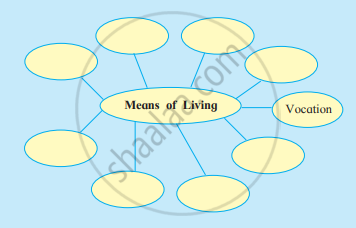
Pick out words that refer to ‘means of living’ and fill them in the Web.
(profession/recreation/occupation/job/ pastime/employment/hobby/career/entertainment/mission/trade/buisness/sports/retirement/placement)
Find evidence from the lesson and write in your own words.
We Indians are obsessed with foreign things.
Answer the given question in your own words.
Why did the Swallow finally decide not to leave the Prince?
Discuss the activities carried out by a farmer.

Johnsy realised that her thinking was wrong.
Read different stories about intelligent ministers of kings, whose judgments helped to bring about law and order in society. For example - Birbal, Tenalirama, etc. Write 5 such stories in your notebook.
Think deeply and write. Is the poet really discouraging the youth from becoming vets? Explain your response.
Read the following sentence carefully and choose the correct meaning.
The Peacock had a gorgeous tail like no other bird.
State whether the following statement is True or False:
Both Demetrius and Lysander fight for Hermia.
Explain the following statement with reference to the context.
From now on The Herald shall be my artillery.
Explain the following statement with reference to the context.
You ought to be ashamed of yourself.
Read aloud/Enact the play.
Explain the meaning of the following phrase:
An eagle’s eye
Write a short note on the following:
Prince Siddharth’s protected life.
Read the poem: ‘Home they brought her warrior dead’ by Alfred Lord Tennyson.
Find the words that mean the following from the first stanza.
- Gold hammered into a flat, thin shape: ______
- show off proudly: ______
- tilt, move at an angle: ______
- across, especially in a slanting direction: ______
Write the symbol that is used in the poem to represent the following idea.
I made a rare choice.
Write in your own words.
What does the poet hope for?
Write the characteristics of a good listener.
Make a list of your favourite fruits and vegetables and note down the time of the year when they are available in plenty.
Read the word. Write the words that combine to make it.
springtime
The taxi driver took away the narrator’s suitcase.
Write the name of the toys against each picture.

Hamid’s granny scolded him for buying iron tongs. Then she understood that Hamid had bought it ______.
Read the comic strip and answer the following question.
What do you mean by cyber safety?
Read the comic strip and answer the following question.
How do you behave in a virtual platform?
What do the people do when the festival of Music is celebrated?
Fill in the table
| Problems Faced By Mr. Fogg And His Team | Solution |
| The train stopped in the middle of the forest. | |
| They couldn’t hire the elephant. | |
| They were in need of an elephant driver. |
Neerja passed on the warning in a code to the pilots because she______.
Why did Muthu and his friends step out of the train?
How is water produced in Mars?
| Mr. Murugan is a farmer. He has a small piece of land and two bulls. He takes good care of his bulls as they help him in farming. Every morning, he takes the bulls for grazing. When it rains he ploughs the land with the bulls. As he has no one to help he starts sowing the seed before sunrise. He irrigates the crop till it grows. He reaps and binds the crop then takes it to thrash the paddy. Finally, with the help of the bulls, he takes the paddy to his house. |
Choose the main idea of the passage.
What does a DIY kid refer to?
_______ is our culture.
How will you treat your guest?
The bird catcher’s clothes were dry.
Some words sound the same but their spelling and meaning are different. Such words are called homophones. There are many homophones.
Match the rhyming words.
| mars | crime |
| bed | cars |
| time | head |
Answer using Yes or No and pick sentence from the story to support your answer.
Was Robinson alone in the island?
Where do the moles save their food?
Speak and win.
Join in one of the two groups. Choose two characters. Support or oppose any one of the characters. Say some sentences for the one you support and say some sentences against the other one, to win.
| I support | I oppose |
Jana and her family moved to the village _______ ago.
Read the passage three times and colour a dustbin each time.
|
I am Mani. I had to take a bus to nearby city. I crossed the road to reach the bus stand. I got the bus, sat down, and read a book. Before I started to read, I just looked at the people around me. The two men sitting next to me were talking loudly. Some were listening to music on their phone. I was unable to focus on reading. The men were talking about cleaning the city. As they were talking, they opened a pack of biscuits to eat. After some time I dozed off. When I opened my eyes, the bus had reached the city. The two men were not there but pieces of the biscuits and wrappers were there. I cleaned the wrappers and put them in the dustbin.
|
- What did Mani take out?
- What did Mani find on the seat when he woke up?
- If you were Mani, what would you do?
In real, the test is for______.
______ is a great risk to the environment.
Who fell down and down and down?
Who said – “Oh, my ears and whiskers? How late it’s getting!”
What is the poem about?
Are these sentence TRUE or FALSE
The poet says that stars will always shine at night.
How did the animals know that the king was just a jackal?
According to Tagore, when will India get the opportunity to win the gift of freedom?
Read the passage given below:
| 1. | Very often, we do not take the first step towards a good cause because we say to ourselves, "The task is so big. What can I do alone?" So nothing gets done. There is much talk about environmental protection, air pollution and saving our forests. Do we really care? If we do, here are a few things we can do to make our surroundings more pleasant. |
| 2. | It is good to adopt a two-uses-attitude! By putting an article to a second use, we are giving it a longer lease of life and using up less raw material from nature. One of the worst things we do is abuse of paper. The clean sides of envelopes can be used to write small notes, lists and reminders around the house. The more paper we use, the more trees will have to be cut down. For the same reason, we should avoid the use of paper napkins or paper plates. Cloth napkins are just as good, for they can be washed and used over and over again. |
| 3. | Another area which needs the most urgent attention is effective garbage disposal. People who are conscious about it follow rules and laws strictly. As a result, their neighbourhoods are clean and beautiful Similarly, each one of us can contribute to a cleaner environment. All kitchen waste should be collected separately. Those of you who have green fingers can turn this into valuable manure. Dig a pit and put the kitchen waste into it. When the pit is a little over half full, cover it up with mud. Let nature do the rest. Within three or six months, we will have a good garden manure. It can also be done as a community project by digging a large pit in the colony. Do take help of all the members, for nothing succeeds like co-operation |
| 4. | A lot of people don't care about the environment because they don't understand the adverse effect that society has on it. It is important to convince people to care about the environment. The first step would be to convince people to change by providing simple alternative solutions and ways of doing things. Theintemet is a powerful tool and a group on social media of like-minded people can be formed. People can share environmental stories and issues, as well as pool in solutions and alternatives to educate one another. With the current state that our planet is in, it is imperative that people actively care about the environment and most importantly to act now. |
Based on your understanding of the passage, answer any Eight questions from the nine given below:
- Why don't we take the first step towards a good cause?
- What is a two-uses-attitude?
- What can we do to avoid the abuse of paper? (any two points)
- What is the result of an effective way of a garbage disposal?
- What procedure can one adopt for kitchen waste?
- How can making of garden manure be done as community project?
- How long does it take to make good garden manure?
- Select a suitable word from the passage which means - being concerned or interested. (Paragraph 3)
- Pick out the word from the passage which means - completely necessary? (Paragraph 4)
