Advertisements
Advertisements
प्रश्न
What facet of political life does the behaviour of Ajamil illustrate?
Advertisements
उत्तर
The poem Ajamil and the Tigers is a political satire by Arun Kolatkar; Ajamil and the Tigers represent the corrupt politicians and the oppressed subjects. The sheep represent the mass, the mob; the sheepdogs are the incarnation of the army. It is to be seen how the commoners, sheep, and sheepdog, are annihilated by the rulers, Ajamil. How their sentiments are overlooked. The poet has beautifully retold the fantastic story of Ajamil, the believed to be a good shepherd, which he possibly heard in Jejuri. When the tigers are captured by the brave sheepdog, Ajamil lets them lose, despite being warned by the dog. To show his prominence, he did not listen to the sheepdog and did not even make any eye contact with him. Rather he offered a gala feast to the tigers and gave them gifts like sheep meat, skin, and wool. The audacious warriors are paid no heed to and the subjects are sacrificed for Ajamil wanted to maintain his supremacy.
APPEARS IN
संबंधित प्रश्न
Read the follow ing extract and answer the questions given below:
Not gold but only men can make
A people great and strong;
Men who for truth and honor's sake
Stand fast and suffer long.
Brave men who work while others sleep,
Who dare while others fly...
They build a nation's pillars deep
And lift them to the sky.
(1) What makes a nation strong?
(2) According to you, what makes India a strong and powerful nation?.
(3) Write down the rhyme scheme used in the extract.
(4) What does the phrase 'others fly ... ' mean?
Attempt a character sketch of Margot Frank as shown in ‘The Diary of a Young Girl’.
Talk to your partner about the following.
Would you agree that the author’s grandmother was a person strong in character? If yes, give instances that show this.
Does the poem talk of an exclusively personal experience or is it fairly universal?
What is the meaning of the line “Both wry with the laboured ease of loss”.
We 'draw up a deed'. Complete the following phrase with an appropriate word.
________a deaf ear to
What does the bird in the poem announce? How is this related to the title, ‘Coming’?
Discuss in pairs
Choice of diction is very crucial to the communication of meaning.
Taking off from Forster’s references to Emily Bronte, Sterne and Proust, discuss the treatment of time in some of the novels you have read.
Fill in the blank.
“Hybrids need more _____________”, said Devu Handa.
Think and answer in your own words.
How do parents react when they see children soil their clothes in dust and heat?
complete the following sentence.
Ajoy reported about ________________.
Answer the given question in your own words.
What decision did the Swallow finally make? Was it a wise one? Comment.
Read the poem and complete the web about the activities the planners do.

Discuss in your class.
Are robots truly useful to human beings? Why? Why not?
Answer the following question in short.
Why did Pundit Shahane visit Vijaynagar?
Form pairs. Present in the class, the conversation between Thiruvalluvar and the young man.
Enlist a few reasons for watching a drama live on the stage.
Comment on the given statement after reading the given dialogue -
I wouldn’t be in your shoes if he rewards me ten times as much. People generally fall victim to incentives. Some people stick to values. They _________________.
Find sentences from the play related to the given points.
Loyalty in Irish Nationalism:
- Maybe Sergeant you’ll be on the side of the country yet.
- ____________________________
- ____________________________
- ____________________________
What do the following words in the poem mean?
- crown
- round
- draw
- blind
Do these words have other meanings? List them.
Discuss the following question after you have seen a presentation of the ‘ad’.
What would happen if you never ate fruits and vegetables?
Find the meaning of ‘Charity begins at home’. Find other sayings which have a similar meaning.
List the phrases that indicate sorrow or pain.
The Emperor says he had realised earlier that Abdul has great talent. Does this tally with his actions? Give your opinion.
Write about how you take care of your books.
Complete the following diagram.
Rewrite in your own words.
One event from the story.
What do you notice about the following pairs of words?
- act naturally
- liquid gas
- open secret
- sound of silence
- sweet sorrow
- original copy
- only choice
- growing smaller
Read the poem and answer the following.
How would you like to eat your strawberries?
What was the businessman looking for? Why?
Read the following and say whether the statement tells you about a fact or whether it is imaginary.
There is a man in the Moon.
____________ raised a dreadful storm.
Who were the inhabitants of the island?
Does Chulong want to earn money honestly?
Hamid’s friends are ______
What were the children doing beside the stone wall?
Read the line and answer the question.
And all I ask is a merry yarn from a laughing fellow rover.
What kind of human company does the poet want?
Work in pairs and answer the following.
Write the rhyme scheme of the poem.
Identify the speaker/character.
Stop ship. Drop anchor. Quick!
Who is Muthu?
Mithali is one of the women players to score seven consecutive 50s.
Fruits, vegetables, and water in the Mars are not ______.
Who was challenged for a race?
Which planet has red storm?
Welcome guests to win everyone’s _____ in life’s race.
Karate makes me brave and bold. Would you like to learn it?
Recite the poem 'Treasure Trove' with the correct intonation.
Answer the following yes or no question.
Did Bujju realise his mistake?
The king looked for a______.
Do you think Ani will be a good leader? Why?
Whose word are these? Name the character.
“Utensils made of brass and tin for sale!”
Let us learn a few more word by joining the dots. Join the dots and fill the table below.
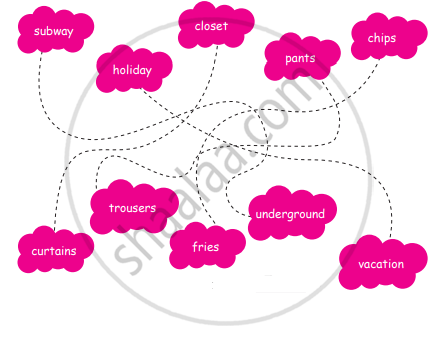
| subway | |
| holiday | |
| closet | |
| pants | |
| chips |
Who wins the world at the end?
Write the correct word.
| rooster, king, hen, tiger, queen, tigress. |
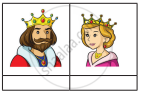
Who was burning with curiosity?
The passage given below is on Kabbadi. Read the passage and complete the activities that follow.
Kabbadi (கபடி - in Tamil) is a contact team sport that originated in Tamil Nadu, India. It is the national sport of Bangladesh. It is also popular in South Asia and is the state game of the Indian states of Tamil Nadu, Kerala, Andhra Pradesh, Bihar, Haryana, Karnataka, Maharashtra, Punjab, and Telangana.

Kabbadi is played between two teams of seven players: the objective of the game is for a single player on offence referred to as a 'raider', to run in to the opposing teams half of a court, tag out as many of their defenders as possible, and return to their own half of the court–all without being tackled by the defenders. Points are scored for each player tagged by the raider, while the opposing team earns a point for stopping the raider. Players are taken out of the game if they are tagged or tackled, but can be 'revived' for each point scored by their team from a tag or tackle. The raider should hold his breath and utter the words like 'kabbadi kabbadi, hututu hututu, chadu kudu' etc. while the opponents try to catch him. If he stops uttering these words, he is considered out.
The game is known by its regional names in different parts of the subcontinent, such as Kabbadi or Chedugudu in Andhra Pradesh, Kabbadi in Kerala and Telangana, Hadudu in Bangladesh, Bhavatik in Maldives, Kauddi or Kabbadi in the Punjab Region, Hu-Tu-Tu in Western India and Hu-Do-Do in Eastern India and Chadakudu in South India. The highest governing body of Kabbadi is the International Kabbadi Federation.
Given below is the visual presentation of the first paragraph.
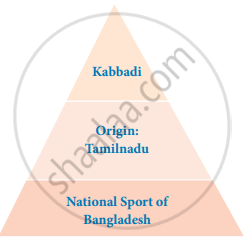
i) Represent the other paragraphs in a visual form of your choice(flow chart, mind-map, pie-chart, etc.).
ii) Choose the correct option.
1. A contact sport usually involves a ______contact between players.
- violent
- gentle
- physical
2. Kabbadi is a game played between ______.
- seven teams of two players
- two teams of seven players
- four teams of seven players
3. A single ______.
- player on offence is referred to as a raider
- offence is referred to as a raider
- raider is an offence by the player
iii) Answer the following.
- How does a raider score points for his team?
- When does a raider concede a point to the opponent team?
- Can a player be revived when he/she is out of the game? Explain your answer.
- Kabbadi is called by different names in different parts of India. Do you know how Pallankuzhi is called in Karnataka, Andhra Pradesh and Kerala?
What should parents do to ensure the safety of children in cyber space?
Being a bachelor, the stranger had no patience with children.
Read the following sentence.
‘A very wise man once remarked that of the unspoken word, you are a master; of the spoken word, you are a slave.’
The sentence has two pairs of opposites - spoken and unspoken, and master and slave. The contrasting ideas make the sentence more effective. Putting together opposite or contrasting ideas in one sentence is a literary device. It is called antithesis.
Read the following examples of antithesis.
- Give every man thy ear, but few thy voice.
- Man proposes and God disposes.
- Speech is silver, but silence is gold.
- Patience is bitter, but it has a sweet fruit.
