Advertisements
Advertisements
प्रश्न
Read the following passage carefully and complete the activities given below :
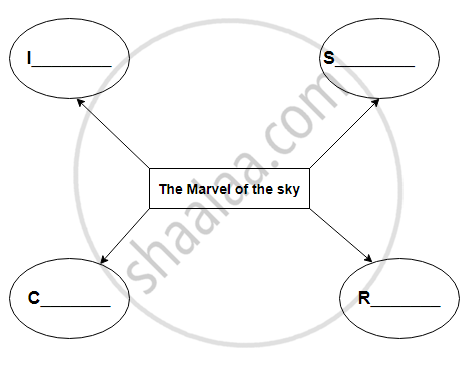
A.1) Complete the web :
Write the words from the passage on the web. 
We saw small bits of grass peeping through the small cracks in concrete pavement. It left us thinking: however impossible things may look, there is always an opening…………
We saw a tree bare of all leaves in the cold winter months. We thought its chapter was over. But three months passed, spring set in and the tree was back to its green majesty once again, full of leaves, flowers, birds, and life. What if we too had the conviction that, however difficult things are right now, it will not remain so forever. Remember, this too shall pass.
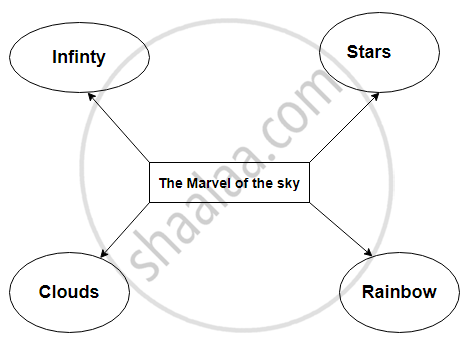
We saw an army of ants lugging a fly which was at least ten times the ant’s size. The ants organized themselves around the fly, lifted it on frail feelers and carried it to quite a distance. Their teamwork and perseverance were impressive. What if we too are consistent, organized, focused ……… Spider webs are delicate, yet very strong. A rainbow colors the entire sky. Oysters take in a grain of sand they open up with a pearl. Innumerable stars shine across the infinite sky. Clouds take new shapes with every passing moment. The wind makes trees dance with unhindered passion. Water, without a hint of ego, changes its form according to the dictates of the sun and the wind. When we see a caterpillar turn into a butterfly, a flower turns into a fruit, we experience the alchemy of nature ………. We touch it and become gold ourselves.
A.2) Finding meanings :
Write what you mean by :
(i) _______ there is always an opening.
(ii) _______ its chapter was over.
(iii) _______ the tree was back to its green majesty.
(iv) _______ this too shall pass.
A.3) Matching :
Match the words in Column ‘A’ with their synonyms in Column ‘B’:
| Column 'A' | Column'B" | ||
| (i) | conviction | (a) | strong feeling |
| (ii) | alchemy | (b) | delicate |
| (iii) | frail | (c) | mysterious/magical power |
| (iv) | passion | (d) | strong belief |
A.4) Language study :
Rewrite the sentence using the correct question tag given in the brackets :
(i) Water changes its form. (does it?, do it?, do they?, doesn’t it)
(ii) However impossible things may look, there is always an opening. (Rewrite using ‘but’)
A.5) Personal Response :
Nature is the best teacher. Explain.
Advertisements
उत्तर
A.1)
A.2) Finding meanings:
(i) ... there is always a solution to an impossibility.
(ii) ... its life or its term was over.
(iii) .... after autumn, the tree was full of green leaves.
(iv) .... this also will go away, and not last forever.
A.3) Matching:
| Column 'A' | Column'B' | ||
| (i) | conviction | (d) | strong belief |
| (ii) | alchemy | (c) | mysterious/magical power |
| (iii) | frail | (b) | delicate |
| (iv) | passion | (a) | strong feeling |
A.4)
(i) Water changes its form, doesn’t it?
(ii) Thigs may look very impossible, but there is always an opening.
A.5)
Nature is a great teacher. No wonder our ancestors used to look up to nature to understand life itself. Our ancient scriptures are filled with hymns devoted to nature, as we treated nature as God in many instances.
SUN: The giver of light, energy, seasons … the list is endless.
MOON: The bestower of calm, cooling sensations to the aggrieved or restless mind.
TREES: Nature’s ardent helper, giver of oxygen, provider of shade to the tired traveler, health giver, shelter provider to the birds and other creatures.
APPEARS IN
संबंधित प्रश्न
Answer the following question in 30-40 words:
“The sight of the food maddened him.” What does this suggest? (His First Fight)
Many sentences and paragraphs in the excerpt begin with the word ‘And’. To what extent does this contribute to the rhetorical style of the lecture?
Dos and Don'ts for Email Etiquettes. Discuss and add one or two Dos and Don'ts on your own.
| Sr. No. | Dos | Don'ts |
| 1. | Have a clear subject line. | Don’t forget your signature. |
| 2. | Use a professional salutation. | Don’t use humour and sarcasm. |
| 3. | Recheck your e-mail. | Don’t assume the recipient knows what you are talking about. |
| 4. | Keep private material confidential. | Don’t punctuate poorly. |
| 5. | Keep your email short and flawless. Stay concise. | Don't hit 'Reply All'. |
| 6. | Check your attachments before sending them. | Don’t think that no one but the intended recipient will see your email. (No predictions) |
| 7. | Include your name or a signature with additional details and contact information. | Don't forward emails without permission. |
Discuss in groups and think about it.
List a few occasions on which you had become angry. What do you do when you are angry?
Link the items in the three columns properly.
| A | B | C |
| The past | A sea beneath a cloudless sun | A pleasant time which has ended |
| The present hour | A soft and mild autumn evening | An exciting, thrilling time which has no end. |
| The future | A green and flowery spray Where a young bird sits | A time, full of life in which you gather strength |
Discuss the following.
Abdul gets what he wants in the end. What is the major factor that contributes to this success?
From the poem ‘The Grumble Family’ what kind of behavior does the poet want the readers to possess?
Why did the farmer have to travel far?
How did Alice reach Wonderland?
Read the passage below:
| 1. | Our history makes it evident that the Indian Plastics Industry made a vigorous beginning in 1957 but it took more than 30 years for it to pervade Indian lifestyles. In 1979, "the market for plastics' was just being seeded by the state-owned Indian Petro-Chemicals and it was only in 1994 that plastic soft drink bottles became a visible source of annoyance. |
| 2. | In the same year, people in other cities were concerned about the state of public sanitation and also urged regulatory bodies to ban the production, distribution and use of plastic bags. However, the challenge was greater than it appeared at first. |
| 3. |
The massive generation of plastic waste in India is due to rapid urbanisation, spread of retail chains, plastic packaging from grocery to food and vegetable products, to consumer items and cosmetics. The projected high growth rates of GDP and continuing rapid urbanisation suggest that India's trajectory of plastic consumption and plastic waste is likely to increase.
|
| 4. | According to the United Nations Environment Programme (UNEP) report of 2018, India stands among few other countries like France, Mongolia and several African countries that have initiated total or partial nationallevel bans on plastics in their jurisdictions. On World Environment Day in 2018, India vowed to phase out single-use plastics by 2022, which gave a much needed impetus to bring this change |
| 5. | In this context, thereafter ten states (Andhra Pradesh, Chhattisgarh, Gujarat, Himachal Pradesh, Karnataka, Madhya Pradesh, Meghalaya, Odisha, Rajasthan and Tamil Nadu) are currently sending their collected waste to cement plants for co-processing, twelve other states/UTs are using plastic waste for polymer bitumen road construction and still four other states are using the plastic waste for waste-to-energy plants and oil production. A world of greater possibilities has now opened up to initiate appropriate and concrete actions to build up the necessary institutions and systems before oceans turn, irreversibly into a thin soup of plastic. |
| 6. | However there is no one single masterstroke to counter the challenges witnessed by the staggering plastic waste management in the country. The time is now to formulate robust and inclusive National Action Plans and while doing so, the country will establish greater transparency to combat the plastic jeopardy in a more sustainable and holistic way. |
Based on your understanding of the passage answer any six out of the seven questions given below:
- What does the writer mean by 'visible source of annoyance'?
- Why did people demand a ban on plastics?
- What created a demand for plastics in India?
- With reference to the graph write one conclusion that can be drawn about the production of plastics in 2019 (approximately).
- What does the upward trend of the graph indicate?
- What does the line, oceans turning 'irreversibly into a thin soup of plastic', suggest?
- What step must be taken to combat the challenges of plastic waste management? What will be its impact?

