English

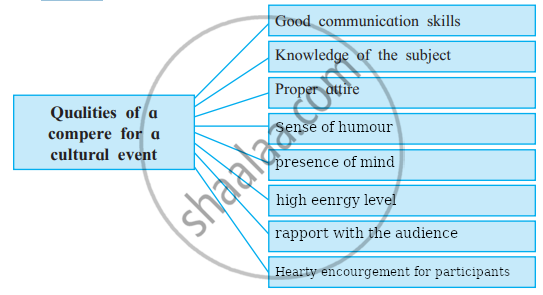
Imagine that you wish to organize a cultural event at your college. Prepare your own web-chart to indicate the qualities that you expect to have in a compere. - English

Advertisements
Advertisements

Question

Imagine that you wish to organize a cultural event at your college. Prepare your own web-chart to indicate the qualities that you expect to have in a compere.

Chart
Advertisements

Solution
shaalaa.com
Reading Skills
  Is there an error in this question or solution?
Chapter 3.6: The Art of Compering - Brainstorming [Page 126]

APPEARS IN

Balbharati English Yuvakbharati [English] Standard 11 Maharashtra State Board
Chapter 3.6 The Art of Compering
Brainstorming | Q (A1) | Page 126

RELATED QUESTIONS

We sang our school fight song dozens of times – en route to Arlington National cemetery, and even on an afternoon cruise down the Potomac River. We visited the Lincoln Memorial twice, once in day – light, the second time at dusk. My classmates and I fell silent as we walked in the shadows of those 36 marble columns, one for every state in the Union that Lincoln laboured to preserve. I stood next to Frank at the base of the 19 foot seated statue. Spotlights made the white Georgian marble seem to glow. Together we read famous words from Lincoln’s speech at Gettysburg remembering the most bloody battle in the war between the status : “………….we here highly resolve that these dead shall not have died in vain – that this nation, under God, shall have a new birth of freedom………..”
As Frank motioned me into place to take my picture, I took one last look at Lincoln’s face. He seemed alive and so terribly sad.
The next morning I understand a little better why he wasn’t smiling. “Clifton,” a chaperone said, “could I see you for a moment?”

(1) When did the boys visit Lincoln Memorial?
(2) What made the Georgian marble glow?
(3) What did the words: “………. We here highly resolve that these dead shall not have died in vain – that this nation, under God, shall have a new birth of freedom …………” remind them?
(4) Do you believe in building memorials? What kind should they be, if your answer is ‘yes’? If no, give reasons why you do not believe in memorials?


Read the following passage carefully and do the given activities:
A.1) True or False:

Write the statements and state whether they are true or false:
(i)
Those who choose to live well must help others.
(ii)
If neighbors grow inferior corn, cross-pollination will steadily improve the quality.
(iii)
The farmer grew award-winning corn.
(iv)
The reporter discovered that the farmer didn’t share his seed corn with his neighbors. 

             There once was a farmer who grew award-winning corn. Each year he entered his corn in the state fair where it won a blue ribbon. One year a newspaper reporter interviewed him and learned something interesting about how he grew it. The reporter discovered that the farmer shared his sweet corn with his neighbors. “How can you afford to share your best seed corn with your neighbors when they are entering corn in competition with yours each year?” the reporter asked. 
             “Why sir”, said the farmer, “didn’t you know? The wind picks up pollen from the ripening corn and swirls it from field to field. If my neighbors grow inferior corn, cross-pollination will steadily degrade the quality of my corn. If I am to grow good corn, I must help my neighbors grow good corn.” He is very much aware of the connectedness of life. His corn cannot improve unless his neighbor's corn also improves. So it is with our lives. Those who choose to live in peace must help their neighbors to live in peace. Those who choose to live well must help others to live well, for the value of a life is measured by the lives it touches.
              The lesson for each of us is this: if we are to grow good corn, we must help our neighbors grow good corn. 

A.2) Consequences:
Write the consequences:
(i) The farmer shares the corn. 
(ii) The farmer doesn’t share the corn. 

A.3) Antonyms:
Find out the words opposite in meaning from the passage: 
(i)
superior x _______ 
(ii)
lost x _______ 
(iii)
improve x _______ 
(iv)
inconstantly x _______ 

A.4)  Language study:
(i)
We must help our neighbors. (Replace the modal auxiliary showing advice). 
(ii) The wind picks up pollen from ripening corn and swirls it field to field. (Use “not only…….. but also” and rewrite)

A.5)  Personal Response: 
What do you learn from the story? Suggest a suitable title.


Does the poem talk of an exclusively personal experience or is it fairly universal?


Group related points.


Discuss the following statement in groups of two pairs, each pair in a group taking opposite points of view.

Reality is what is directly experienced through the senses.


“One day back there in the good old days when I was nine and the world was full of every imaginable kind of magnificence, and life was still a delightful and mysterious dream. ” The story begins in a mood of nostalgia. Can you narrate some incident from your childhood that might make an interesting story?


What impression of the character of Iona do you get from this story?


Examine the communication channels in the story between Paul and his mother.


Explain the line:
She makes too much steam–you want to hang the monkey wrench on the safety valve!


State the central issue in the poem.


The poem is a satire against the present political class. How effectively does it convey the anger and anguish of the common man trapped in the system?


How do stories/biographies of such famous people help youngsters?


Pick out words from the poem to fill in the web diagram. They should be related to the theme in the web.


The mother was working, when the Swallow brought the yellow jewel.


Pick out a word from the poem to complete the sentence meaningfully.

Everyone stood ______ (horrified) when the terrible accident took place.


Imagine that you are the peasant. Compose a short prayer to God, after having received the plate of gold. Write it using stylish handwriting.


Given below are various professions in column A and in column B, the nature of work in respective professions. Match the columns.

A B
(i) Anaesthetist (a) Specialist in the treatment of problems concerning the position of teeth and jaws.
(ii) Pharmacist (b) A person who designs buildings and supervises the process of constructing them.
(iii) Orthodentist (c) A person who is in charge of a newspaper or of a part of a newspaper.
(iv) Dermitologist (d) The medical study of the skin and its diseases.
(v) Architect (e) A person who has been trained to prepare medicines and sell them to the public.
(vi) Chartered Accountant (f) A person whose job is to give drugs which makes the person not feel pain especially in preparation for a medical operation.
(vii) Editor (g) A person who is engaged in the profession of accounting and examining the statements and records of accounts.

Answer the following question in short.

What was Pundit Shahane’s claim as a scholar?


Write a short note on Emperor Akbar.


Suggest what you would do in the following situation:

You are going through a crisis that is making you short-tempered and impatient, due to which you end up causing harm to your family and friends. They have started complaining about it quite often.


Discuss with your teacher how/why are ‘stars’ given to a movie.


Read the story aloud (or present it) in groups of three - the narrator, the peacock, and the crane.


State the difference between poetry and drama.


Relate the themes of the Fair to your science textbook by writing the relevant chapter numbers under each theme.


Discuss what makes the following sentences funny.

  • Your wasted time will be refunded.
  • There was no highway attached to the booth.

What do the following event/action tell us about the characters? Discuss.

The Archbishop announced that everyone was free to try his hand at the sword and called all the Lords to a Tournament.


Complete the following diagram.


List the names of body parts used in the passage.


Observe the picture and the labels carefully. Then match the words and the meanings given in the following table.

Words Meaning
1. yard (a) a floor, flat area built on a ship
2. mast (b) the forward part of the main body of a ship
3. bow (c) the forward part of a deck
4. deck (d) tall, upright pole on a ship
5. forecastle (e) a pole slung across a ship’s mast. A sail hangs from a yard.
6. starboard (f) the rearmost (back) part of a ship
7. stern (g) the part which is always at the front while the ship is sailing.
8. afterdeck (h) the right-hand side of a ship as one faces forward
9. fore (i) an open deck near the back

From any collection of classic poetry or the internet, find another famous poem by Robert Frost titled ‘Stopping by the Woods on a Snowy Evening’. Try to understand the symbolism used in that poem in 8-10 lines.


Write your own impressions about the news items given in (a), (b), (c), and (d) in the table below. 

News item Good news Bad news Reliable Unreliable Interesting Uninteresting Boring Others
(a)        
(b)        
(c)        
(d)        

Write in your own words.

How should that person sing? 


Read the following words aloud and copy them in your notebook. 

  • idle
  • enough
  • exclaimed
  • commotion
  • astounded
  • antics
  • wander
  • wielding

Listen carefully and guess how the sentence would end.

When the teacher read the answer papers, she was ______.


Mahatma Gandhi, Che Guevera, Guru Nanak, and Gauthama Buddha are some of the famous personalities and thinkers who made extensive journeys to understand life. Do you think journeys can be life-changing?


Identify the speaker/character.

‘ Remember the tiny penknife he gave me last year’.


Read the data below and answer the following question.

Choose the correct answer.

Identify the three jobs where the same percentage of women work.


Imagine you are a marketing executive for a company in a specific industry (toothpaste, soup, hair care products, automobiles, etc) and are developing a product with a brand name that refers to a character from the story.

For example: You want to sell bandages that have little pictures of Don Quixote on them. Your company’s name is Kure-All and you decide to call them “Kure-All Quixote Bandages”.

The slogan might be: “Had a tough day with windmills? When you take a fall, use Kure-All.”

You can use exciting words, a catchy new slogan and a jingle among other things to promote sales of your item.


Give an example for dazzling light.


One of the Lilliputians gave a ten minutes talk in Gulliver’s language.


Match the planet with its feature.

1. Mars blue ice giant
2. Saturn red storm
3. Jupiter red planet
4. Neptune ring and moons

How did Santhosh record his diary?


A ________ dies for the nation.


What was the epidemic that broke out in the story?


The battle of Nauranang lasted for three days.


Read scene I of the play carefully and answer the question below.

Whom does Mother Wolf talk about? How does she describe him?


Choose the odd one out.


Look at the picture and Choose the correct word.


Identify the character or the speaker.

“I hope he is safe.”


What is the main idea of the story?


Why did they sail?


Meena’s father was a fisher man.


Name the animal and sound it makes.


______ had made Math easy for Bala.


Recite the poem Never give up with correct intonation.


List three questions that the little boy asks.

  1. ______
  2. ______
  3. ______

Why is the play called ‘The Giving Tree’?


According to Tagore, when will India get the opportunity to win the gift of freedom?


Bertha was very good but very proud too.


Arrange a ‘Jokes’ session in the classroom where each student tells a joke. The jokes must be told in English.


Share
Notifications

Englishहिंदीमराठी


      Forgot password?
Use app×