Advertisements
Advertisements
Question
Form groups of 6-8. One person (leader) chooses one item - a picture, a paragraph, or a lesson from any one of the 9th standard textbooks and writes the reference on a slip of paper, and folds it. Others ask him/her questions and try to guess what it is, from his/her answers. Follow the rules given below.
- The maximum number of questions the rest of the group can ask is 20.
- You cannot ask a direct question like ‘What do you have in mind?’
- You can ask ‘Wh-’ questions or ‘Yes/no’ questions.
- The leader has to give truthful answers.
Advertisements
Solution
List of Questions based on the poem 'Silver':
| Questions | Answers |
| Are there birds with white feathers around? | Yes. |
| The environment looks cool, is it daytime that the author is referring to? | No. |
| Is everything in the surroundings all quiet and calm? | Yes. |
| Does something appear to be silvery and shining? | Yes. |
| Is the writer referring to a ghost that is trying to haunt him? | No. |
| If it's not daytime and it is night time, can we hear dogs barking? | No. |
| Is someone staring at the trees and birds at this time of the night? | Yes. |
| Is the writer referring to a living being? | Yes. |
| Is the poet referring to something on earth? | No. |
| Is the writer talking about some unknown person walking the path, during night time? | No. |
| If not, a person, then is it some object that he speaks of? | Yes. |
| Does the writer experience some change around, every night? | Yes, absolutely! |
| What are some of those changes that he talks about? | The writer observes everything around him sparkling at night. |
| Is the writer talking of some shining insect, like fireflies at night? | No. |
| Which creatures does he speak of? | He observes various creatures like the doves along with dogs, mice, and fish. |
| Does the poet happen to be by any water body, during the night? | Yes. |
| How does the water look? | The brightness of the water seems to increase at night. |
| Is there an influence of that object on all our surroundings? | Yes. |
| From the picture of the landscape, is there some kind of "Reflection" that is affecting the area? | Yes. |
| Well, then, what is the poet talking about when he compares it to 'Silver'? | It's the moon that the poet is referring to, from the poem "Silver." |
RELATED QUESTIONS
How did Helen display her passion for Radcliffe College?
Aunt Jennifer's tigers prance across a screen,
Bright topaz denizens of a world of green.
They do not fear the men beneath the tree;
They pace in sleek chivalric certainty.
(a) Why are the tigers called Aunt Jennifer's tigers?
(b) How are they described here?
(c) How are they different from Aunt Jennifer?
(d) What does the word, 'chivalric' mean?
To what end have humans used their superior intelligence ?
Read the following extract carefully and complete the activities given below :
A1 Complete the following :
(i) Books were found on the _____________ and ____________.
(ii) The tales are described as ______________ and __________.
|
Have you forgotten? Don't you know?
We'll say it very loud and slow:
THEY ... USED ... TO ... READ! They'd READ and READ,
AND READ and READ, and then proceed
To READ some more. Great Scott! Gadzooks!
One-half of their lives was reading books!
The nursery shelves held books galore!
Books cluttered up the nursery floor!
And in the bedroom, by the bed,
More books were waiting to be read!
Such wondrous, fine, fantastic tales
Of dragons, gypsies, queens, and whales
And treasure isles, and distant shores
Where smugglers rowed with muffled oars,
And pirates wearing purple pants,
And sailing ships and elephants,
And cannibals crouching 'round the pot,
Stirring away at something hot.
(It smells so good, what can it be?
Good gracious, it's Penelope.)
|
Complete the call-outs:
A.1)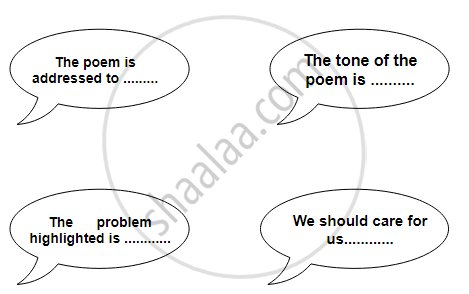
Our world is an institution
Of environmental pollution
We choose not to care
For our future generations
And I for one am guilty
For buying the hundreds of electronic gadgets
That attracts the industries to produce like maggots
environmental pollution is at the heart of our planet
The forests are dying
Wildlife is crying
Millions of fish are dying
Mother earth is sighing
Tell me is it right
That we sleep well at night
Replenishing ourselves
For tomorrow’s greedy fight
Overcrowded trains
Overloaded brains
Where is the light? What is our plight?
While the river break their banks
And greedy industries play their polluted pranks.
A.2) Find the examples that show that we do not care for our future generation
A.3) Match:
Match the lines in Column ‘A’ with the figures of speech in Column ‘B’:
| Column ‘A’ | Column ‘B’ | ||
| (i) | Our world is an institution | (a) | Personification |
| (ii) | Mother earth is sighing | (b) | Simile |
| (c) | Metaphor |
Give reasons for the following statement.
The author thought that his positive thinking strategy worked well after all.
Read the text below and summarise it.
The Great Desert Where Hippos Once Wallowed
The Sahara sets a standard for dry land. It’s the world’s largest desert. Relative humidity can drop into the low single digits. There are places where it rains only about once a century. There are people who reach the end of their lives without ever seeing water come from the sky.
Yet beneath the Sahara are vast aquifers of fresh water, enough liquid to fill a small sea. It is fossil water, a treasure laid down in prehistoric times, some of it possibly a million years old. Just 6,000 years ago, the Sahara was a much different place.
It was green. Prehistoric rock art in the Sahara shows something surprising: hippopotamuses, which need year-round water.
“We don’t have much evidence of a tropical paradise out there, but we had something perfectly liveable,” says Jennifer Smith, a geologist at Washington University in St Louis.
The green Sahara was the product of the migration of the paleo-monsoon. In the same way that ice ages come and go, so too do monsoons migrate north and south. The dynamics of earth’s motion are responsible. The tilt of the earth’s axis varies in a regular cycle — sometimes the planet is more tilted towards the sun, sometimes less so. The axis also wobbles like a spinning top. The date of the earth’s perihelion — its closest approach to the sun — varies in cycle as well.
At times when the Northern Hemisphere tilts sharply towards the sun and the planet makes its closest approach, the increased blast of sunlight during the north’s summer months can cause the African monsoon (which currently occurs between the Equator and roughly 17°N latitude) to shift to the north as it did 10,000 years ago, inundating North Africa.
Around 5,000 years ago the monsoon shifted dramatically southward again. The prehistoric inhabitants of the Sahara discovered that their relatively green surroundings were undergoing something worse than a drought (and perhaps they migrated towards the Nile Valley, where Egyptian culture began to flourish at around the same time).
“We’re learning, and only in recent years, that some climate changes in the past have been as rapid as anything underway today,” says Robert Giegengack, a University of Pennsylvania geologist.
As the land dried out and vegetation decreased, the soil lost its ability to hold water when it did rain. Fewer clouds formed from evaporation. When it rained, the water washed away and evaporated quickly. There was a kind of runaway drying effect. By 4,000 years ago the Sahara had become what it is today.
No one knows how human-driven climate change may alter the Sahara in the future. It’s something scientists can ponder while sipping bottled fossil water pumped from underground.
“It’s the best water in Egypt,” Giegengack said — clean, refreshing mineral water. If you want to drink something good, try the ancient buried treasure of the Sahara.
Staff Writer, Washington Post
What do you think is the message that the author seems to convey through the story?
Find from the story one word for the following.
the highest-ranking official who commands a ship ______
Read the poem aloud and you will find some old outdated words that we do not use in the everyday language now.
However, some writers/poets use them to impart an old-fashioned flavour to suit the background of their write-up. Such words are called Archaic words.
Give the modern words for the archaic words from the poem.
- thy
- being
- bestow'd
- thee
- thou
- cans't
You might have visited a bridge. Complete the web describing the sights you could see from the bridge.
Think and answer in your own words.
'Beauty' in stanza 5 to 6 can refer to a beautiful maiden as well as nature itself. Explain when and how nature ‘dances’ and also 'smiles'.
How do we help animals and birds?
Read the expression:
‘the blueprint of our past’s tomorrow’. Consider in a group why the poet has not mentioned ‘the present’. It is because of the planners who have possessed our ‘present’ in order to change ‘our past’ into the ‘future’ they desire. Go through the poem and write the lines which support this thought.
- The buildings are in alignment with the roads which meet at desired points.
- ____________________________________________
- ____________________________________________
- ____________________________________________
- ____________________________________________
- ____________________________________________.
Read the lesson and name the following.
The First surgeon to perform operations ______
Select a season of your choice and give the following details:
- Time of the year -
- Characteristics- crops, festivals, etc.
- Features/changes - climate/weather/temperature etc.
- Advantages/Disadvantages -
Have you ever given up on something good? Share your story with your friend.
Comment on the given statement after reading the given dialogue -
And if we get him itself, nothing but abuse on our heads for it from the people, and maybe from our own relations -
you may begin like this
We do not think about society at large _________________________________________________.
State whether the following statement is True or False:
Oberon transforms Bottom's head into that of an ass.
Select the correct options :
A Midsummer-Night’s Dream is a ___________________.
- poetic drama
- comedy of errors
- a comedy based on fantasy
- a character play
- a revenge tragedy
- belongs to realm of dreams
Answer the following question in one sentence.
What would he do if he had the power to do it?
Write about one occasion when you have behaved like -
Mr. Nobody
This story takes an unexpected turn when the lion decides to spare the camel’s life. Choose any fable, a story that you like, and rewrite it giving it an unexpected turn.
List the lines that begin with 'Here' or 'And here'.
Also, list the sentences or phrases that begin with ‘And there’.
These phrases and sentences tell us about things that appear one after the other as the carriage moves. Can we tell which ones are closer to the train and which ones are at a distance? How?
In the last stanza, there are three four-letter words that refer to a beautiful valley.
They are: • ______ • ______ • ______
Read the following lines from the poem and answer the question that follow.
Let me but live my life from year to year,
With forward face and unreluctant soul;
- Whom does the word ‘me’ refer to?
- What kind of life does the poet want to lead?
Read the following lines and answer the questions.
It isn’t an instantaneous thing
Born of despair with a sudden spring
- What does ‘it’ refer to?
- What does ‘born of despair mean’?
Try your own.
What kind of a boy was Vicky?
Name the character or speaker.
"Why don't you do that yourself?"
How does Raju help his mother?
Welcome guests to win everyone’s _____ in life’s race.
His father wanted him to do well in ______.
_____ fights with everyone in school.
What do you save? Why it is needed?
Why did Jana have a nightmare?
Read the passage three times and colour a dustbin each time.
|
I am Mani. I had to take a bus to nearby city. I crossed the road to reach the bus stand. I got the bus, sat down, and read a book. Before I started to read, I just looked at the people around me. The two men sitting next to me were talking loudly. Some were listening to music on their phone. I was unable to focus on reading. The men were talking about cleaning the city. As they were talking, they opened a pack of biscuits to eat. After some time I dozed off. When I opened my eyes, the bus had reached the city. The two men were not there but pieces of the biscuits and wrappers were there. I cleaned the wrappers and put them in the dustbin.
|
- What did Mani take out?
- What did Mani find on the seat when he woke up?
- If you were Mani, what would you do?
What will help us grow?
Name the animal and sound it makes.
Who said – “Oh, my ears and whiskers? How late it’s getting!”
