Advertisements
Advertisements
प्रश्न
Comment on the symbols used in ‘A Munda Song’. What aspect of the tribal worldview do they reflect?
Advertisements
उत्तर
In ‘A Munda Song’, symbols such as the sun, moon and cowshed connect human life with the rhythms of nature. The rising sun is associated with the birth of a son, while the moon is associated with the birth of a daughter. The cowshed being depleted after a son’s birth and filled after a daughter’s birth shows that daughters are considered precious and valuable.
These symbols reflect the tribal worldview of living in close harmony with nature. The Munda community’s life is linked to natural cycles such as the rising and setting of the sun and the changing seasons, rather than clock time.
APPEARS IN
संबंधित प्रश्न
After the convocation, Mrs. Mini, Rahul’s mother and Rahul have a conversation. Write the conversation and present it to the class in groups of three.
Big male elephants throw logs at electric fences because
In which language do you think Gangadharpant and Khan Sahib talked to each other? Which language did Gangadharpant use to talk to the English receptionist?
Discuss the following in pairs or in groups of four:
“Tribal arts are not specifically meant for sale.” Does this help or hamper their growth and preservation?
What does the line 'I never writ, nor no man ever loved' imply?
The text is an excerpt from Sesame and Lilies which consists of two essays, primarily, written for delivery as public lectures in 1864. Identify the features that fit the speech mode. Notice the sentence patterns.
What would you say are 'the finer growths' that the story supports in a novel?
Discuss the following in pairs or in small groups.
Kumudini Lakhia's life is an inspiring illustration of the emancipation of women.
Read the extract 'Being Neighborly' and complete the following statement:
Jo entered the old stone house carrying _______________.
Think deeply and write. Is the poet really discouraging the youth from becoming vets? Explain your response.
Fill in the gap, choosing a word from the bracket to make an appropriate comparison.
(tall / quiet / humble / merry / busy / slippery / fast / sly / slow / big)
as ______ as a fox
Discuss with your teacher how/why are ‘stars’ given to a movie.
What do restive horses do?
What did one of the fluttering creatures do?
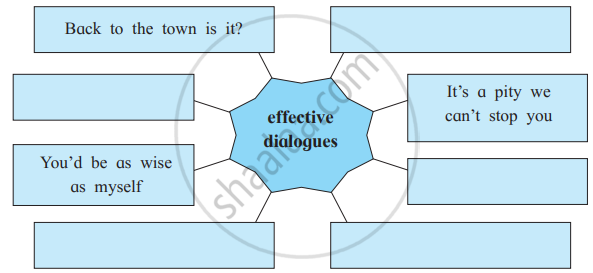
There are some dialogues that are short, but quite effective. They give us enjoyment and add beauty to the main story. Find some more from the text.
Find, in your science textbook, the topics of the stalls handled by students of VI A.
(Write the page number.)
Visit a library:
Find and read the biography of your favourite scientist.
Gather more information about the following from your Science textbook, the internet, and other sources.
Gravitational force
Suggest at least one method of creating something useful or beautiful from waste.
Say whether you agree or disagree.
The children would have behaved well on the train if their aunt had scolded them harshly.
Correct the following sentence and rewrite it.
By afternoon, Papa Panov had stopped looking out for Jesus.
List and say whether the following statement agrees with the passage or not.
If you don’t understand something, don’t let the others know about it.
Write other meaningful words that begin/end with snowwhite.
Where was the well situated?
Identify the character or speaker.
What a trouble must I have been to you then!
What was Ariel ordered to do with the people on the ship?
Why did Prospero set Ferdinand a severe task to perform?
Where did Chulong catch the bird?
What happened when Somu left Zigzag with the Krishnans?
Answer the following question based on the reading of the story. Do not forget to go back to the passage whenever necessary to find and confirm the answer.
| Action | Effect |
| While you warm yourself | I will prepare the best tea. |
| I saved enough money | |
| Six hundred and two villages were destroyed. | |
| It was a terrible earthquake and it was felt | |
| I ran back to the village | |
| They lifted the door | |
| I went to thank the Army Officer |
Write about Hamid in one or two sentences.
What did Usha see while walking to the bazaar?
| soft | vain | fear | joy | love | heard | toiled | mild | good | sand | life | harsh |
The ______, the______, which it may bring.
Describe the elephant driver in your own words.
Read the poem aloud in pairs.
The boy was so inspired by Mithali that he was happy for his sister to play cricket.
Identify the speaker/character.
They somehow managed to put him on the platform.
Describe Gulliver’s encounter with the army of Blefuscu.
The little bird broadened the hole with her______.
We don’t use _________ in the soil.
Where is Jaswantgarh located?
Read scene I of the play carefully and answer the question below.
List the characters that appear in the scene. What human characteristics do they exhibit?
Read scene I of the play carefully and answer the question below.
Match the following.
| Sr.No. | CHARACTER | TRAIT |
| a. | Father Wolf | with a grey nose…feeds her four cubs |
| b. | Tabaqui | the big one from Waingunga River with a lame foot |
| c. | Mother Wolf | the chief of the Wolves |
| d. | Shere Khan | begs for meat and thanks for the meal/warns the wolves about the arrival of Shere Khan |
Write the rhyming word.
goat
Choose the best answer.
The animals ______ the boat.
Like whom did they want to do?
Appu felt hungry and ate a______.
Choose the correct answer.
All the animals called the sparrow ______.
Why did Kani run to the kitchen?
Fill in the blank with rhyming word.
tree- ______
When does the world become green?
The tank in Divya’s village was almost ______.
______will often say to be honest.
Write the word with same meaning.

eraser- ______.
What does she paint?
He started selling wooden toys at a high price.
What happens when the day is over?
How did the jackal become blue?
Collect the outer coverings of fast food items. Discuss the following points in groups and then write your observations in your notebook.
- Ingredients
- Manufactured by
- Net weight
- Veg or Non-veg
- Recipe
- Nutrition facts
- MRP
- Mfg date
- Website
- Other instructions, if any
