Advertisements
Advertisements
प्रश्न
Identify the phrases and lines that indicate distance between father and son.
Advertisements
उत्तर
Phrases/lines that indicate distance between the father and the son are:
1. ‘I do not understand this child’
2. ‘I know / Nothing of him’
3. ‘We speak like strangers’
4. ‘there’s no sign/ Of understanding in the air’
5. ‘Silence surrounds us.’
APPEARS IN
संबंधित प्रश्न
How did Helen display her passion for Radcliffe College?
|
The energy stored in coal and petroleum originally came to the earth from the sun. The bulk of the present-day supplies was laid down some 200 to 600 million years ago, when tropical conditions were widespread. Lush, swampy forests produced huge trees; warm coastal seas swarmed with microscopic forms of life. When these organisms died, much of their tissue was recycled as it is today — through scavenging and decay. But a significant amount of dead plant and animal material was covered with mud, which prevented complete decomposition. With the passage of time, layer upon layer of the fine sediment was deposited over the once-living material; the sheer weight turned the sediments to rock. Sandwiched between the layers, both coal and petroleum were produced and preserved under pressure. Coal was formed mostly of giant fern-like plants that have only small counterparts today. Coal may still be forming here and there on earth, but conditions are not right for the production of significant quantities. |
Number the points.
Tick the statement that is true.
The story is an account of real events.
In which language do you think Gangadharpant and Khan Sahib talked to each other? Which language did Gangadharpant use to talk to the English receptionist?
Why do you think Paul's mother was not satisfied with the yearly birthday gift of 1,000 pounds for five years.
Who said to whom and when / why?
| Who said | To whom? | When / why? | |
| ......the world is full of inequalities. | |||
| I want to do something interesting. | |||
| It is against the will of God. | |||
| Our home is full of love....... | |||
| ...... we can affirm along with United Nations that men and women are equal. |
Read the following words :
Brigadier, Commander, capture, evicting, enemy, defense
All these words are related to war affairs and war.
Find more such words from the passage.
Find evidence from the lesson and write in your own words.
In Israel, the media have a positive outlook and self-respect.
State whether the following statement is True or False. Correct the false statement by finding evidence from the poem to support your remark.
The poet repents planting the cherry tree.
Answer the given question in your own words.
Why was the Prince sad?
Suppose you suffer from a long - term illness (one or two weeks), what should you do and what should you avoid? Fill up the table of Dos and Don’ts.
| Dos | Don’ts |
| (1) Go to a doctor for diagnosis | (1) Do not ____________ |
| (2) ____________ | (2) Do not avoid medication on time. |
| (3) Take a suitable diet | (3) Avoid ____________ |
| (4) ____________ | (4) Avoid physical stress and exertion. |
| (5) Rest in a properly ventilated room. | (5) Do not ____________ |
| (6) Have cheerful thoughts, courage, positive attitude | (6) Do not lose ______ and ______ |
You will come across many blogs written by famous personalities on different topics and issues. Read and make a list of at least ten blogs available on the internet. Read and summarise a blog and present it before the class.
| Sr.No. | The topic of the Blog | Name of the Blogger |
| 1. | Don’t teach kids how to read, teach them why. (https://www.teachthought.com/literacy stop-teaching-kids-how-to-read-reading-practice/) | Terry Heick |
| 2. | ||
| 3. | ||
| 4. | ||
| 5. |
Form suitable groups and discuss the following.
You have heard/read stories of Akbar and Birbal, Tenali Raman, Mulla Nasruddin. Recollect and write down the names of those stories.
Pick out those aspects of a story that you find a common in all their stories.
- Humour
- Supernatural event
- Wisdom
- Suspense
- Magic
- Beauty of Nature
- Wit
- Play upon words
- Sadend
- Violence
Write a short autobiography of any bird or animal of your choice.
Read the given words and share with your friend what comes to your mind.

Name the type of fabric closely associated with Mahatma Gandhi, the Father of the Nation. Why did Gandhiji want all of us to use this fabric?
Shakespeare is acknowledged as the greatest writer because he understood human nature better than anyone else. Explain the statement in the context of the play.
Enact the advertisement:
Seven children wait in different places, striking a suitable pose as shown in the ad. The character ‘Krispy Krunchy’ comes in dancing. He goes near every child, singing the words shown in the ad. He offers a Krispy Krunchy piece to every child.
The child eats it and begins to smile and clap. At the end, the character faces the class, shows a big pack of Krispy Krunchy, and presents the last few lines.
Find two examples of the word made by using the following suffix.
-ness
From the play, find all the words that are related to the following:
knowledge and learning
Add other related words you know to the list.
Prepare charts for each one of the asanas described in the passage. Use the following points:
- Name (in English, in your mother tongue)
- Meaning in English
- General information
- Steps and pictures
- Benefits
Colour, sound, and images from nature add to the beauty of a poem: 'Tartary' is a perfect example of the above. Pick outlines that contain –
- Colour
- Sound
- Images from nature
Read aloud a couple of stanzas of the poem ‘Invictus’ and ‘Please Listen’. In what ways do they differ? Think and fill up the table with ‘Yes’ or ‘No’.
| Invictus | Please Listen | |
| Rhyming lines | ______ | ______ |
| Steady rhythm | ______ | ______ |
| Uniformity in the length of lines | ______ | ______ |
| Uniformity of the number of lines in each stanza. | ______ | ______ |
| Figurative language | ______ | ______ |
Write out a few things that you would really miss about your home if you were to stay away from it for long.
Describe the following in one or two lines.
The world around the bird’s nest.
What plans did the wife make?
The following thing is mentioned in the poem.
Classify it as a happy and sad thing.
flowers - falling leaves
Discuss the following in group.
Do’s and Don’ts for young children.
Where was the well situated?
How did the bird try to reach its parents without having to fly?
Read the following line from the poem and answer the question that follow.
In the dim past, nor holding back in fear From what the future veils; but with a whole And happy heart, that pays its toll To Youth and Age, and travels on with cheer.
Identify the rhyming words of the given lines.
Why do you think Mrs. Bodwell wanted to sell the house?
Why was it a struggle for the children to dry their clothes?
Write the names of the characters in this story.
1. ______ 2. ______ 3. ______
Read these lines and answer the question given below.
The laughter and beauty of women long dead;
Explain the meaning of the above line.
Read the poem aloud in pairs
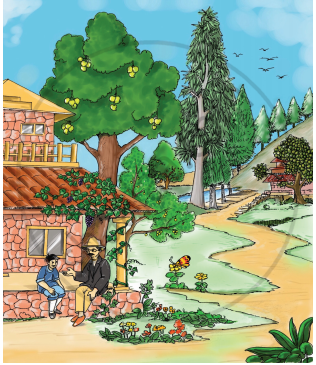
Listen to your teacher read the first part of the story. Many things described in the story can be seen in the picture. Find and name them.
Identify the speaker/character.
They somehow managed to put him on the platform.
Work in pair, find answer for the question and share in the class.
Why does the poet say the ‘ Spring is pretty’?
Is the brother boastful? What makes you think so?
Read the events of the story. They are in the wrong order. Put them in the correct order.
| 1. And it charged straight at the cavalry officers on horseback. |
| 2. And so she flew onto the back of the cow. |
| 3. So everybody panicked and made a general rush to safety |
| 4. The startled cow charged off in fear |
| 5. She applied brakes, but was thrown off the cycle. |
| 6. Just then she saw a lone cow in the middle of the road. |
| 7. Finally the cow fell into a ditch and dislodged the girl. |
| 8. The girl cried out in delight as she overtook her brother on her cycle. |
The aliens gave a new shuttle to them.
Jaswant decided to stay in his post.
Vicky was an active boy.
Name the character or speaker.
"Play me a pleasant song."
Identify the character or the speaker.
“I hope he is safe.”
Akilan’s passion is to learn ______.
Choose the correct answer.

Parents help us to overcome our______.
Why relationships are more important than wealth?
Leafcutter ants grow fungus.
Why did the king want a leader who knows to grow a plant?
Nithin had many ______toys.
Write the word with same meaning.

dustbin- ______.
How did Mugund’s mother die?
What happen to a child who shuts his ears?
Chris enjoyed doing all sorts of things except, writing and ______.art
Name a few things that sink.
How did Alice reach Wonderland?
