Advertisements
Advertisements
प्रश्न
How is the father’s helplessness brought out in the poem?
Advertisements
उत्तर
The helplessness of the father is highlighted through the depiction of the emotional struggle that he undergoes. He is aware of the problem and is willing to resolve it, but is unable to do so. He regrets the lack of a strong emotional bond and proper communication with his son who is also physically distanced from him.
APPEARS IN
संबंधित प्रश्न
Attempt the following in 150-200 words.
Write a character sketch of Bishop Brooks as he appears in Helen Keller's − The Story of My Life.
Answer any four of the following in 30-40 words each:
(a) Why was the peddler amused at the idea of the world being a rattrap?
(b) Why did Gandhiji agree to a settlement of mere 25 percent?
(c) Aunt Jennifer's efforts to get rid of her fear proved to be futile. Comment.
(d) What does Stephen Spender want to be done for the children of the school in a slum?
(e) How did the ten-day-old baby (the future Tiger King) react to the prediction about his future made by the astrologers?
(f) Why was Dr. Sadao not sent abroad along with the troops?
Answer the following in 120-150 words :
Within a few days of his arrival in Iping, people became suspicious of Griffin. Why?
How do Shahid and the writer react to the knowledge that Shahid is going to die?
Explain the line:
Within a week it sickened to a raging fever and its pulse went up to a hundred and fifty in the shade.
'The author's treatment of the subject matter makes the readers identify themselves with the experience.' Comment on the statement.
Explain the phrase.
his bending sickle's compass
Study each of the following sentences and notice the balance between its parts. Pick out other sentences in the text that reflect this kind of balance
a. It is right that a false Latin quantity should excite a smile in the House of Commons; but it is wrong that a false English meaning should not excite a frown there.
b. Let the accent of words be watched, by all means, but let the meaning be watched more closely still, and fewer will do the work.
Make sentence of your own using the following expression.
put up with:
Make a list of the preparations made for an assault on Tiger Hill.
After confirming the multidirectional assault as the best strategy the commanding officer ________________.
Answer in your own words.
In what ways is Ashangbi different from other women of her community?
State whether the following statement is True or False. Correct the false statement by finding evidence from the poem to support your remark.
Birds and insects were benefitted from the tree.
Read the poem below and fill in the gaps, choosing appropriate pairs of rhyming words, to make them meaningful.
|
Little things Little drops of water, Thus the little minutes, Little deeds of kindness, |
(love - above / sand - land / be - eternity)
Doctors who do special advanced study of specific parts of the body have special terms.
In your group try to match the specialist doctors with who / what they treat.
| Specialists | Who/What they treat | ||
| 1. | Dentist | a. | bone |
| 2. | Cardiologist | b. | brain/with spine |
| 3. | Ophthalmologist | c. | small kids |
| 4. | Orthopedic | d. | teeth |
| 5. | Pediatrician | e. | animals/birds |
| 6. | Neurologist | f. | eye |
| 7. | Veterinarian | g. | heart |
Human beings can learn from honey bees ______.
Read the description of the Kabaddi match and do the following:
Note down the names of the players and say whether each one belongs to 9 A or 9 B.
From the internet or other sources, find the other names by which Kabaddi is known in different parts of our country and the world.
Find one more example which shows that a beautiful appearance is not enough.
Discuss the following question after you have seen a presentation of the ‘ad’.
How many times is the name Krispy Krunchy repeated in the ad? Why?
Read the passage and answer the following:
When was the book written?
Try to write interesting time tables for imaginary people or creatures.
Discuss:
Is it necessary to develop a good accent? Why? What efforts can you take to improve your pronunciation? With your teacher’s help, find out how to use online dictionaries for the purpose.
There were no human settlements on the moon.
Think of a play/skit which you have seen enacted on the stage and which has impressed you. Write the following details about it.
| Name of the play/skit: | ______________ |
| Important characters: | ______________ |
| Any famous actors/actresses: | ______________ |
| Theme: | ______________ |
| Climax: | ______________ |
| Ending: | ______________ |
| Use of lights and special effects if any: | ______________ |
| Use of background music and sound effects if any: | ______________ |
| Use of sets: | ______________ |
| The costumes, make up, etc. of the characters: | ______________ |
| How well the actors present the play and behave on the stage: | ______________ |
| Your own opinion about the play: | ______________ |
Answer in your own words.
What did Neel realise from his encounter with his ancestors?
Mention the various places that the brook flows past.
Read: ‘Just So Stories’ and ‘The Jungle Book’ by Rudyard Kipling.
Find from the Internet and write down.
Which character from the play sings this song?
Which of the words and phrases in the poem will you use in a realistic description?
Put a tick mark against the ones you will use.
- little
- shining tail
- golden scale
- cheerful
- grin
- claws
- gently smiling
- jaws
Listen carefully and guess how the sentence would end.
When the students saw the question paper, they were ______.
Name the following.
Not comfortable with the wet ground.
Find out how the following game is played.
Kabaddi
List and say whether the following statement agrees with the passage or not.
You should try to talk most of the time whenever there is a discussion.
Guess the meaning of the following word.
magnificent
Guess the meaning of the following word.
beautify
Answer the following question in about 80 – 100 word.
Describe the journey of life as depicted in the poem by Henry Van Dyke.
What made the reporter gaze at the author?
Read the data below and answer the following question.
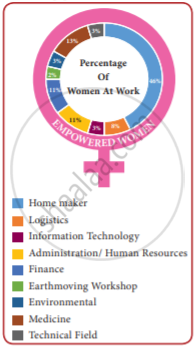
Choose the correct answer.
Percentage of women working in finance is the same as ______.
Read the lines and answer the questions.
There are many legends based on their heroic exploits
a legacy of tales which have been told with much adroit
- What does ‘heroic exploits’ mean?
- What are legends?
Identify the character/speaker.
One side makes you big, the other side makes you small.
Why does Alice drink from the bottle that says ‘DRINK ME’ and why does she eat from the cake that says ‘EAT ME’?
What are the characteristics of a courageous man?
Selvi asked, 'Did they come in an aeroplane?' because she______.
There is a connection between the rhyming words and rhythms of the train. Present your views about it.
Who was challenged for a race?
Read the passage and colour one flag each time you read.
Our national emblem is taken from Ashoka’s pillar at Sarnath. It is found on all government documents, coins, currency notes, postcards, and envelopes. It consists of four lions standing back to back but, we can see only three lions at a time. There is a Dharma chakra in the centre of the base plate, with the figure of a bull in the right and that of a horse in the left. The entire structure is sitting on a lotus. The words ‘Sathyameva Jayate’ is written under it in Devanagari script. These words mean, ‘Truth alone Triumphs’.

Who asked the Robot to charge the phone?
How do the wheels go?
Look at the picture and Choose the correct word.

Choose the correct picture for the passage.
There is a table under a tree. A man with a big hat and a hare with long ears are sitting. A young girl is sitting between them. There are many cups on the table. The girl has a cup in her hand, and the man has a pot in his hand. It seems like they are having tea. Yes, they are having tea at the tea party in Wonderland. The girl is Alice, and she is in Wonderland.
Fill in the blank
Do you like apple______ orange?
Circle and write the adverbs.
We will leave today. ______
Write a paragraph on the topic ‘Park’.
What did the leader see on the river?
The monster tree was protecting the ______.
Fill in the blank
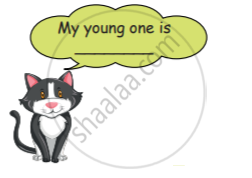
Did the seeds given to Ani sprout? why?
The grandmother had kept the plate in memory of her ______.
Read the passage carefully and answer the following question.
What did the farmer find in the field?
Mugund learnt the art from his ______.
