Advertisements
Advertisements
प्रश्न
How is the father’s helplessness brought out in the poem?
Advertisements
उत्तर
The helplessness of the father is highlighted through the depiction of the emotional struggle that he undergoes. He is aware of the problem and is willing to resolve it, but is unable to do so. He regrets the lack of a strong emotional bond and proper communication with his son who is also physically distanced from him.
APPEARS IN
संबंधित प्रश्न
He asked. Boy, did he ask! First he asked me for a chance, then he asked nearly all the people he came across if they wanted to buy a telephone system from him. And his asking paid off. As he likes to put it, “Even a blind hog finds an acorn every once in a while.” That simply means that if you ask enough, eventually someone will say ‘yes’.
He cared. He cared about me and his customers. He discovered that when he cared more about taking care of his customers than he cared about taking care of himself, it wasn’t long before he didn’t have to worry about taking care of himself.
Most of all, Cowboy started every day as a winner! He hit the front door expecting something good to happen. He believed that things were going to go his way regardless of what happened. He had no expectation of failure, only an expectation of success. And I’ve found that when you expect success and take action on that expectation, you almost always get success.
Cowboy has made millions of dollars. He has also lost it all, only to get it all back again. In his life as in mine, it has been that once you know and practice the principles of success, they will work for you again and again.
He can also be an inspiration to you. He is proof that it’s not environment or education or technical skills and ability that make you success. He proves that it takes more: it takes the principles we so often overlook or take for granted. These are the principles of that Ya Gotta’s for success.
Question:
(1) What was the cowboy’s motto?
(2) What did the cowboy learn after he lost millions of dollars?
(3) Why did the cowboy firmly believe that asking would pay off?
(4) When you expect success and take action on that expectation you almost always succeed. [Name the part of speech of the underlined words]
(5)
(a) He cared about me and his customers. [Rewrite using ‘not only ……………….but also’’]
(b) Cowboy has made millions of dollars [Add a question tag]
(6) In what way is the cowboy a source of inspiration for you?
Attempt a character sketch of Otto Frank, Anne's father.
Answer any four of the following in 30-40 words each:
(a) Why was the peddler amused at the idea of the world being a rattrap?
(b) Why did Gandhiji agree to a settlement of mere 25 percent?
(c) Aunt Jennifer's efforts to get rid of her fear proved to be futile. Comment.
(d) What does Stephen Spender want to be done for the children of the school in a slum?
(e) How did the ten-day-old baby (the future Tiger King) react to the prediction about his future made by the astrologers?
(f) Why was Dr. Sadao not sent abroad along with the troops?
What strategy do chimps use to open hard shells and fruits ?
Answer the following in 200-250 words :
Describe the relationship between Anne and Margot?
Give reasons for the following statement.
The author was disappointed with Darchen.
Notice the italicized sentence placed at the top of the article which tells us at a glance what the article is about.
Why do you think Professor Gaitonde decided never to preside over meetings again?
What are the criteria that Ruskin feels that readers should fulfil to make themselves fit for the company of the Dead?
What is the emphasis placed by Ruskin on accuracy?
Many sentences and paragraphs in the excerpt begin with the word ‘And’. To what extent does this contribute to the rhetorical style of the lecture?
Why does the poet prefer to be a primitive Pagan rather than a member of civilised society?
Read the following statement and mark those that apply to you.
I have a large group of friends but no best buddy.
Discuss in groups, reasons/ consequences/ effects:
The cherry blossomed.
Answer the given question in your own words.
What decision did the Swallow finally make? Was it a wise one? Comment.
The drone is given a death sentence because he ______.
Draw a diagram to show a volcanic eruption from its description given in this passage. Label the diagram. Show the following in it :
Volcano; earth’s crust; crack in the earth’s crust; hot molten rock; red, hot lava; smoke; ash; burning chunks of rock.
Discuss and write 1-2 lines about the following,
Yonamine’s ideas about marriage.
Divide the story into different sections to show the different events and time periods in it. Give a suitable title to each section.
Add ten more words to the list on your own. Each of the component words must be meaningful.
Write about one occasion when you have behaved like -
Mr. Nobody
We all follow a class time table made by the school. Imagine for a minute what will happen if there was no time table for your class.
Form groups of five and discuss:
There are many things that seem small, minor, or insignificant to some people but the same may be the cause of great pain, suffering for others. Can you list such things? What can you do to provide help on those occasions?
Read the following sentence aloud. Write who said it and to whom.
“Look, here’s something for you.”
Write five words each -
with the suffix
- -less
- -ly
- -ness
Complete the following sentence with reference to the passage.
At the back rose the high peak of Mount Ida, from which _______________.
Find three lines, that contain images of nature in the autumn season.
At night
- ______________________
- ______________________
- ______________________
Form groups of 4. Find all the references to the time given in the passage. Then make a chart to show the events described in the passage along with the time when they occur. Example:
| All night long: | The crew stayed on their feet. |
| Near midnight: | ________________________ |
| At 12.53: | ________________________ |
(Use as many lines as you need.)
Find from the Internet and write down.
From which play is this song extracted?
Which season would you say is the hardest in your locality? What help would the poor and homeless people need in that season?
How do we come to know that Kasim was a generous man?
Guess the meaning of the following word.
finely
Answer the following question in about 100-150 word.
Describe the funny incident that caused the confusion in the house.
Look at the following situations the writer was in. He could have avoided the situation and saved himself. Glance through the write up again and comment on what the writer should have done in the following situations.
- Gilson asked the writer to bring a tie.
- On the day of arrival, the writer had no time to think about the tie.
- The writer remembered about the tie when the bus was leaving for the airport.
- The writer walked down in search of the shop.
- The writer rushed out with the tie in a paper bag.
Who told the children the story about the ghosts on Haunted Hill?
Discuss with your partner and complete the table.
| S.No. | Question | Who asked this? | Who answered? | What was the answer? |
|
1. |
Shall we run back together? | |||
| 2. | Can you see something behind the wall? | |||
| 3. | Who said good bye? | |||
| 4 | Was it just the wind? |
Write down the word that alliterate in the poetic line below
Festival of Flowers.
Write a summary based on the story map.

What did she sell to support her family?
Identify the sports and the sports personalities from the lesson and fill in the table.
| Sports | Name of the player & Field of sports | Awards |
 |
||
 |
||
 |
Gulliver was set free because the emperor______.
The little bird broadened the hole with her______.
The aliens gave a new shuttle to them.
The hen-pigeon got dry _______ for the bird catcher.
Name the character or speaker.
“How did I win the competition with a single stroke?”
Who was Akilan’s inspiration?
How did he lose his hand?
What did the archer want to show to the crowd?
Match the following.
| pale |  |
| tremble |  |
| fainted |  |
Parents never let us get ______.
What kind of water did Divya use to brush her teeth?
Write the rhyming word.
save- ______
He started selling wooden toys at a high price.
What happen to a child who shuts his ears?
The rabbit had
Why did the animals think that the jackal was a king?
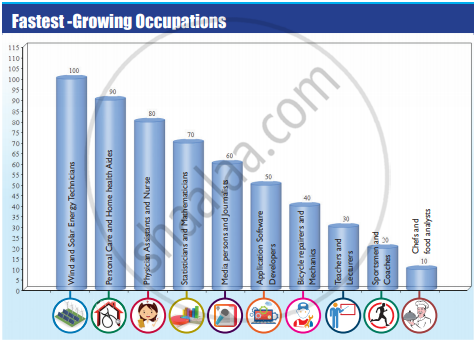
Look at the following non-verbal representation. Based on your understanding and inference, write a paragraph on career trends in the next decade.
What should we do to ensure Safe Surfing?
Read the passage given below:
| 1. | Very often, we do not take the first step towards a good cause because we say to ourselves, "The task is so big. What can I do alone?" So nothing gets done. There is much talk about environmental protection, air pollution and saving our forests. Do we really care? If we do, here are a few things we can do to make our surroundings more pleasant. |
| 2. | It is good to adopt a two-uses-attitude! By putting an article to a second use, we are giving it a longer lease of life and using up less raw material from nature. One of the worst things we do is abuse of paper. The clean sides of envelopes can be used to write small notes, lists and reminders around the house. The more paper we use, the more trees will have to be cut down. For the same reason, we should avoid the use of paper napkins or paper plates. Cloth napkins are just as good, for they can be washed and used over and over again. |
| 3. | Another area which needs the most urgent attention is effective garbage disposal. People who are conscious about it follow rules and laws strictly. As a result, their neighbourhoods are clean and beautiful Similarly, each one of us can contribute to a cleaner environment. All kitchen waste should be collected separately. Those of you who have green fingers can turn this into valuable manure. Dig a pit and put the kitchen waste into it. When the pit is a little over half full, cover it up with mud. Let nature do the rest. Within three or six months, we will have a good garden manure. It can also be done as a community project by digging a large pit in the colony. Do take help of all the members, for nothing succeeds like co-operation |
| 4. | A lot of people don't care about the environment because they don't understand the adverse effect that society has on it. It is important to convince people to care about the environment. The first step would be to convince people to change by providing simple alternative solutions and ways of doing things. Theintemet is a powerful tool and a group on social media of like-minded people can be formed. People can share environmental stories and issues, as well as pool in solutions and alternatives to educate one another. With the current state that our planet is in, it is imperative that people actively care about the environment and most importantly to act now. |
Based on your understanding of the passage, answer any Eight questions from the nine given below:
- Why don't we take the first step towards a good cause?
- What is a two-uses-attitude?
- What can we do to avoid the abuse of paper? (any two points)
- What is the result of an effective way of a garbage disposal?
- What procedure can one adopt for kitchen waste?
- How can making of garden manure be done as community project?
- How long does it take to make good garden manure?
- Select a suitable word from the passage which means - being concerned or interested. (Paragraph 3)
- Pick out the word from the passage which means - completely necessary? (Paragraph 4)
Being a bachelor, the stranger had no patience with children.
